


Removal
1. Remove the wheels from the vehicle.
2. Remove the brake caliper assembly. See the Removal section.
Attention:
- There is no need to disconnect the brake hose from the brake caliper.
- Hang the brake caliper on the wire so as not to stretch the brake hose.
- Don't press the brake pedal too hard, otherwise the piston will pop out.
- Make sure the brake hose is not kinked.
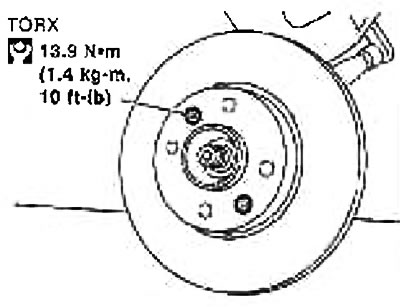
3. Loosen the brake disc mounting screws (torx), then remove the brake disc from the front axle.
Installation
Installation is performed in the reverse order of removal. Tighten the mounting screws (torx) to the required torque.
Caution: Do not install brake discs that have been dropped.
Checking the brake disc
Visual inspection
Check for uneven wear, cracks or serious damage on the brake disc surface. Replace if necessary.
Checking the runout
1. Secure the brake disc to the wheel hub using wheel bolts (in 2 or more places).
2. Check the runout with an indicator.
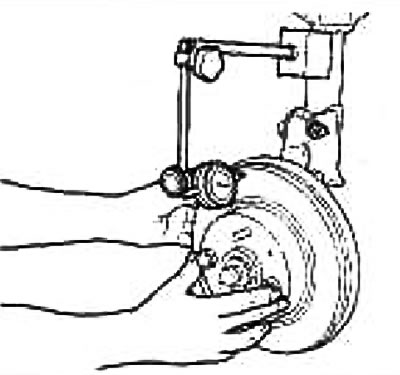
Measuring point: 10 mm from the outer edge of the disc.
Max. runout: 0.058 mm
Note: Before taking the measurement, make sure that the wheel bearing axial play is within the normal range. See the chapter "Front Axle and Suspension".
3. If the runout is significant, find the point of minimum runout by successively shifting the installation position of the brake disc on the hub by one hole.
4. If the runout is still abnormal, ream the disc on a lathe for reaming brake drums on a vehicle ("MAD DL-8700", "AMMSO 700 and 705" or equivalent).
Thickness check
Check the thickness of the brake disc with a micrometer. If the thickness is different from the standard value, replace the brake disc.
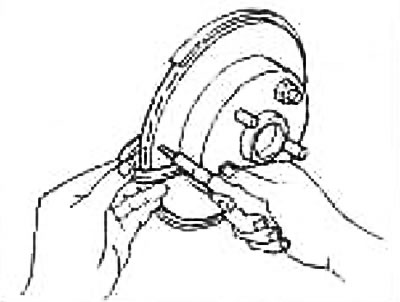
Standard thickness: 22.0 mm
Wear limit: 20.0 mm
Max, thickness variation (measured at 8 points): 0.03 mm
Brake running-in procedure
Carry out the running-in of the friction surfaces of new brakes in accordance with the following procedure in case of boring or replacement of drums or discs, after replacing brake shoes or friction linings, and also if the pedal begins to "fall through" after a short mileage.
Warning: Perform this procedure only on safe roads, without obstructing traffic. Be extremely careful.
1. Drive a car on a straight, level road at a speed of 50 km/h.
2. Brake the car from 50 km/h to a complete stop, applying medium force to the brake pedal. Adjust the pressure on the brake pedal so that the car stops in 3-5 seconds.
3. Allow the brake system to cool by driving the vehicle at 50 km/h for 1 minute without stopping.
4. To complete the burn-in, repeat steps 1-3 ten times or more.