


Table of contents: Catalyst operation ↓ Operating mode with a catalyst ↓
Catalyst operation
In a car, a catalyst is a ceramic particle coated with noble metals - platinum and rhodium - placed in a special container. The exhaust gases, passing through this container, flow around particles that have a very large total active surface. The total amount of noble metals contained in the catalyst is 2-3 grams (5 parts platinum to 1 part rhodium). Thanks to the three-stage catalytic converter, it is possible to get rid of harmful substances such as CO, CH and NOx.
CO and CH, when oxidized by oxygen, turn into harmless carbon dioxide CO₂.
To neutralize NOx, a chemical reaction is used to remove oxygen. This produces nitrogen (N) and CO 2. Both substances are harmless.
The catalyst only works under certain conditions. For this to happen, there must be a certain ratio of fuel to air. The biggest difficulty is to maintain this proportion constant as operating conditions change. This is the task of lambda regulation (oxygen sensor).
The catalytic converter can only operate once the temperature reaches 300°C. This is typically achieved in 25-28 seconds, but in city traffic it may take up to 3 minutes. On the other hand, the catalytic converter is very sensitive to overheating. At 900°C its efficiency drops sharply. At a temperature of 1200°C it can be destroyed. If a catalytic converter is present, unleaded gasoline must be used. When using leaded gasoline, after 2-3 refills the catalyst stops working.
Operating mode with a catalyst
When operating a vehicle with a catalytic converter, the remains of unburned mixture are particularly dangerous, as they can ignite inside the hot catalytic converter, and the temperature can exceed the critical level. As a result, the catalyst may partially melt and cease to function.
That's why:
- If there are interruptions in the ignition, which may indicate a malfunction, it is necessary to take urgent measures for repair. When driving further with a malfunction, high revs should be avoided.
- Small amounts of unburned mixture do not pose a danger, especially if it enters a cold catalytic converter.
- Overheating of the catalytic converter cannot occur during prolonged driving at full throttle, since in this mode the catalytic converter cools down.
The original can be read on the website [NissanBook]
Besides:
- In the summer heat after a multi-day drought, you should not park your car on dry grass. Under unfavorable conditions, a fire may occur under the vehicle.
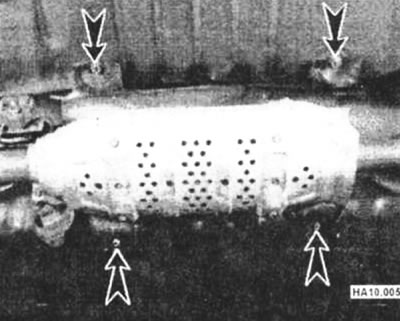
- When installing underbody protection, do not allow it to touch the catalytic converter or heat shields.
- From time to time, support the vehicle and check that the heat shields are not damaged or missing.
- It is useful to periodically remove the protective shields and clean them from dirt (if the vehicle is used in rural areas).
What else is useful to know:
- High oil consumption is harmless to the catalytic converter. Since oil is made up of essentially the same elements as gasoline, burned oil is deactivated by the catalyst in the same way as burned fuel.
- Additives added to fuel and motor oil do not harm the catalytic converter if they do not contain lead.
- Defects in the catalytic converter or lambda probe can only be detected by properly performing exhaust gas testing. A catalyst damaged by high temperatures can be identified by a knocking sound, as the ceramic filler, when partially melted, crumbles and begins to roll around inside the metal container.