


Table of contents: Removal the brake drum/disc and hub ↓ Installing the hub bearing ↓
Removal the brake drum/disc and hub
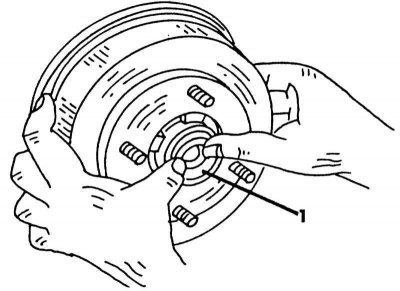
Removing the brake drum together with the hub. The outer hub bearing (1) should be held with a finger.
To check the rear hub bearings for wear or damage, place the vehicle on stands and, grasping the wheel on both sides, push it in and pull it out as shown illustrations. Excessive play indicates bearing damage. For a second check, quickly rotate the wheel several times and pay attention to noise.
Too much play on the first check may indicate poor hub bearing adjustment. To determine if the bearings have too much axial play, this can be checked after unscrewing the rear wheels. To do this, install a dial indicator on the rear suspension and place the feeler gauge on the outer edge of the brake drum or the outer side of the hub. Move the drum back and forth and read the indicator. If the value is more than 0.05 mm, the bearings should be replaced, as there is no possibility of adjustment. Hub bearings do not require maintenance. Since the hub and bearing must be replaced together in the case of removal, there is no good reason to remove the hub.
1. Knock off the grease cap. Rotate the brake drum to knock off the cap evenly. Wipe off any excess grease from the hub nut.
2. Remove the cotter pin from the nut and loosen the hub nut.
3. Place the rear of the vehicle on supports and remove the wheel.
4. Completely unscrew the hub nut.
5. With disc brakes installed, remove the brake caliper without unscrewing the brake hose.
6. Remove the brake drum or brake disc and remove the hub from the axle. If the hub sits very firmly, try using a puller. The brake drum can be left on the hub. When removing the brake drum or hub, hold the outer hub bearing with both thumbs so that it does not fall out (see fig. illustration). If removed, the bearing and hub must be replaced together.
Installing the hub bearing
When installing the hub, proceed in reverse order. Note the following:
1. Place the drum with the hub or the hub on the axle and hammer it in completely with a plastic hammer.
2. Screw a new nut (with washer) onto the hub axle and tighten to 186-255 N·m. Secure the nut with a cotter pin.
3. Tap the hub grease cap onto the hub.
4. Install the wheel, lower the car.