


Examination
Standard batteries
1. If the vehicle has a low mileage, it is recommended to check the density of the electrolyte every 3 months.
2. If you suspect a battery malfunction, compare the density of the electrolyte in the cells, which should differ by no more than 0.04. Otherwise, the plates are damaged or there is an electrolyte leak.
3. If the density differs within the specified limits and the battery is discharged, it must be charged.
Maintenance free batteries
4. The battery condition is determined by a voltmeter or indicator.
5. The battery status is determined by the color of the indicator, which depends on the battery type (consult when purchasing).
6. When checking the voltage with a voltmeter, at least 6 hours must have passed since the last trip. Otherwise, turn on the high beam headlights for 30 seconds before checking.
For more information, see the website NissanBook.ru
7. The battery is completely discharged if the voltage is below 12.2 V.
8. Remove the discharged battery and charge it.
Charger
Standard batteries
1. The battery is charged with a current equal to 0.1 of the capacity until the density of the electrolyte stops changing for at least 4 hours.
2. The battery can also be charged with a low current of 1.5 A, leaving it overnight.
3. Force charging is not recommended.
4. The temperature of the electrolyte during charging should not be higher than 38°C.
Maintenance free batteries
5. Batteries of this type require a long time to charge (up to three days depending on the degree of discharge).
6. A partially discharged battery can be charged with a stabilized source with a voltage of 13.9–14.9 V, typically within 3 hours to a voltage of 12.5 V.
7. A completely discharged battery (with voltage below 12.2 V) it is recommended to charge in a specialized workshop, since constant monitoring is required during the long-term charging process.
Removal
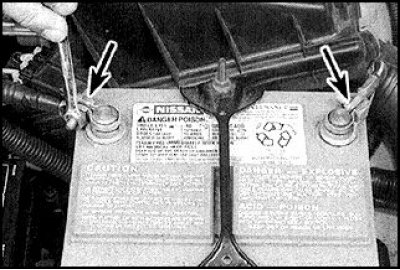
1. Unscrew the nuts and disconnect the terminals (arrows) from the poles (the negative terminal is disconnected first).
2. Unscrew the nuts and remove the clamp, unhook the mounting studs.
3. Remove the battery and plastic tray.
Installation
1. Installation is carried out in reverse order.
2. First, the positive pole terminal is connected, then the negative one.
3. Lubricate the battery terminals with petroleum jelly.
Electrolyte density
| Above 25°C | Below 25°C | |
| Fully charged battery | 1,21 – 1,23 | 1,27 – 1,29 |
| Charged to 70% | 1,17 – 1,19 | 1,23 – 1,25 |
| Discharged | 1,05 – 1,07 | 1,11 – 1,13 |