


2. ECCS control unit indicates damage (or serviceability) by means of a digital code displayed by two LEDs, one red and one green. The red LED is the decimal place, the green one is the unit place, if the red LED lights up three times, simultaneously with the green LED lighting up twice, this indicates code number 32.
3. If damage is suspected, proceed to the following steps.
4. First, position the ECCS control unit at the bottom of the passenger seat.
5. Unscrew the bolts and unfold the control unit.
Warning: The self-diagnosis results are stored in memory by a small electric current from the battery. Disconnecting the battery cable or the ECCS connector pin 15 will erase the data in the memory. Always read the self-diagnosis results before disconnecting the unit.
6. Check that the self-diagnosis selector (photo) is turned fully counter-clockwise (use a small screwdriver).
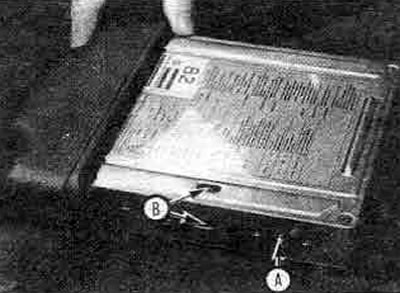
58.6. Self-diagnostic selector 'A' and LEDs 'B'
7. Turn on the ignition. If the engine does not start, crank it with the starter for at least two seconds before the self-test.
8. Check the LEDs for illumination. If they do not light, check the battery polarity and EFI/fuel pump relay.
9. When both LEDs light up, use a small screwdriver to gently turn the self-diagnosis selector fully clockwise.
10. Press the accelerator pedal, then release it.
11. Start the engine and let it idle.
12. On Executive models, turn the air conditioning system off, then on and off again.
13. Read and write down the code:
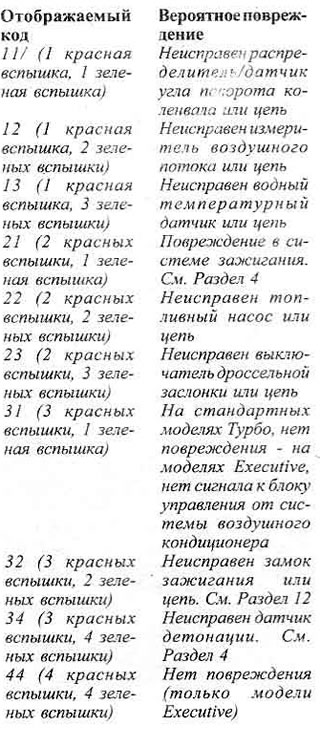
Note: There may be cases where two fault codes are displayed. If one of them is code 11, always check the distributor/crankshaft angle sensor first.
14. Turn the self-diagnosis selector fully counterclockwise, then turn off the ignition and repair the damage.
15. After repairing the damage, always erase the data from the memory as follows.
16. Turn on the ignition, turn the error detection method selector clockwise and hold it for at least two seconds.
17. Then turn it counterclockwise and hold for at least two seconds, then turn off the ignition.
18. Install the control unit back into place.
19. When the self-diagnosis system indicates a fault in any individual circuit, always check the condition of the wiring and connections first: usually, faults can be caused by loose connections or broken wires.
20. If the wires are intact, check the components (as described in this Guide if there is a verification procedure). If the component is OK, the damage may be in the ECCS unit itself.
21. Always consult your Nissan dealer before replacing any component.