


Table of contents: Relieving pressure in the fuel system ↓ Checking for external fuel leaks ↓ Checking fuel pressure ↓ Fuel pump maintenance ↓ Replacing the fuel filter ↓ Fuel Pressure Regulator Service ↓ Fuel line and fuel injector…↓
Note: To perform the procedures described below, you will need a pressure gauge with a measuring range of up to 600 kPa, a suitable three-way fitting and hoses.
Caution! Before disconnecting any fuel system components, relieve the fuel pressure!
Relieving pressure in the fuel system
1. Loosen the screws and lift up the engine compartment relay panel next to the battery. Remove the cover and take out the 15A fuel pump fuse.
2. Start the engine and let it idle until it stops on its own. To be sure, turn on the starter for another ten seconds.
3. Turn off the ignition and replace the fuel pump fuse.
Checking for external fuel leaks
1. Make sure there is enough fuel in the gas tank.
2. Turn on the ignition for five seconds.
3. Wait thirty seconds and turn the ignition back on for five seconds. This will increase the pressure in the fuel lines of the fuel system.
4. Inspect the system components for signs of leaks, paying particular attention to the pump damper, filter and fittings.
Checking fuel pressure
1. Relieve the pressure in the system and disconnect the negative battery cable.
2. Disconnect the fuel supply hose from the fuel line.
3. Using a section of fuel hose and reliable clamps, install a three-way fitting between the fuel supply hose and the fuel line.
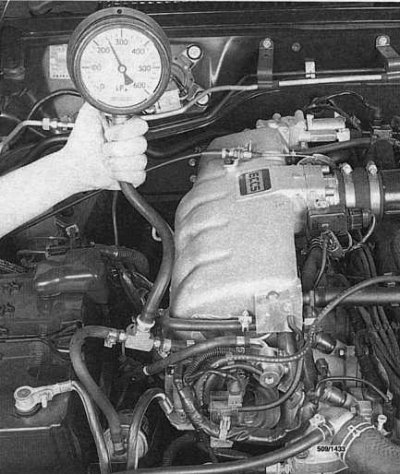
4. Connect a pressure gauge with a measurement range of up to 600 kPa to the free branch of the fitting (see accompanying illustration). Make sure all connections are capable of withstanding the expected pressure.
5. Connect the negative cable to the battery and check the power system for signs of external leaks.
6. Run the engine at idle speed for three minutes and measure the fuel pressure - it should be approximately 235 kPa.
Note: If the engine temperature is above 90°C on models produced before October 1994, the vacuum supply to the pressure regulator will be cut off for three minutes after engine start-up in order to raise fuel pressure.
7. If the fuel pressure is insufficient, check the fuel filter and fuel supply lines for leaks. Also check the condition of the fuel pump mesh filter.
Information copied from the website www.nissanbook.ru
8. If the pressure is excessively high, check the pressure regulator vacuum hoses for proper connection and the fuel return line for blockage. On models prior to October 1994, connect a vacuum hose directly between the pressure regulator and the intake manifold. If the pressure now returns to normal, check the operation of the regulator control solenoid valve. If the pressure is still excessively high, replace the regulator.
9. Disconnect the vacuum hose from the fuel pressure regulator and check that the pressure increases to approximately 294 kPa. If the pressure does not increase, replace the regulator.
10. Connect the vacuum hose to the pressure regulator and stop the engine. Make sure that the pressure continues to hold for at least five minutes.
Note: There may be a slight drop in pressure at first. This is normal and should not be a cause for concern.
11. If the pressure does not hold, proceed as follows:
- Clamp the fuel return hose at the pressure regulator. If the pressure drop stops, replace the regulator.
- If the pressure continues to drop, remove the clamp from the return hose and pinch the fuel supply hose at the fuel filter. If the pressure drops, repair the fuel pump check valve or replace the pump.
- If the pressure still continues to drop, you should check the injectors for leaks. To do this, remove the fuel line with the injectors from the engine without disconnecting the fuel supply and return hoses, turn on the ignition and perform an external inspection of the injectors.
12. After completing the check, release the pressure in the fuel system and remove the pressure gauge and three-way fitting.
Fuel pump maintenance
Examination
1. Perform the tests described in the section on diagnosing failures to start the engine under road conditions for later model years.
2. If there is no power to the fuel pump even though the relay and fuse are in good condition, check the condition of the wiring between the relay and the pump and perform the necessary repairs.
3. If power is supplied but the pump does not operate, measure the resistance between the green/red wire of the pump and the black wire. If the measurement is not 0.5 ohms, replace the pump.
Removal and installation
The fuel pump, as on the 3.0 l models, is combined with the fuel flow sensor unit. The procedures for removing and installing the unit are described in Part 1 of this Chapter in the Section dedicated to fuel tank maintenance. The only thing to take into account is that before disconnecting the negative cable from the battery, it is necessary to relieve the pressure in the fuel system.
Checking the fuel pump relay
The procedures for removing and checking the fuel pump relay are described in detail in Chapter On-board electrical equipment.
Replacing the fuel filter
The procedure is described in detail in Chapter Settings and ongoing maintenance.
Fuel Pressure Regulator Service
Removal and installation
Attention! Removal
1. Relieve pressure in the fuel system.
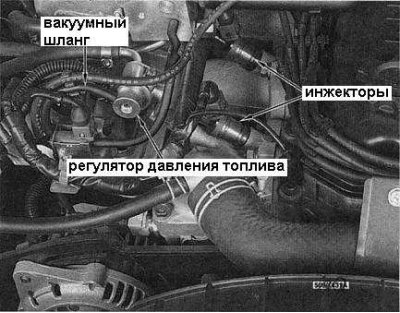
2. Disconnect the fuel and vacuum hoses from the regulator (see accompanying illustration).
3. Loosen the mounting screws and remove the regulator from the fuel line. Discard the sealing ring.
Attention! Installation
Installation is carried out in reverse order.
1. Install a new O-ring onto the regulator.
2. Make sure the fasteners are tightened securely.
3. Check the fuel system for signs of external fuel leaks.
Fuel line and fuel injector maintenance
Removal and installation
Attention! Removal
1. Relieve pressure in the fuel system.
2. Disconnect the negative cable from the battery.
3. Disconnect the throttle cable from the linkage on the throttle body and its bracket.
4. Loosen the clamps, remove the mounting bolt and remove the air duct with the muffler from the throttle body and air flow meter.
5. Disconnect the electrical wiring from the throttle position sensor (TPS), additional air valve (AAV), and fast idle speed compensation device (FICD).
6. Drain the coolant until its level is below the level of the cooling hoses of the pressure chamber.
7. Disconnect the cooling hoses from the discharge chamber.
8. Mark and disconnect the brake booster hose, vacuum hoses and engine ventilation hose from the pressure chamber.
9. Loosen the mounting bolts and remove the pressure chamber with the gasket from the intake manifold.
Note: Three of the plenum mounting bolts can be accessed from underneath the intake manifold.
10. Loosen the clamps and disconnect the fuel lines from the fuel line.
11. Disconnect the fuel pressure regulator vacuum hose.
12. Disconnect the electrical wiring from each of the fuel injectors and release the clamps securing the wiring harness to the fuel line.
13. Loosen the mounting bolts and remove the fuel line assembly with injectors from the vehicle.
14. Remove the injectors from the line.
Attention! Installation
Installation is carried out in reverse order.
1. Always replace the injector sealing rings. Before installation, lubricate the rings with technical petroleum jelly.
2. Fill the cooling system.
3. Check the fuel system for signs of external fuel leaks.
Checking the injector circuit
1. Disconnect the electrical wiring from the fuel injectors.
2. Using an ohmmeter, measure the resistance between the terminals of each injector. If the resistance is outside the range of 10÷14 Ohms, the defective injector should be replaced.
3. Connect a LED test lamp alternately between the terminals of the electrical connector of the wires of each of the injectors, while turning on the starter. The lamp should light. Otherwise, check the condition of the fusible links near the battery. On models produced between October 1994 and August 1995, check the condition of the fuel pump relay. If the fusible links and relay are OK, you should check the condition of the wiring and the ECU. Contact the dealership of the car manufacturer.
4. To check the proper functioning of the injectors, perform the following procedures:
- Connect the wiring to the injectors and start the engine.
- With the engine idling, disconnect the wiring from each injector one at a time for no more than five seconds. When disconnecting a serviceable injector, the engine speed will drop and become unstable.
- If there is no change in the rotation speed and stability of revolutions, the corresponding injector is jammed, or for some other reason its passability is impaired. However, before removing the injectors for detailed inspection and cleaning, check for a spark on the spark plug wires.
Note: Cleaning and checking the condition of the injectors requires special equipment, so this work should be entrusted to employees of the dealership of the car manufacturer.