


Table of contents: Models with 4.2L carburetor engine ↓ Models with 3.0L carburetor engine ↓ Models with 4.2L EFI engine (since…↓
Models with 4.2L carburetor engine
Removal
Exhaust system components
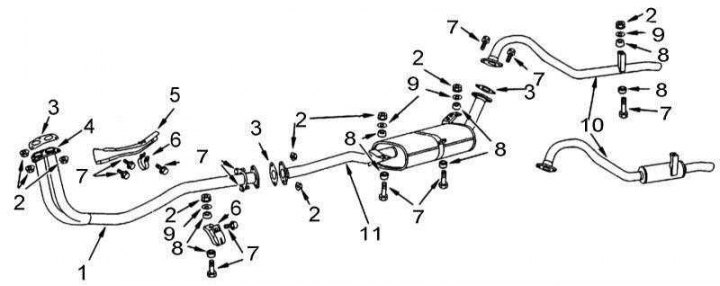
1 - intake pipe; 2 - nuts; 3 - gasket; 4 - flange; 5 - heat shield; 6 - clamp 7 - bolts; 8 - rubber cushions; 9 - washers; 10 - exhaust pipe assembly; 11 - intermediate section with muffler
1. Jack up the car and place it on supports.
Note: Before loosening any exhaust system fasteners, soak them in a suitable penetrating compound or rust converter.
2. Remove the nuts and bolts securing the flange of the exhaust pipe to the intermediate section with the muffler. Remove the nut of the exhaust pipe support, remove the washers, rubber cushions and bolt and remove the exhaust pipe from under the car.
3. Loosen the nuts and bolts securing the intermediate section with the muffler to the exhaust system inlet pipe.
4. Loosen the fasteners of the suspension brackets of the intermediate section with the muffler, remove the washers, rubber cushions and remove the assembly from under the car.
Note: If there are problems with disconnecting the system sections from each other, they can be cut with a hacksaw or pipe cutter and then replaced.
Caution: When loosening a "stuck" fastener, be careful not to damage the floor panels, fuel and brake lines, or chassis wiring.
5. Loosen the nuts securing the inlet pipe to the exhaust manifold.
6. Loosen the nut of the rear suspension of the receiving pipe, remove the washer, rubber cushions, bolt and remove the assembly from under the car.
Installation
Installation is carried out in reverse order.
1. Clean the mating surfaces of all flange connections, be sure to replace the gaskets.
2. First install all sections of the system on the vehicle without completely tightening their fasteners.
3. Check the correct placement of the components, make sure that they do not touch the bottom of the car and the chassis and suspension elements. If necessary, adjust the position of the sections.
4. Tighten the fasteners, starting with the flange connection of the inlet pipe to the exhaust manifold.
5. Start the engine and check the exhaust system for signs of exhaust leaks.
6. Eliminate the cause of any leaks found, then lower the vehicle to the ground.
Models with 3.0L carburetor engine
The procedures for removing and installing exhaust system components are completely analogous to those described for 4.2L carburetor engines.
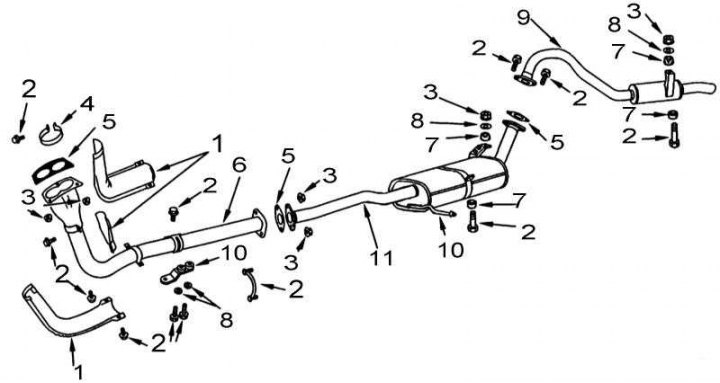
1 - heat shield; 2 - bolts; 3 - nuts; 4 - clamp; 5 - gasket; 6 - intake pipe; 7 - rubber cushions; 8 - washers; 9 - exhaust pipe assembly; 10 - bracket; 11— intermediate section with muffler
Models with 4.2L EFI engine (since 1992.)
The exhaust system design for the 4.2L EFI models is basically the same as shown in the illustrations, except for the installation of the catalytic converter between the downpipe and the muffler.
The catalytic converter is a component of the exhaust gas toxicity reduction system and is a ceramic core placed in a metal casing and coated with a layer of platinum, palladium and rhodium. Passing through the converter, hydrocarbon compounds contained in the exhaust gases, nitrogen oxides (NOX) and carbon monoxide (CO) are converted as a result of chemical reactions into carbon dioxide, nitrogen and water.
Under normal conditions, the catalytic converter does not require regular maintenance or replacement. However, it can be damaged or permanently contaminated by exposure to excessive exhaust temperatures, exposure to raw fuel, or use of leaded fuel (high lead content). To prevent accidental filling with leaded fuel, the 4.2L EFI models have a smaller diameter fuel filler neck, which also has a spring-loaded trap door. The ceramic core can also be damaged by impacts and strong shocks. If the core overheats or becomes leaded, its permeability is impaired, which leads to a decrease in the flow area of the exhaust tract, increasing the resistance to the exhaust gases and, therefore, reducing the efficiency of the engine.
The engine of a car equipped with a catalytic converter should be filled with oil with a reduced phosphorus content.
To avoid damage to the catalytic converter, it is necessary to follow the rules:
- Do not fill your car with leaded fuel;
- Do not start the vehicle from a point and do not tow it;
- Try to avoid running the engine at idle for long periods of time;
- Do not operate the vehicle if misfiring occurs;
- Avoid running out of fuel completely.