


General information
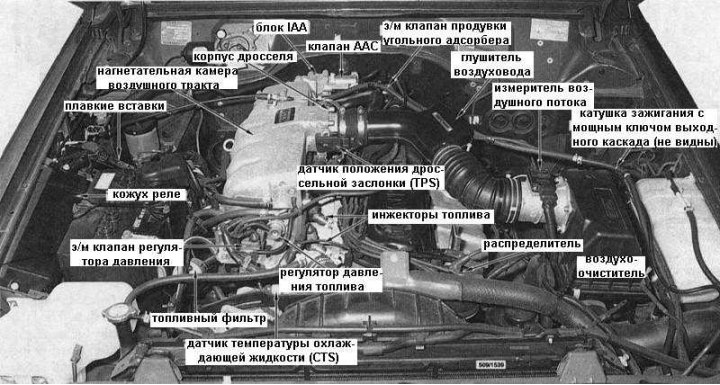
The accompanying illustration shows a view of the engine compartment of the 4.2L EFI model, showing the location of the various fuel and engine management system components.
Since October 1994, manufacturers have stopped using the electromagnetic pressure regulator valve.
The engine management system is referred to in this manual as the Electronic Controlled Ignition System (ECCS). The system controls both ignition and fuel injection.
The central component of ECCS is the control unit (ECU), which is a microprocessor. The ECU controls the ignition timing and the amount of fuel injected based on signals it receives from various sensors. When registering changes in engine load, engine speed, vehicle speed, coolant temperature, throttle position, gear selection, intake air temperature and exhaust gas composition, the ECU issues commands to adjust the ignition timing and fuel injector opening times accordingly to obtain maximum engine performance under current conditions.
When registering a repetitive abnormal signal, the ECU remembers the signal source circuit and records it in the memory unit as a digital code, which significantly simplifies the procedure for diagnosing system malfunctions. When detecting a malfunction of the distributor angle sensor or a global internal failure inside the ECU that affects the engine efficiency, the "Check Engine" indicator lamp on the instrument panel comes on, at the same time the ECU turns on the emergency operation system, which allows you to continue operating the car with limited engine capabilities until the cause of the failure is eliminated. Reading fault codes from the ECU memory at the workshop of the dealership of the car manufacturer will facilitate the diagnosis of the causes of the failure.
The high-energy ignition system consists of a distributor, a high-power output stage switch, an ignition coil and connecting wiring.
The distributor has a dual function. First, it supplies secondary coil voltage to the spark plugs. Second, the distributor supplies the ECU with information about engine speed and piston position. This information is collected by a steering angle sensor located inside the distributor.
Since the engine management system is responsible for setting the ignition timing angle, the distributor is not equipped with either a vacuum or a centrifugal ignition timing corrector.
The powerful key of the output stage is fixed near the ignition coil. And it performs the function of interrupting the primary circuit, turning on at the command of the ECU. At the same time, high voltage is induced in the secondary circuit.
The ignition coil has a special design that meets the special requirements of the electronic ignition system and should only be replaced with a similar one.
The engine is powered by an electronic multi-position fuel injection system. The system injects fuel into the intake air flow at the cylinder head intake ports. The air-fuel mixture is then fed into the combustion chambers through the intake valves.
Fuel is supplied to the injectors by a high-pressure submersible pump, fixed in the fuel tank. In order to suppress fuel pulsations caused by the operation of the injectors and its own operation, the pump is equipped with a special damper.
The pressure in the fuel system is maintained at 235÷294 kPa, depending on the pressure in the pipeline. Fuel pressure is controlled by a special regulator built into the fuel line. When the engine is not running, the fuel in the section between the injectors and the fuel pump remains under pressure due to the installation of a one-way valve in the pump.
The amount of fuel injected is determined by the injector opening time. The duration of the injector opening interval is determined by the ECU based on data received from the distributor angle sensor and the air flow meter. The basic injection duration can then be adjusted based on information from the coolant temperature sensor (CTS), throttle and start enable switches, vehicle speed sensor, ignition key position and I-probe data in order to obtain maximum engine performance under specific conditions and current operating mode.
The air regulator increases the engine's idle speed during its warm-up by bypassing the air flow around the throttle valve. The air regulator is controlled by a bimetallic plate that bends when heated by electric current. By bending, the bimetallic spring rotates the disk inside the air regulator, which leads to a gradual reduction in air flow until it is completely blocked.
The Idle Air Adjustment (IAA) unit, mounted at the rear of the plenum chamber, controls the engine's idle speed. The unit is equipped with a speed adjustment screw, an additional air valve and a fast idle compensation device (FICD).
The AAC valve provides additional air supply bypassing the throttle valve, thereby maintaining idle speed when engine loads increase. The FICD device operates similarly to the AAC valve, but is used specifically to compensate for the increase in load associated with the inclusion of the air conditioner.
The throttle body is located on the air duct's discharge chamber and controls the amount of air sucked into the engine depending on the position of the gas pedal.
The efficiency of the engine management system depends on the accuracy of the information supplied to the ECU about the volume of controlled air flow from the air flow meter. Therefore, the cleanliness, quality of condition and reliability of fastening of all air, fuel and electrical connections are of particular importance.