


Table of contents: 3.0L models ↓ Models 4.2L ↓
Note. The following procedures will require a suitable fuel pressure meter (pressure gauge) and a three-way connection.
3.0L models
Checking fuel pressure
Note: It is important that the fuel lines and filter are not blocked during the fuel pump check. Otherwise, the pump may be replaced without justification based on false measurement results.
1. Place a drain pan under the fuel vapor separator.
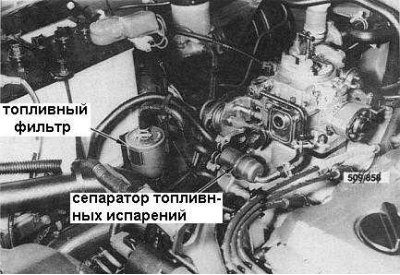
2. Disconnect the fuel inlet hose from the separator (see illustration) and seal the open end of the nipple connecting it to the separator.
3. Connect a suitable pressure gauge to the hose and turn on the ignition (turn the key to the ON position).
4. Compare the pressure gauge reading with the standard requirements (see size and adjustment tables at the end of the Manual). Replace the fuel pump if necessary.
Checking the proper functioning of the fuel pump
1. Check the condition of the fuel pump and engine control fuses located in the mounting block. Replace any that are burnt out.
2. In the luggage compartment, loosen the mounting screws and remove the tie-down hooks.
3. Loosen the mounting screws and remove the carpet mounting trim from the tailgate flaps.
4. Fold the mat forward and loosen the screws securing the access cover. Remove the cover.
5. Disconnect the electrical wiring from the fuel pump (see accompanying illustration).
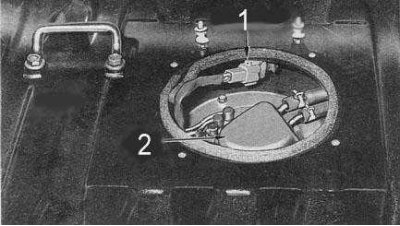
1 - fuel pump
2 - electrical connector
6. Connect a voltmeter between the red/green (+) and black (-) negative wires near the electrical connector of the harness. Crank the engine and read the voltmeter reading.
7. If the voltmeter registers battery voltage, check for continuity between the red-green and black wires near the fuel pump electrical connector. If there is no continuity, replace the fuel pump.
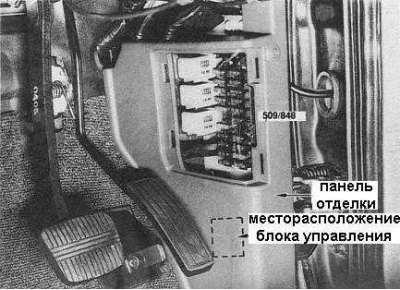
8. If there is no battery voltage, remove the trim panel under the fuse box and disconnect the fuel pump control unit electrical connector (see accompanying illustration).
9. Check for continuity between the black wire and the chassis ground. If there is no continuity, check the condition of the wiring.
10. Disconnect the wire from the starter terminal S.
11. Turn on the ignition (key to ON position) and measure the voltage between the brown (+) wire and the body ground (-). Turn the ignition key to the START position and check the voltage again. If there is no battery voltage in both cases, check the condition of the engine control fuse and the associated wiring.
12. Turn the key to the ON position and check for voltage between the light green (+) wire and the chassis ground (-). If there is no battery voltage, check the condition of the fuel pump control fuse and associated wiring.
13. Reconnect the starter S terminal. Connect the fuel pump control unit electrical connector and start the engine. Connect the probe to the white-red (+) wire on the back of the electrical connector and check the voltage between this wire and the body ground (-). If there is no battery voltage, check the condition of the generator wiring harness.
14. With the engine running, connect the probe to the green wire on the back of the electrical connector and check for voltage between this wire and the body ground (-). If there is no battery voltage, check the condition of the oil pressure switch and associated wiring.
15. Disconnect the S terminal of the starter. Turn the ignition switch to the ON position, connect the probe to the green/red wire on the back of the fuel pump electrical connector and check the voltage between this wire and the body ground (-). Turn the key to the START position and measure the voltage again. If there is no battery voltage in both cases, replace the fuel pump control unit.
16. If there is battery voltage, check the condition of the fuel pump wiring.
Removal and installation
1. Disconnect the negative cable from the battery.
2. In the luggage compartment, loosen the mounting screws and remove the tie-down hooks.
3. Loosen the mounting screws and remove the carpet mounting trim from the tailgate flaps.
4. Fold the mat forward and loosen the screws securing the access cover. Remove the cover.
5. Disconnect and plug the fuel hoses. Disconnect the electrical connector.
6. Loosen the mounting bolts and remove the fuel pump with the sealing ring from the fuel tank.
Attention! Installation
Installation is carried out in reverse order.
1. Make sure the sealing ring is in good condition.
2. Check the condition of the electrical connector contacts.
Models 4.2L
Checking fuel pressure
Note: It is important that the fuel lines and filter are not blocked during the fuel pump check. Otherwise, the pump may be replaced without justification based on false measurement results.
1. Disconnect the fuel supply hose from the carburetor.
2. Disconnect the fuel return hose from the fuel pump and plug the fitting on the pump.
3. Connect the three-way fitting in series to the fuel supply line to the carburetor.
4. Connect a suitable fuel pressure meter (pressure gauge) to the remaining free branch of the fitting.
Note: Run the engine for approximately 60 seconds to remove any air pockets from the system.
5. Run the engine at different speeds and observe the pressure gauge readings. Compare the results with the standard requirements (see size and adjustment tables at the end of the Manual). Replace the fuel pump if necessary.
Removal and installation
Attention! Removal
1. Disconnect the negative cable from the battery.
2. Mark the hoses coming to and coming from the fuel pump.
3. Disconnect the fuel hoses from the fuel pump.
4. Loosen the mounting screws and remove the pump with the insulator and gaskets (see accompanying illustration).
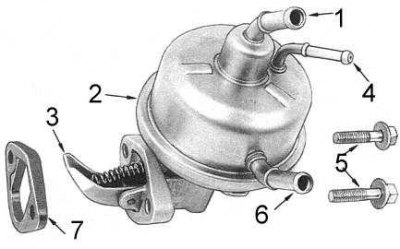
1 - inlet fitting; 2 - fuel pump; 3 - drive lever; 4 - return nipple; 5 - bolts; 6 - outlet fitting; 7 - insulator
6. If necessary, check the pump as described below.
Attention! Installation
1. Installation is carried out in reverse order.
2. Replace the insulator and gasket if necessary.
Checking the proper functioning of the fuel pump
1. Remove the fuel pump.
2. Lower the pump into a container filled with fuel and flush it by pressing the drive lever several times.
3. Drain the fuel from the pump. Block the pump inlet with your finger and operate the drive lever. Holding the lever in the upper position, release your finger - you should hear the sound of air being sucked in.
4. Press the outlet nipple with your finger and raise the pressure in the pump by working the lever. The pressure should be maintained for two to three seconds.
5. Re-pressurize as described in the previous paragraph, then lower the pump into the fuel container and check for air leaks.