


Warning! See warnings at the beginning of the Section Relieving pressure in the fuel system.
General checks
Make sure there is enough fuel in the gas tank. Inspect the fuel lines for signs of leaks.
Make sure the fuel pump is actually working. Set the parking brake and have an assistant turn the ignition key to the ON position - you should hear the characteristic sound of the pump working in the gas tank (the pump should operate for about two seconds, during which the required pressure increase in the power supply system is achieved).
Note: The sound of the pump running can be heard clearly through the open fuel tank neck. If the pump is working properly, but there is a suspicion of a malfunction in the fuel system, measure the pressure developed by the pump.
If the pump does not turn on, proceed to check the condition of its electrical circuit (see Chapter On-board electrical equipment). Check the relevant fuses and relays, make sure the power supply to the pump connector is working properly. Assess the quality of the grounding.
If the power supply is correct and the grounding quality is not impaired, replace the pump (see section Removal and installation the fuel pump).
Checking the pressure characteristic of the fuel pump
Note: To check the fuel pressure, you will need a special pressure gauge with a wide range scale and an adapter to connect the pressure gauge to the injection system.
1. Release the pressure in the fuel system (see section Relieving pressure in the fuel system).
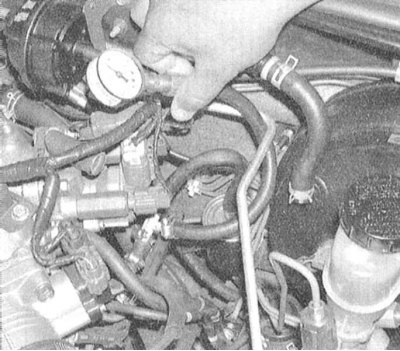
2. Disconnect the outlet line from the fuel filter, connect a three-way fitting between the filter and the fuel line, and connect a pressure gauge to it. Make sure the hose clamps are securely tightened.
3. Switch off all electrical consumers and turn the ignition key to the ON position. The fuel pump should turn on for 5 seconds - read the pressure gauge reading. Compare the result with the requirements of the Specifications.
4. Start the engine and warm it up at idle speed to normal operating temperature. Read the pressure gauge reading and compare it with the value given in the Specifications. Disconnect the vacuum line from the pressure regulator (see section Removal and installation the fuel pressure regulator), - the pressure should increase to the value specified in paragraph 4.
5. If the readings taken are within the permissible ranges specified in the Specifications, then the system is functioning properly, otherwise, perform the following checks:
a) If the pressure is excessively high, check the vacuum supply to the fuel pressure regulator. Changing the engine speed should cause vacuum fluctuations. If there is a vacuum, check the fuel return line hose and tube for patency and condition. If the return line is OK, replace the pressure regulator;
b) If the pressure is excessively low, check the condition and patency of the fuel filter and the fuel line from the fuel line to the fuel tank. If no faults can be found during the inspection, start the engine and slowly pinch the return line. If the pressure increases above 3.0 kgf/cm², replace the pressure regulator (see section Removal and installation the fuel pressure regulator).
Caution! Do not allow the pressure to increase above 4.2 kgf/cm². If the pressure is still too low, replace the fuel pump (see section Removal and installation the fuel pump);
6. Turn off the engine, leaving the ignition on. Continue to monitor the pressure gauge for about 5 minutes - the pressure should drop slowly. If the pressure drops too quickly, perform the following checks:
- a) Without turning off the ignition, pinch the fuel supply line between the three-way fitting and the fuel tank, then turn off the ignition - if the pressure drops quickly, then there are leaks through the injection injector(s);
- b) Turn the ignition back on and pinch the feed line, this time between the nipple and the fuel line. Turn the ignition off - a rapid drop in pressure indicates a malfunction of the check valve of the submersible fuel pump.
[See the source on the portal: www.nissanbook.ru]
7. After completing the check, release the fuel pressure (see section Relieving pressure in the fuel system) and disconnect the pressure gauge.