


Location of fuel system components in the engine compartment of 1993 and 1994 models.
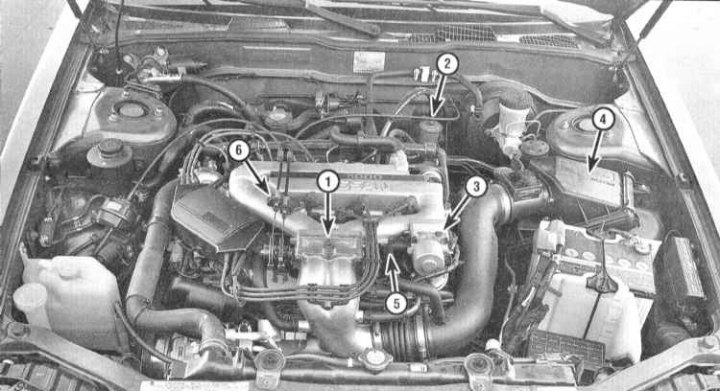
1 - Throttle body; 2 - Fuel filter; 3 - IAC valve; 4 - Air cleaner housing; 5 - Fuel line with injection injectors (under the upper section of the intake manifold); 6 - Throttle cable
Location of fuel system components in the engine compartment of V6 models
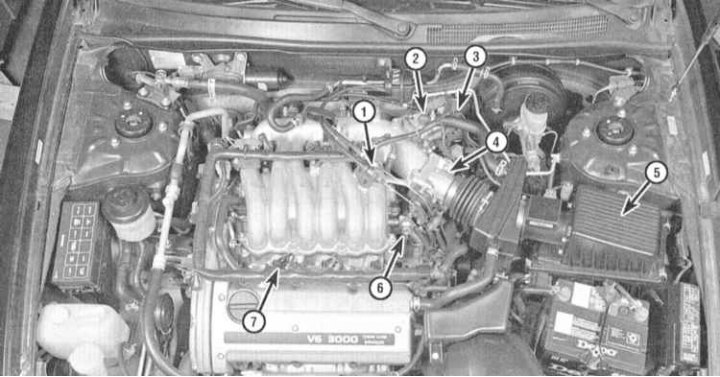
1 - Throttle cable; 2 - IAC valve; 3 - Fuel filter; 4 - Throttle body; 5 - Air cleaner housing; 6 - Fuel pressure regulator; 7 - Injector
Functional diagram of the fuel injection system of the 1993 and 1994 models equipped with a catalytic converter
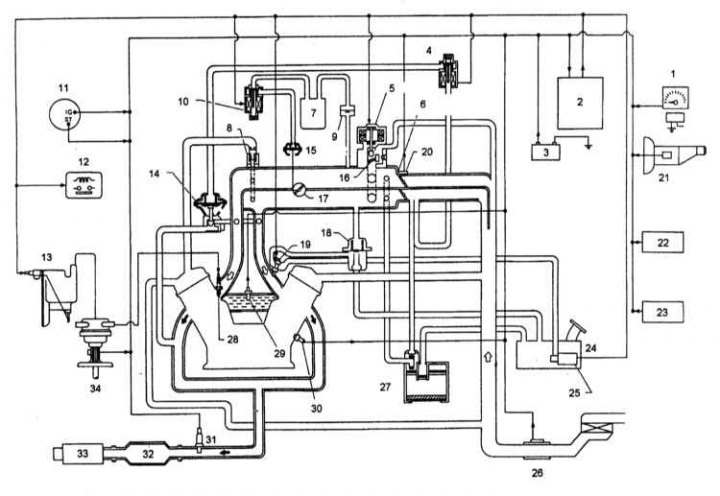
1 - VSS; 2 - ECCS control unit; 3 - Battery; 4 - EGR control solenoid valve; 5 - IAC valve; 6 - Throttle body; 7 - Equalizing tank; 8 - PCV valve; 9 - One-way valve; 10 - Economizer electromagnetic valve; 11 - Ignition switch; 12 - Cooling system fan relay; 13 - Ignition coil with power transistor; 14 - EGR valve; 15 - Economizer actuator; 16 - Air cut-off valve; 17 - Economizer; 18 - Fuel pressure regulator; 19 - Injector; 20 - Throttle Position Sensor/Idle Switch; 21 - Start enable switch sensor; 22 - Switch for controlling the operation of the K/V; 23 - Power steering hydraulic fluid pressure sensor (models with AT); 24 - Fuel tank; 25 - Fuel pump; 26 - Air flow meter; 27 - Carbon adsorber; 28 - Spark plug; 29 - Engine temperature sensor; 30 - Knock sensor; 31 - Oxygen sensor; 32 - Catalytic converter; 33 - Silencer; 34 - Crankshaft position sensor
Functional diagram of the fuel injection system of the 1993 and 1994 models without a catalytic converter
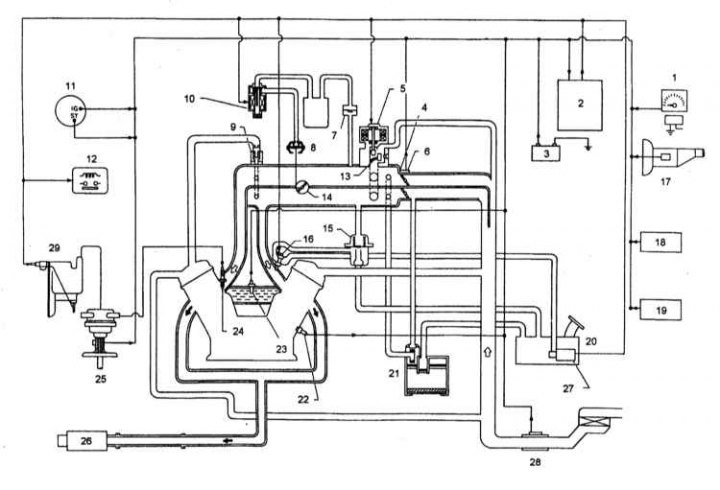
1 - VSS; 2 - ECCS control unit; 3 - Battery; 4 - Throttle body; 5 - IAC valve; 6 - Throttle Position Sensor/Idle Switch; 7 - One-way valve; 8 - Economizer actuator; 9 - PCV valve; 10 - Economizer electromagnetic valve; 11 - Ignition switch; 12 - Cooling system fan relay; 13 - Air cut-off valve; 14 - Economizer; 15 - Fuel pressure regulator; 16 - Injector; 17 - Start permission switch sensor; 18 - Switch for controlling the operation of the K/V; 19 - Power steering hydraulic fluid pressure sensor (models with AT); 20 - Fuel tank; 21 - Carbon adsorber; 22 - Knock sensor; 23 - Engine temperature sensor; 24 - Spark plug; 25 - Crankshaft position sensor; 26 - Muffler; 27 - Fuel pump; 28 - Air flow meter; 29 - Ignition coil with power transistor
Functional diagram of the fuel injection system of models from 1995, equipped with a 3-function catalytic converter
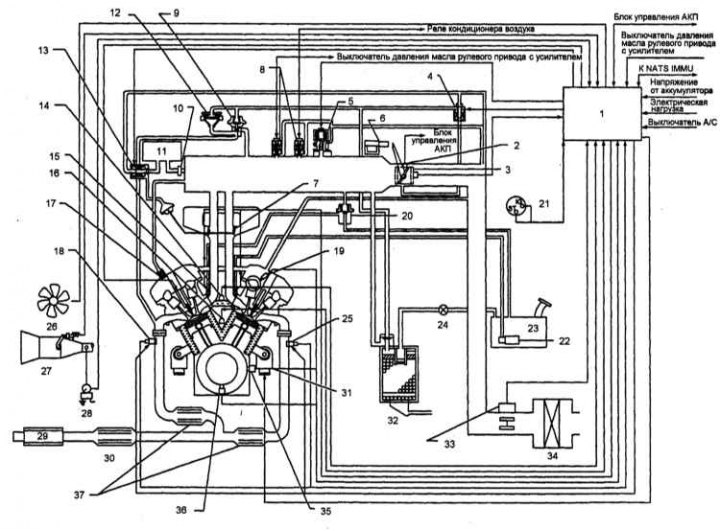
1 - Control module; 2 - Throttle position switch; 3 - Throttle position sensor; 4 - EGR valve; 5 - IAC valve; 6 - Fast idle cam; 7 - Economizer; 8 - IAC valve; 9 - PCV valve; 10 - Economizer electromagnetic valve; 11 - Ignition switch; 12 - Cooling system fan relay; 13 - Air cut-off valve; 14 - Economizer; 15 - Fuel pressure regulator; 16 - Injector; 17 - Start permission switch sensor
The fuel system consists of a fuel tank, an electric fuel pump placed in it, and a fuel pressure regulator (next to the pump), EFI main relay, fuel pump relay (circuit opening relay), fuel line with injection injectors, air cleaner assembly and throttle body. All models described in this Manual are equipped with an electronic distributed fuel injection system.
Distributed fuel injection system
In the system under consideration, electrical pulses of a strictly limited duration are used to control fuel injection through injectors directly into the intake port of each of the engine combustion chambers. The moment and duration of opening of each of the injectors are controlled by the powertrain control module (PCM). The PCM continuously monitors various operating parameters of the engine and, based on the incoming information, determines the required volume of fuel injected into each of the intake ports. In this case, the throttle body serves only to control the supply of air to the fuel system. Due to the fact that each of the cylinders is equipped with its own injector, this scheme provides the ability to very accurately control the composition of the air-fuel mixture.
Fuel pump and fuel lines
Fuel is supplied from the gas tank to the injection system and its excess is returned back to the gas tank via two metal lines laid under the bottom of the car. The submersible electric fuel pump is located inside the gas tank and is combined into a single assembly with the fuel consumption sensor unit. The fuel vapor return system carries out the removal of fuel vapors back to the gas tank via a separate return line.
The fuel pump relay consists of two windings (primary and secondary). The primary circuit is controlled by the PCM, and the secondary circuit is powered directly from the battery via the ignition switch. When the ignition is on, (do not start the engine) The PCM provides 5-second energization of the relay. When the engine is cranked, the PCM energizes the relay until the camshaft position sensor provides a signal (see Chapter Engine management systems). If there are no reference pulses for five seconds, the fuel pump is switched off.
On 1995 California models and all 1996 and 1997 models, a fuel pump control module is provided. The module provides a reduction in supply voltage to the pump whenever the engine is running without a load. The module is located in the luggage compartment under the left combination lamp assembly. A step-down resistor is included in the wiring harness in close proximity to the module.
Exhaust system
The exhaust system consists of the exhaust manifolds, a downpipe equipped with an oxygen sensor, a catalytic converter(s), a muffler, and a tailpipe. On 1995 and later models, there are two primary oxygen sensors, two heated catalytic converters, and one secondary oxygen sensor.
Catalytic converters are the main components of the exhaust gas toxicity reduction system (see Chapter Engine management systems Engine management systems).
[The original is posted on the portal: www.NissanBook.ru]