


Warning! See warnings at the beginning of the Section Relieving pressure in the fuel system.
1. Release the pressure in the fuel system (see section Relieving pressure in the fuel system). To relieve excess pressure in the tank, remove the filler cap.
2. Disconnect the negative cable from the battery.
Warning! If the car stereo system is equipped with a security code, make sure you have the correct combination to activate the audio system before disconnecting the battery!
3. If there is fuel left in the tank, pump it out using a special kit (ask in car accessories stores).
Attention! Never suck out fuel with your mouth!
4. Remove the rear seat and the fuel pump and fuel flow sensor assembly(s) access cover. Disconnect the wiring harnesses (see section Checking the condition and replacing the fuel flow sensor).
5. Jack up the car and place it on supports.
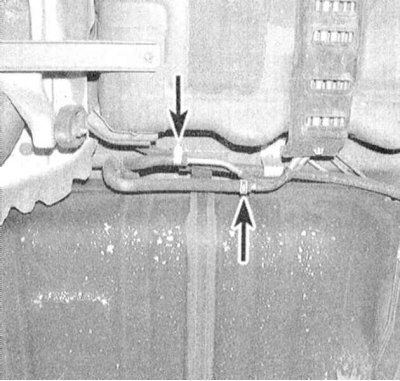
6. Disconnect the fuel supply and return lines from the fittings on the tank.
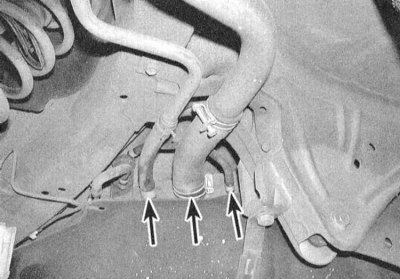
7. Loosen the mounting clamps and disconnect the filler neck, ventilation and fuel vapor capture (EVAP) hoses from the tank.
8. Support the tank with a trolley jack, placing a wooden block between the head of the jack and the bottom of the tank to distribute the load.
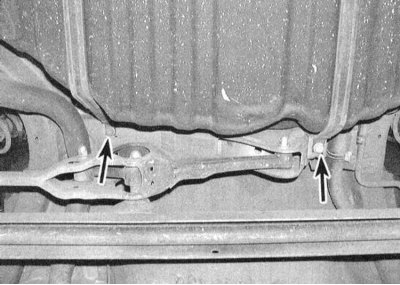
9. Remove two of the four bolts securing the tank mounting brackets - the brackets should drop down, hanging on the remaining two bolts.
10. Slowly lower the tank below the exhaust gasket level and remove it from under the vehicle.
11. A description of the procedures for cleaning and repairing the tank is given in Section Fuel Tank Cleaning and Repair - General Information.
12. If necessary, remove the fuel pump/fuel flow sensor assembly(ies) (see section Removal and installation the fuel pump).
13. Installation is carried out in reverse order.
Note: To facilitate the seating of the fuel filler hose, lubricate the inlet pipe with clean engine oil.