


Removal
1. Remove the fuel level sensor, fuel filter and fuel pump module (see previous section).
2. If necessary, drain the fuel from the tank.
Attention.
- Since the fuel tank tilts forward and becomes unstable during removal/installation, any remaining fuel must be drained.
- Place the vehicle on a level, hard surface.
3. All-wheel drive versions: remove the propeller shaft.
4. Remove the main muffler.
5. Remove the fuel tank protection.
6. Versions with petrol engine:
Remove the ventilation hose (1) behind the fuel tank.
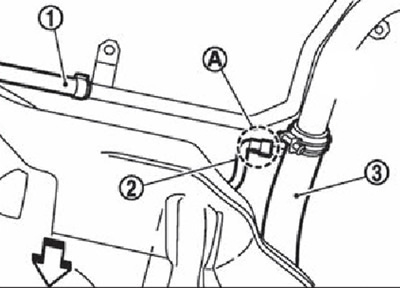
Note: The arrow in the illustration points to the front of the vehicle.
Disconnect the fuel vapor recovery system line (2) behind the fuel tank.
Remove the fuel filler hose (3) from the fuel filler line side.
7. Versions with diesel engines:
Disconnect the fuel vapor recovery system line (A).
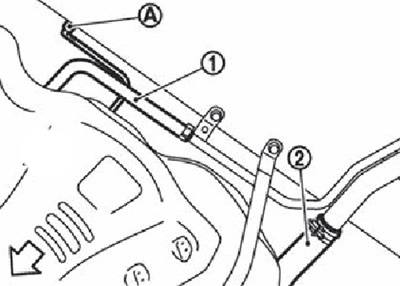
Note: The arrow in the illustration points to the front of the vehicle.
Remove the ventilation hose (1) behind the fuel tank.
Remove the fuel filler hose (2) from the fuel filler line side.
8. If necessary, loosen the parking brake cable mounting bolts and disconnect it from the suspension arm.
9. Support the center of the fuel tank (1) with a transmission jack (A).
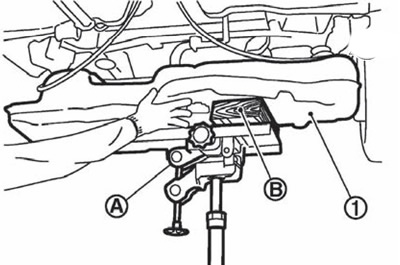
Caution: Support the fuel tank securely with a wooden block (B).
10. Remove the left and right fuel tank mounting clamps
The text is published on the website [NissanBook.ru]
11. Carefully lower the transmission jack while supporting the fuel tank with your hands.
Caution: The fuel tank may be unstable due to fuel residue at the bottom. Do not lower the jack too quickly. Make sure the fuel tank is securely fixed.
Installation
Installation is carried out in the reverse order of removal.
Note.
- Attach a 35mm fuel hose.
- Tighten the fuel hose clamp so that the protruding thread length is:
- From the fuel line side: 7-11 mm.
- From the fuel tank side: 5-9 mm.
Post-installation check
1. Turn the ignition switch to the "ON" position (without starting the engine), to create pressure in the fuel lines, then check all connections for leaks.
2. Start the engine at idle speed and make sure there are no leaks in the fuel system connections.