


Table of contents: Description ↓ Preliminary check ↓ Checking the camber unit ↓ Checking wheel alignment ↓ Adjusting the camber angle ↓ Adjusting the toe-in ↓
Description
Measure the rear wheel alignment angles when unloaded.
Note: "Unloaded" condition means full fuel, coolant and engine oil. Spare tire, jack, tools and floor mats in their proper locations.
Preliminary check
Check the following:
- is the tire pressure normal and is there any wear?;
- road wheel beating;
- axial play in wheel bearings, see above;
- shock absorber operation;
- is there any play or deformation in the places where the axle and suspension are attached?;
- are there any cracks, deformations or other damages on the steering rod, wishbone, rear suspension beam, suspension arm and shock absorber;
- height of an unloaded vehicle.
(Source is available on the resource NissanBook)
Checking the camber unit
- Measure the camber angle of the right and left wheels using a suitable gauge.
- If the camber angle is different from the standard, adjust using the adjusting bolts on the steering rod. See below.
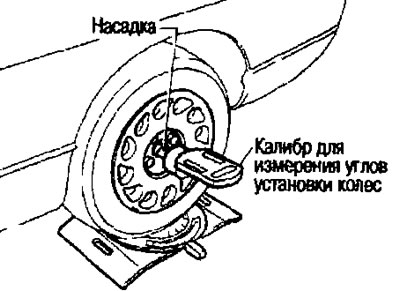
Standard.
Camber angle: See below under "Technical data and specifications".
Checking wheel alignment
Measure the wheel alignment as follows:
Attention:
- Always take measurements on a level surface.
- Before rolling the car, make sure there is no one in front of it.
1. Rock the front of the car to stabilize the suspension.
2. Roll the car straight forward, approximately 5 m.
3. Place a mark (A) at the tread baseline (rear) of both wheels at the height of the hub center. These marks will be the measurement points.
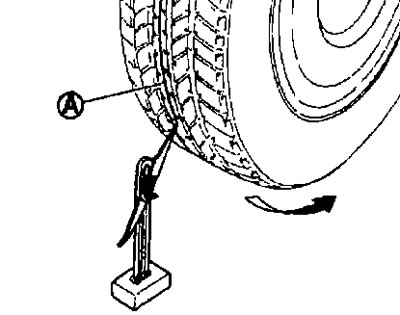
4. Measure the distance "A" (from the back).
5. Slowly roll the car forward so that the wheels turn 180°(1/2 turn)
Note: If the wheels have turned more than 180° (1/2 turn), take the measurement first. Do not roll the car backwards.
6. Measure the distance "B" (from the front side).
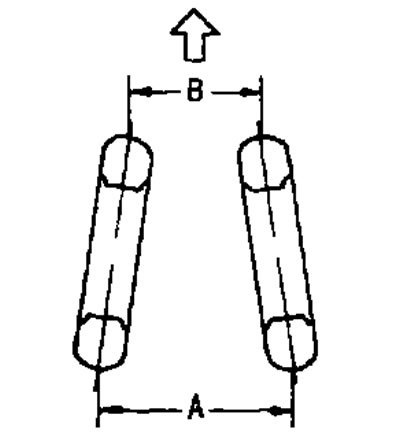
Standard.
Overall Toe-in: See below under "Technical Data and Specifications".
- If the camber angle is different from the norm, adjust it using the adjusting bolts on the suspension arm.
Adjusting the camber angle
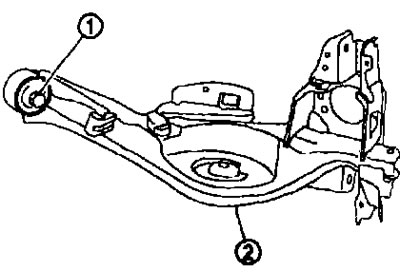
If the camber angle is different from the standard, adjust using the adjusting bolt (1) on the steering rod (2).
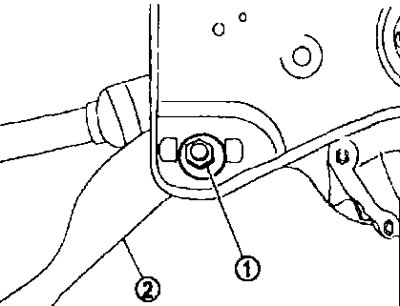
Attention:
- To prevent the bolt from turning when tightening the nut and reaching the tightening torque, secure it with a wrench.
- After adjusting the camber, check the toe-in.
Standard.
The angle of the spread. See below under "Technical data and specifications".
- If the camber angle is not normal, check the rear suspension components and replace any damaged or worn parts.
Adjusting the toe-in
- If the toe-in is not correct, adjust using the adjusting bolt (1) on the suspension arm (2).
Standard.
Wheel alignment: See below under "Technical data and specifications".
Attention:
- When adjusting the toe, turn the adjusting bolts the same number of turns on both the right and left sides.
- To prevent the bolt from turning when tightening the nut and checking the tightening torque, secure it with a wrench.
- If the camber angle is not normal, check the rear suspension components and replace any damaged or worn parts.