

1. Check the condition of the tires and the pressure in them.
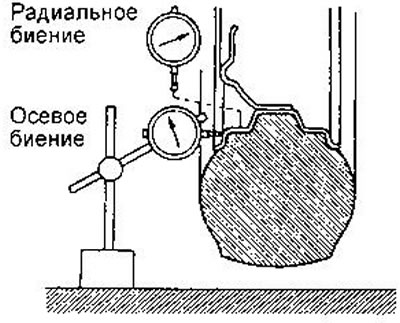
2. Check wheel runout (valid values are given in section «Data for adjustments and control»).
3. Make sure there is no play in the wheel bearings. suspension and steering.
4. Check the operation of the telescopic struts.
5. Check the position of the body relative to the ground (unloaded).
collapse, longitudinal and transverse inclination of the axis of rotation. These angles are set by the suspension design and cannot be adjusted during operation. Angles are given in section «Data for adjustments and control». If any of the angles is not within acceptable limits, it is necessary to check the suspension flying, replacing damaged or worn ones.
Convergence. Convergence is measured as follows.
1. Place the vehicle on a level surface and squeeze the front end to stabilize the position of the body.
2. Drive the car in a straight line for about 5 m.
3. Make marks on the back of the treads of both tires. The marks should be located in the middle of the tread at the height of the center of the hub.
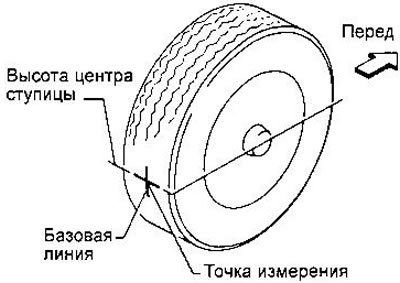
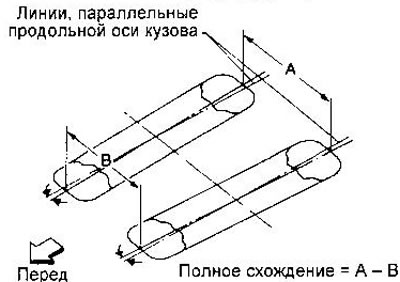
4. Measure the distance A between the marks.
5. Slowly move the car forward so that the wheels turn 180°and the marks are in front.
If the wheels have turned more than 180°, start the measurement again. Do not move the vehicle back.
6. Measure distance B and determine the toe. The required data is contained in the section «Data for adjustments and control».
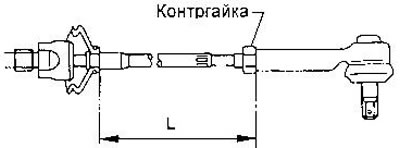
7. If necessary, adjust the convergence by changing the length of the steering rods. To do this, loosen the lock nuts and rotate the adjusting rods to set the desired convergence. The nominal value L, as well as the tightening torque of the locknuts, are given in chapter «Steering». Change the length of both rods at the same time by the same amount.