


Table of contents: Fuses ↓ Fusible links ↓
Fuses
To protect the contact circuits of the vehicle's electrical equipment, various combinations of fuses, circuit breakers and fusible links are used. Mounting blocks are installed under the instrument panel and in the engine compartment of the vehicle. The layout of the blocks may vary depending on the model and year of manufacture of the vehicle.
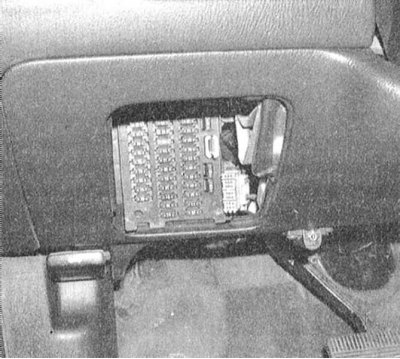 |
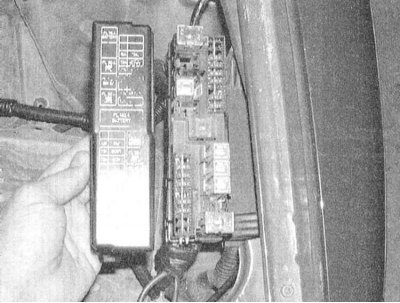 |
Each individual fuse is used to protect a specific electrical circuit or several circuits at once. The identification card of the location of the fuses in the mounting block is usually glued to the cover of the latter, on its inner side.
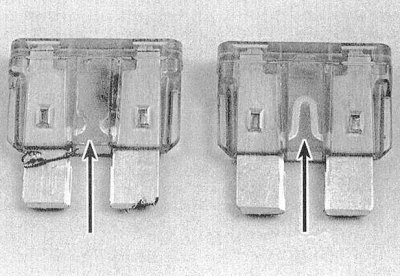
The fuse boxes contain compact fuses with bayonet terminals that can be easily removed from their sockets in the box with your fingers if necessary. If any of the power consumers fails, the condition of the corresponding fuse should always be checked first. Turn the ignition key to the ON position and probe the open terminals of each fuse with a test lamp. If the lamp lights up when connected to each terminal, the fuse is OK. If voltage is present only on the power supply side, the fuse has blown. Note also that the fuse body is usually made of transparent plastic, through which the condition of the working jumper can be easily determined.
When replacing a blown fuse, make sure that the replacement fuse you install matches the type of the element that has failed. Fuses rated for different nominal currents may not physically differ from each other, but they are not interchangeable. Each electrical circuit has different operating parameters and requires different levels of protection, so replacing a fuse rated for a certain current with one that does not match its parameters is fraught with the most serious consequences (until a fire breaks out). Operating parameters of the fuse (rated current) usually marked on its plastic body.
If the new fuse also fails immediately after installation, there is no point in replacing it further - first you need to identify and eliminate the cause of the overload in the circuit. In most cases, this is a short circuit in the connecting wiring caused by damage to its insulation.
Fusible links
Fusible links are used to protect circuits in which, for whatever reason, conventional fuses cannot be used, such as the ignition system circuit, and also for power circuits in which high-amperage current circulates.
On the models covered in this manual, the fuse links are located in the fuse box located in the engine compartment.
To replace the fuse, disconnect the negative cable from the battery and pull the failed element out of its socket.
Warning! If the car stereo system is equipped with a security code, make sure you have the correct combination to activate the audio system before disconnecting the battery! Before replacing the faulty fuse link, you should find out and eliminate the cause of the overload that occurred.