


Brush mechanism (brush holder)
The brushes (1) should be 5.5 mm long. Use calipers to measure the brushes.
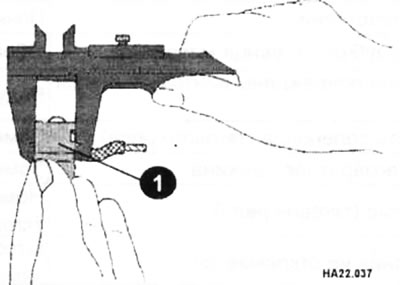
Check that the brushes move easily in the guides by inserting them and gently pulling them back and forth. If necessary, wipe the sides of the brushes with a cloth soaked in gasoline or polish with a file. Replace brushes if necessary.
Check the elasticity of the brush springs with a dynamometer by attaching it to the spring.
Collector
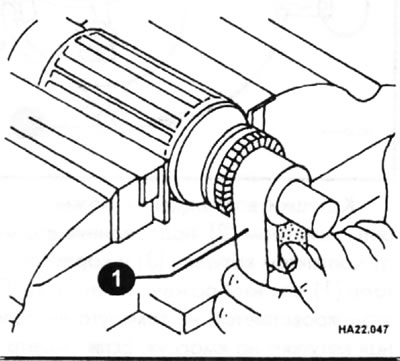
A good collector should be smooth across the entire top surface and should not have any uneven or burnt areas. Wipe the collector with a rag soaked in gasoline while turning the rotor. If this does not work, you can sand it down (1) (grain 500-600), as shown in the picture, but do not use abrasive paste for this.
- To renew a heavily worn manifold (1), it can be ground down. Before this, measure the diameter of the manifold with a caliper (2).
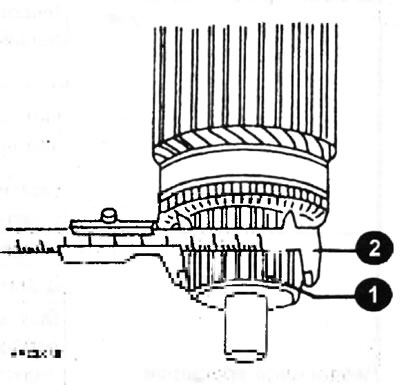
- To turn, clamp the armature in a lathe and remove a layer of metal at high speed. Do not remove more metal than necessary.
- Finally, saw the grooves between the manifold segments to a depth of 0.5-0.8 mm. To do this, insert the hacksaw blade into the separation of the lamellas so that it cuts along the entire length, i.e., the blade should not be inserted at an angle. After this, polish the manifold with sandpaper until it shines.
- Common collector faults are the result of short circuits in the armature (burnout of the collector windings), otherwise it will last a very long time.
Excitation coil (pole coils)
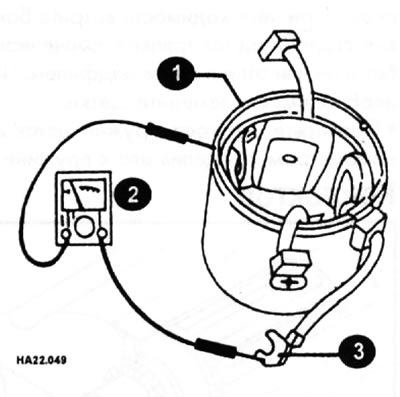
The excitation coils can be tested with an ohmmeter (2) by connecting it between the coil contact (3) and the stator housing (1), as shown in the figure. At the same time, it is checked whether the pole coil is shorted to ground: If the ohmmeter shows resistance, the stator housing with the pole coils must be replaced.
During another test, connect an ohmmeter between the connection points of both brushes as shown in the figure. In this case, the flow of current between the two brushes is checked. If there is no reading, replace the stator housing. Checking the flow of current between the positive terminal of the pole coil and the "positive" carbon brush
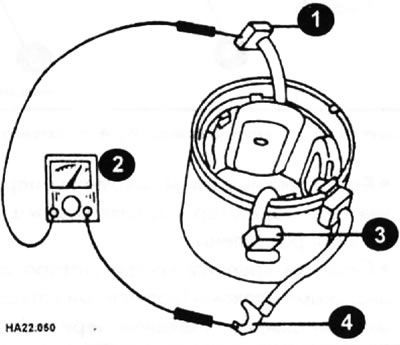
1 - "positive" brush; 2 - ohmmeter; 3 - "negative" brush; 4 - positive terminal.
Anchor
Caution: Never attempt to straighten a bent armature shaft or grind or remove burrs from the armature core.
To check the armature windings, a special device called a buzzer is used. If you don't have the device, you can check the old anchor by temporarily replacing it with a new, known good anchor.
Bearing
If the bearing is broken and lateral runout of the anchor occurs, it must be replaced. At the same time, check the seating surfaces for wear. If wear is detected, it is best to replace the entire starter assembly.
[The original is posted on the portal: NissanBook.ru]