


Table of contents: Disassembly ↓ Assembly ↓
The starter consists mainly of four parts: the starter motor itself, the solenoid (traction relay), drive gear housing and planetary gearbox. The drive housing contains a mechanical lever between the starter and the traction relay.
Due to the design reliability and durability of the starter, it is unlikely that it will have to be disassembled until it is completely worn out, when it will need to be replaced.
The traction relay is sold separately as a spare part. Unscrew the fasteners and remove the relay from the starter.
It is impossible to repair the relay, and therefore, if after connecting it to the battery using two thick wires it remains lifeless or works poorly, then the relay must be replaced completely.
Disassembly
Disassemble according to the drawing at the beginning of the section.
- After the solenoid is removed (traction relay) (if necessary), you need to separate the front part of the starter from the engine itself. The starter is connected into a single unit by tie bolts that pass through the rear cover, stator and are screwed into the front cover.
- Before separating the starter into its components, it is necessary to disconnect the electrical connections between them. The electrical wires running from the excitation winding in the starter motor to the contacts in the front cover must be disconnected from these contacts.
- When the clamping screws are loosened, the front cover, stator and rear cover can be separated.
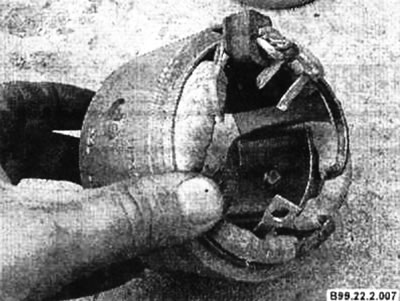
- The windings are secured inside the stator with special blocks (pole coils), screws passing through the stator housing.
Assembly
- The starter is assembled in the reverse order of disassembly. The starter requires virtually no adjustments, as all parts are installed in precise positions.
Note: The anchor axial clearance should not exceed 0.5 mm. Otherwise, it must be adjusted using shims.
- If the starter motor starts to rotate more slowly, this indicates a faulty starter bearing, which needs to be replaced.