


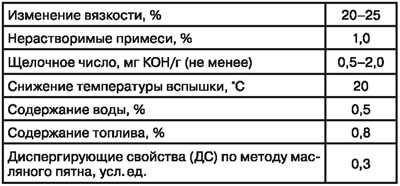
It should be noted that most of the rejection indicators of oil service life can only be determined in laboratory conditions, but such parameters as changes in oil viscosity and the value of dispersing properties (DP) are available even to a simple car enthusiast.
With changing viscosity, everything is simple: if the oil becomes too thin during operation (when checking the level, it flows from the dipstick like water), it is obvious that its physical properties have changed and it is not able to fully perform its functions.
To determine the DS, the oil stain method is used, which consists of the following:
- Immediately after stopping the engine, remove the dipstick and wipe it twice to ensure that the dipstick is completely removed. Insert the dipstick back until it is time and sit down, then place a drop of oil from the dipstick on filter paper (blotter) or a coffee filter (filter used for coffee makers).
- Place the paper or coffee filter on a flat horizontal surface so that the oil stain is evenly distributed over the test material. After 30 minutes, you can judge the condition of the engine oil.
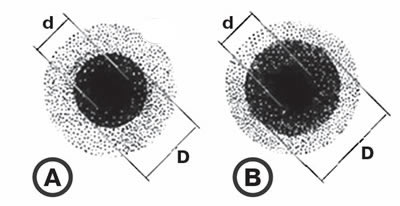
A) Oil with low dispersant properties,
B) oil with a high level of dispersing properties.
A distinction is made between the central core (d), corresponding to the spread of oil, and the zone (D) of diffusion of oil-insoluble contamination products around the central core.
A decrease in the diffusion zone width indicates the activation of additives or the presence of water in the oil. The DS of the oil is determined by the formula:
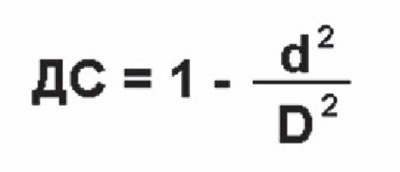
A DS value of less than 0.3 conventional units is considered unsatisfactory; in this case, an oil change is required.
Example
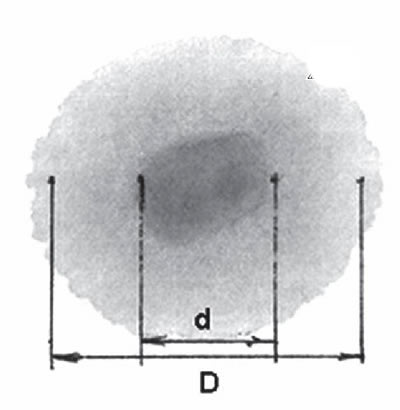
In this example, the diameter of the central region (d) is 18 mm, and the diameter of the outer region (D) = 41 mm.
Substituting these values into the formula, we get: DS = 1 - (18²/41²) = 1 - (324/1681) = 1 - 019 = 0,81.
The obtained value corresponds to the permissible range from 0.3 to 1, therefore, the condition of the oil is quite satisfactory.
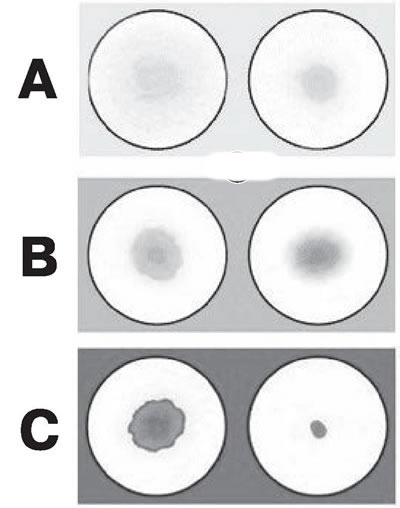
The presence of large insoluble particles can also be visually assessed by the oil stain. Area A corresponds to the normal state of the oil; oil stains in area B indicate that the oil will soon need to be changed; oil stains in area C indicate that the oil is heavily contaminated and must be replaced.