


Table of contents: General information ↓ Disassembly, maintenance of internal…↓ Dismantling the primary shaft…↓ Dismantling the secondary shaft…↓ Dismantling the main gear assembly ↓
Layout diagram of internal components of the manual transmission
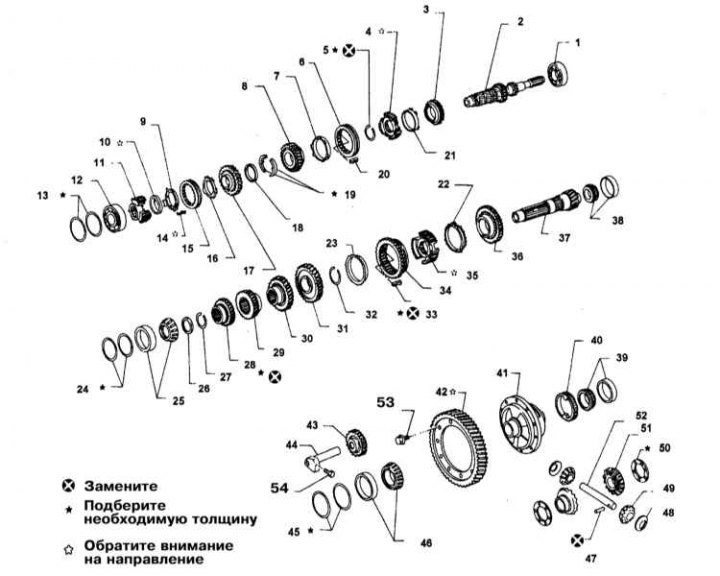
1 - Front primary shaft bearing; 2 - Primary shaft; 3 - 3rd gear drive pinion; 4 - Sliding synchronizer clutch hub; 5 - Thrust ring; 6 - Sliding clutch; 7 - 4th gear locking ring; 8 - 4th gear pinion; 9 - Reverse gear synchronizer locking ring; 10 - Reverse gear synchronizer cone; 11 - 5th gear synchronizer sliding clutch hub; 12 - Rear bearing of the primary shaft; 13 - Adjusting rings of the rear bearing of the primary shaft; 14 - Spring key; 15 - Sliding synchronizer sleeve; 16 - 5th gear synchronizer locking ring; 17 - 5th gear pinion; 18 - Retaining ring; 19 - Primary shaft thrust half rings; 20 - Spring key; 21 - Reverse gear synchronizer locking ring; 22 - 1st gear synchronizer locking ring; 23 - 2nd gear synchronizer locking ring; 24 - Secondary shaft rear bearing adjusting rings; 25 - Secondary shaft rear bearing; 26 - Thrust washer; 27 - Thrust ring; 28 - 5th gear driven gear; 29 - 4th gear driven gear; 30 - 3rd gear driven gear; 31 - 2nd gear driven gear; 32 - Thrust ring; 33 - Spring key; 34 - Rear driven gear; 35 - 1-2 gear synchronizer hub; 36 - 1st gear driven gear; 37 - Secondary shaft; 38 - Secondary shaft front bearing; 39 - Differential bearing; 40 - Speedometer drive gear; 41 - Differential box; 42 - Driven gear of the main transmission; 43 - Reverse intermediate gear; 44 - Reverse intermediate gear shaft; 45 - Bearing adjusting rings; 46 - Differential bearing; 47 - Pin; 48 - Satellite axle thrust washer; 49 - Differential satellite; 50 - Thrust washer of the differential side gear; 51 - Differential side gear; 52 - Axis of satellites; 53 - Bolt (74÷88 Nm); 54 - Bolt (16÷21 Nm)
Gear Selector Components
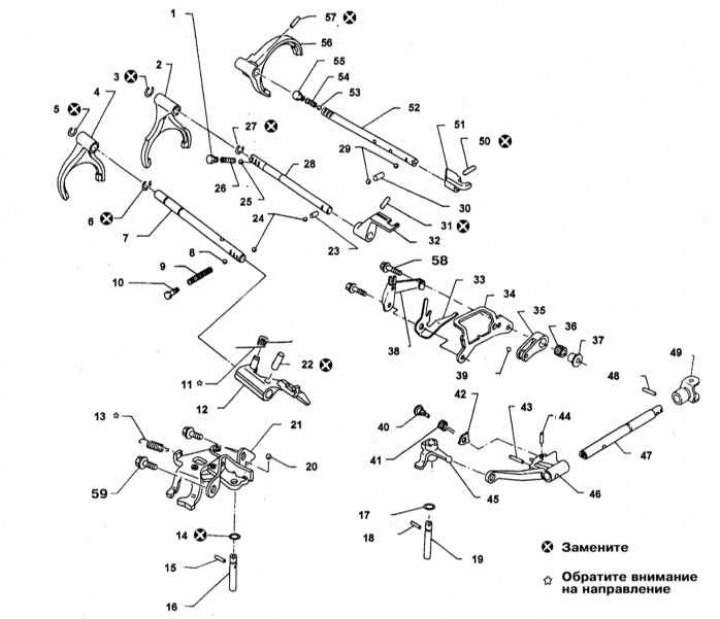
1 - 3rd and 4th gear shift fork lock plug; 2 - 3-4 gear shift fork; 3 - Retaining ring; 4 - 5th gear engagement fork; 5 - Retaining ring; 6 - Retaining ring; 7 - 5th gear shift fork rod; 8 - Blocking ball; 9 - Return spring; 10 - 5th and reverse gear control plug (16 yo 22 Nm); 11 - Retaining spring; 12 - 5th and reverse gear bracket; 13 - Reverse gear level spring; 14 - Sealing ring; 15 - Pin; 16 - Reverse lever axis; 17 - Sealing ring; 18 - Pin; 19 - Gear selection rod; 20 - Ball; 21 - Reverse gear engagement device; 22 - Interlock plunger; 23 - Interlocking ball; 25 - Ball; 26 - Return spring; 27 - Retaining ring; 28 - 3-4 gear shift fork rod; 29 - Ball; 30 - Interlock plunger; 31 - Pin; 32 - Bracket; 33 - Return spring; 34 - Damper; 35 - Selector foot; 36 - Return bearing; 37 - Bushing; 38 - Selector spring; 39 - Ball; 40 - Cam pin; 41 - Return spring; 42 - Cam; 43 - Pin; 44 - Pin; 45 - Selector; 46 - Locking lever; 47 - Shut-off rod; 48 - Pin; 49 - Fork clamp; 50 - Pin; 51 - Bracket; 52 - 1-2 gear shift fork rod; 53 - Ball; 54 - Return spring; 55 - 1-2 shift fork lock plug; 56 - 1-2 gear shift fork; 57 - Pin; 58 - Bolt (16÷21 Nm); 59 - Bolt (16÷21 Nm)
General information
The authors of this Manual do not recommend that car owners undertake major repairs of the manual transmission on their own. During the procedures of disassembling and assembling the transmission, it is necessary to remove and then install many small components. It is necessary to make a lot of precise measurements and, by selecting adjusting washers, rings and spacer bushings, accurately set many gaps. In view of all the above, it would be wiser to entrust the performance of major repairs of the manual transmission to car service specialists. Note that in many cases it is possible to purchase a reconditioned unit on an exchange basis, which is often cheaper than carrying out complex repairs.
Despite the above, independent repair of the manual transmission by an amateur mechanic is not at all an absolutely impossible undertaking. The only indispensable conditions are the availability of the necessary special tool and accuracy in the approach to performing all procedures.
The tools needed to perform a manual transmission overhaul include circlip pliers, a bearing puller, a sliding hammer, a set of punches and center punches, a DTI gauge, and possibly a hydraulic press. Of course, you will also need a sturdy workbench with a vice or a special assembly stand.
When performing the manual transmission disassembly procedures, try to remember, or better yet, write down, the installation order of each of the removed parts.
Before disassembling the gearbox, it would be wise to try to analyze the symptoms of its failures in order to roughly determine their causes. Many failures are clearly associated with the failure of very specific components.
The following subsection provides a schematic description of the procedure for disassembling the manual transmission and servicing its internal components.
Disassembly, maintenance of internal components and assembly of manual transmission
Extracting components
1. The layout of the internal components of the manual transmission and the gear selection mechanism is shown in the illustrations.
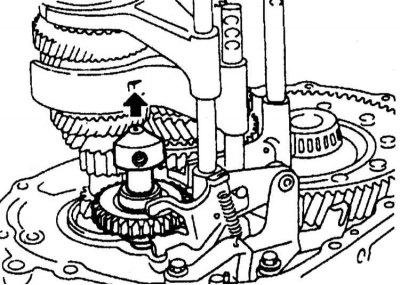
2. Remove the 4th gear through the hole, then remove the reverse intermediate gear shaft and the gear itself.
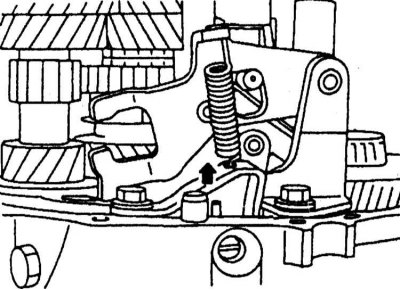
3. Remove the mounting pin from the coupling housing.
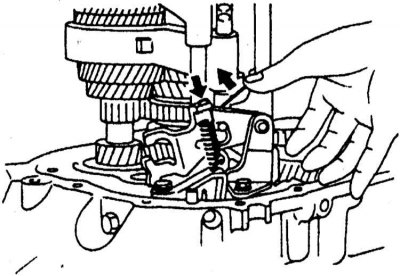
4. Remove the lever return spring and the reverse gear stop spring from the reverse gear engagement mechanism.
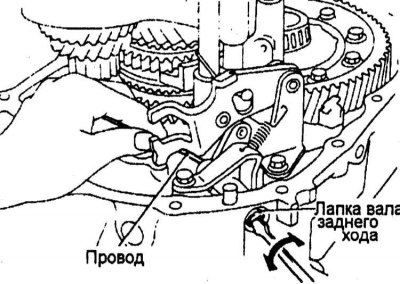
5. Remove the reverse gear pinion axle tab.
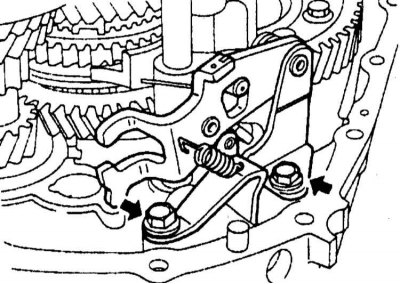
6. Remove the reverse gear lever assembly.
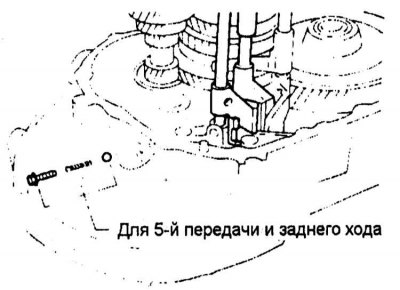
7. Remove the 5th and reverse gear fork lock plug, remove the spring and ball.
8. Remove the retaining rings and mounting pins from the 5/reverse and 3-4 gear shift fork rods.
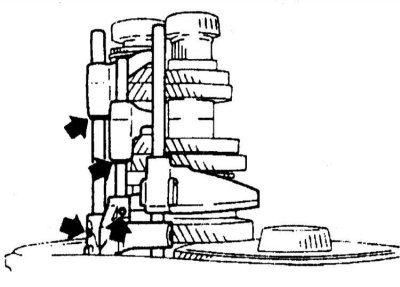
9. Remove the 5/reverse and 3-4 gear rods.
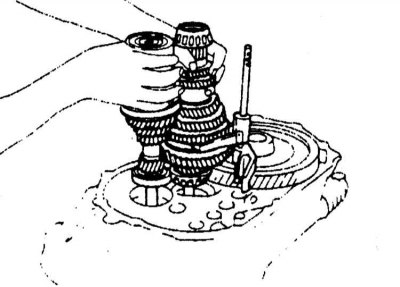
10. Remove the assemblies of both shafts (primary and secondary) Manual transmission and 1-2 gear fork with its own rod.
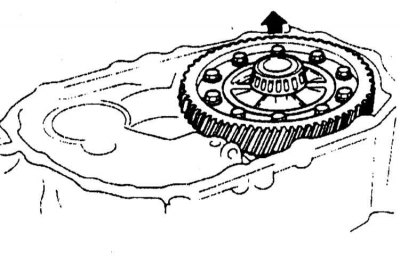
11. Remove the final drive assembly.
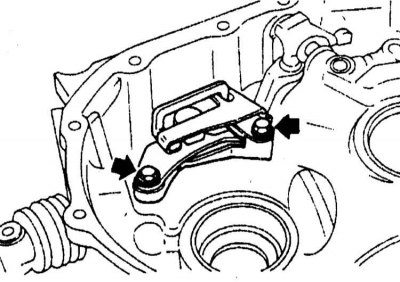
12. Remove the reverse gear assembly.
13. Using a special punch (KV32101000) remove the retaining pin and disconnect the selector.
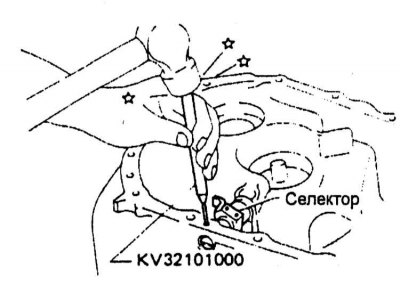
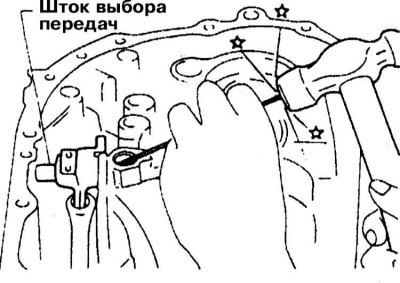
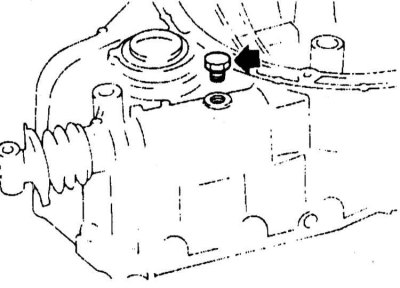
14. Unscrew the drain plug to provide access to the pin securing the lever to the rod.
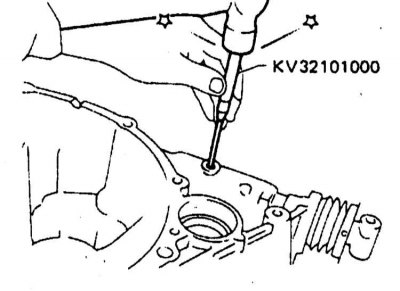
15. Remove the pin (use punch KV32101000) and remove the lever with the rod.
Dismantling the primary shaft assembly
Disassembly
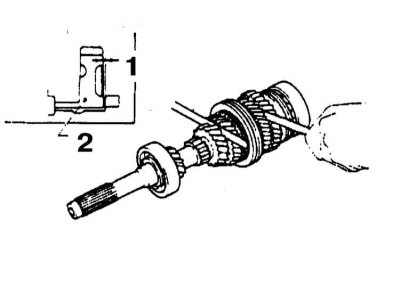
1. Before you begin dismantling the primary shaft, estimate the amount of axial play of the drive gears of 3rd, 4th and 5th gears.
 |
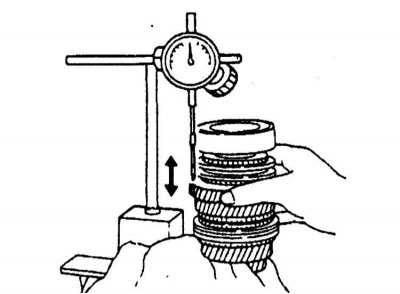 |
2. If the gear play is outside the permissible ranges (see Specifications), dismantle the assembly and check the condition of the mating surfaces of the gears, shaft and hubs, then evaluate the clearance of the retaining ring and thrust half rings of the primary shaft.
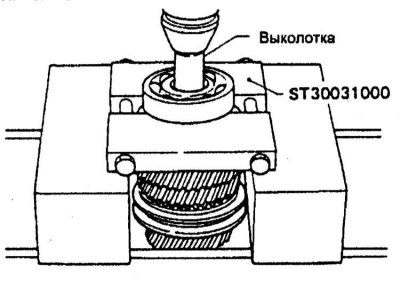
3. Remove the rear bearing of the input shaft.
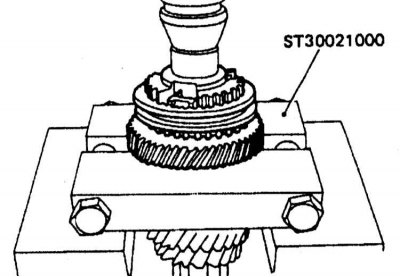
4. Remove the 5th and reverse synchronizer assemblies and the 5th gear pinion.
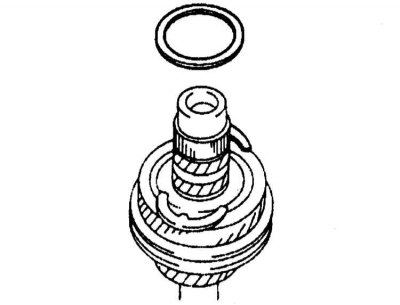
5. Remove the axial lock washer, two thrust half rings and the 4th gear drive gear.
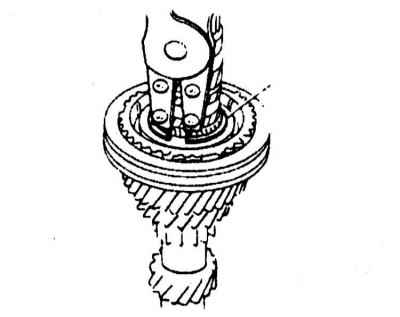
6. Remove the retaining ring.
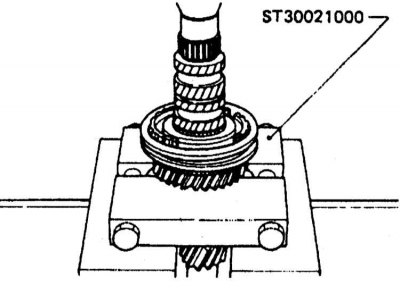
7. Remove the 3-4 gear synchronizer and the 3rd gear pinion.
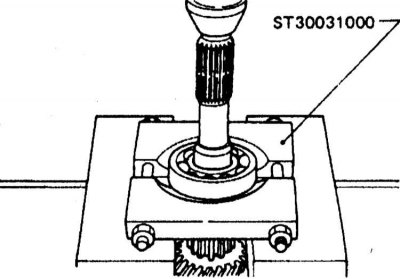
8. Remove the front input shaft bearing.
Checking the status of components
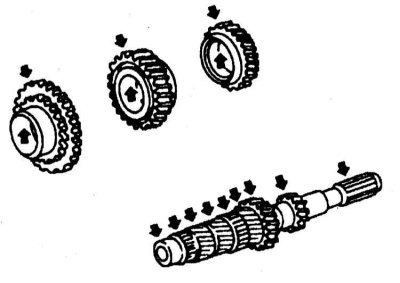
1. Check the primary shaft assembly for cracks, signs of deformation and excessive wear, and assess the condition of the drive gears.
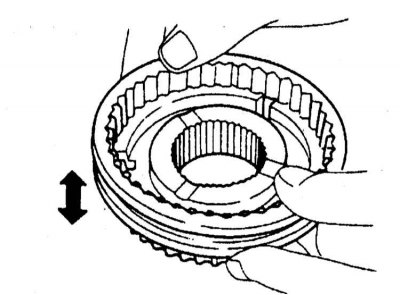
2. Check synchronizer components for cracks, signs of excessive wear, cracks and other mechanical defects. Assess the condition of hubs, sliding clutches, locking rings, keys and other assembly parts.
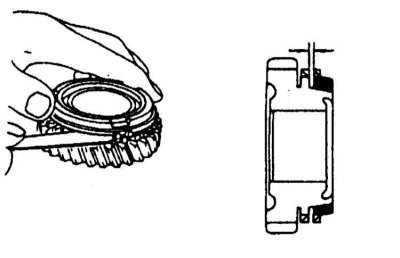
3. Measure the gap between the synchronizer locking ring and the gear (for 4th and 5th gears). The nominal value lies within the range of 1.0÷1.35 mm with a wear tolerance of up to 0.7 mm.
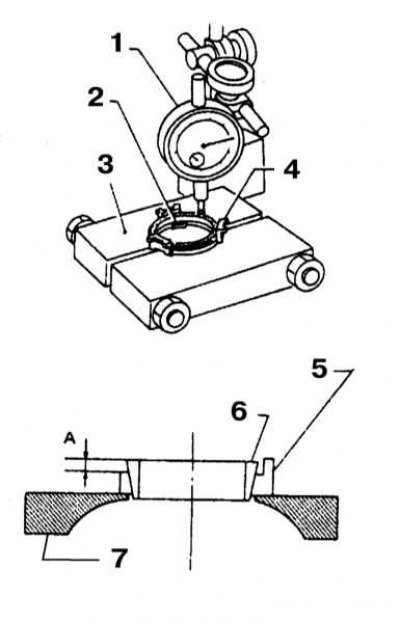
1 - Dial meter; 2 - Synchronizer cone; 3 - Tie (fixture ST30031000); 4 - Locking ring; 5 - Synchronizer cone; 6 - Tie (fixture ST30031000)
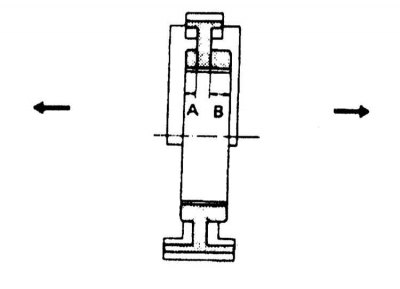
4. Assess the degree of wear of the reverse synchronizer locking ring. Place the locking ring on a suitable device and place the synchronizer cone on it. Make sure that the projection of the cone falls within the perimeter of the recess in the device. Press the cone firmly against the locking ring and use a plunger-type dial gauge to determine the distance A. If the value A is less than 1.2 mm, replace the locking ring.
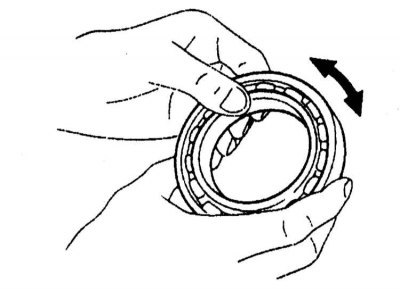
5. Assess the freedom of rotation of the bearings.
(The material is based on data from the portal: «nissanbook.ru»)
6. Check bearing assemblies for cracks, cavities and other mechanical damage.
Assembly
1. Assemble the 3-4 gear synchronizer. Make sure the components are engaged correctly.
2. Place the 3rd gear pinion and the corresponding synchronizer locking ring on the primary shaft assembly.
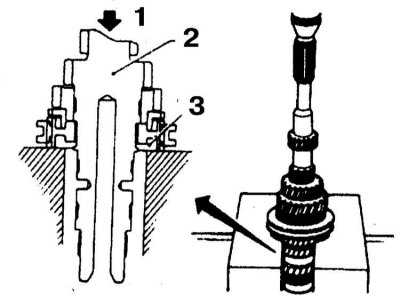
3. Press the hub of the 3-4 gear synchronizer clutch onto the assembly. Ensure that the components are oriented correctly. Select and install the appropriate thrust ring, minimizing the gap in the groove (the gap should not exceed the range of 0÷0.1 mm).
4. Install the 4th gear pinion.
5. Select the appropriate thrust washers to ensure the minimum clearance in the groove (0÷0.06 mm) and place them on the thrust ring.
6. Install the 5th and reverse gear synchronizer. Insert the spring keys into the reverse gear synchronizer locking ring. Insert the assembly into the synchronizer sliding sleeve, - make sure that the spring keys are inserted into the sleeve correctly.
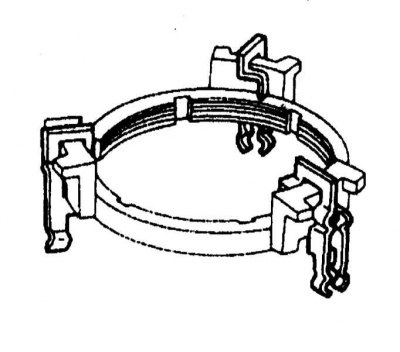
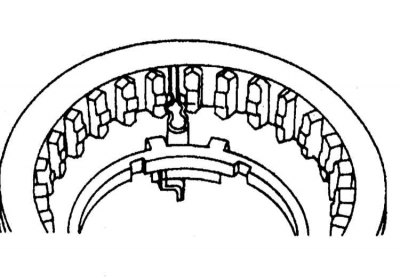
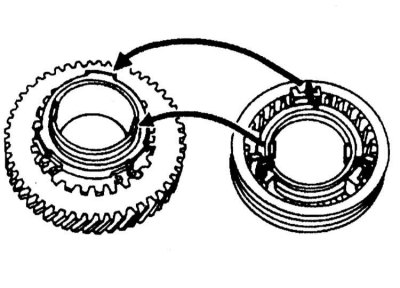
1 - 5th gear pinion
2 - Reverse gear synchronizer assembly
7. Place the 5th gear locking ring into the corresponding pinion gear. Install the reverse gear synchronizer cone onto its locking ring. Place the assembled reverse gear synchronizer onto the 5th gear pinion gear. Tuck the cone projections into the mating grooves of the pinion gear.
8. Place the reverse synchronizer locking ring snap ring retainers on top of the 5th gear drive gear.
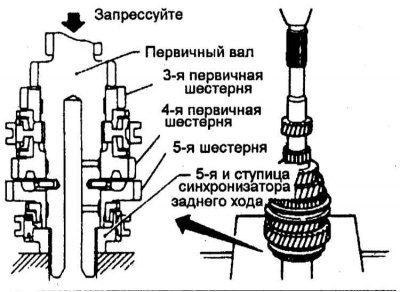
9. Press the 5th/reverse synchronizer assembly with the 5th gear onto the input shaft assembly.
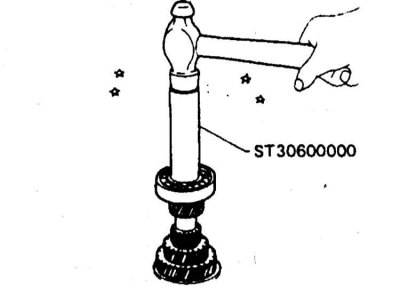
10. Install the front and rear bearings onto the input shaft assembly.
 |
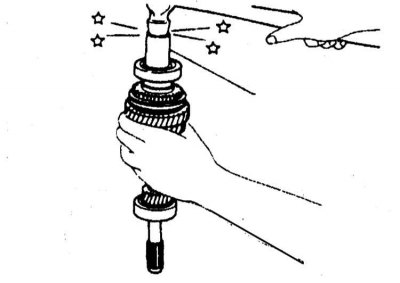 |
11. Estimate the amount of axial clearance of the gears.
Dismantling the secondary shaft assembly
Disassembly
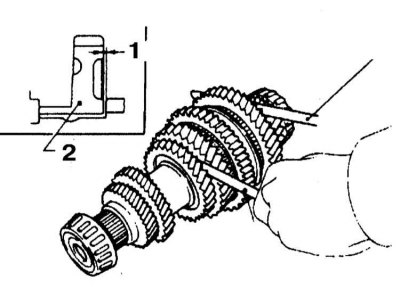
1. Before dismantling the assembly components, measure the axial clearance of the driven gears of 1st and 2nd gears. If the measurement results are outside the permissible ranges (see Specifications), remove the components and assess the condition of the mating surfaces of the shaft, gears and hubs (see subsection Assembly).
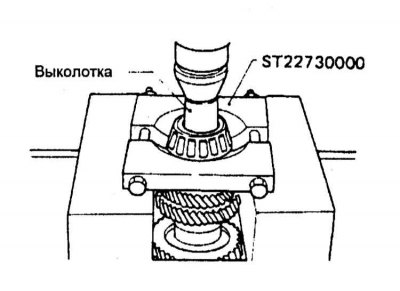
2. Press out the secondary shaft rear bearing.
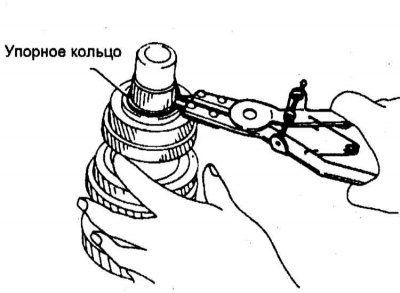
3. Remove the thrust washer and ring.
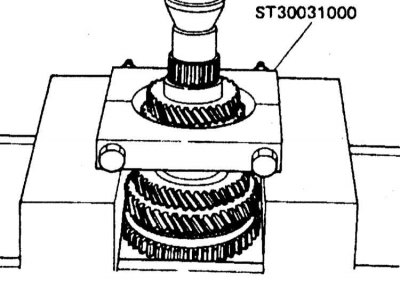
4. Press out the driven gears of 5th and 4th gears.
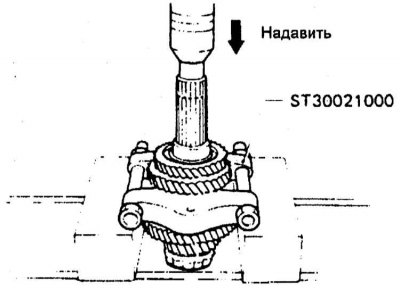
5. Press out the driven gears of 3rd and 2nd gears.
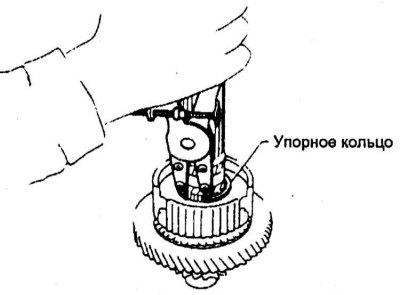
6. Remove the thrust ring.
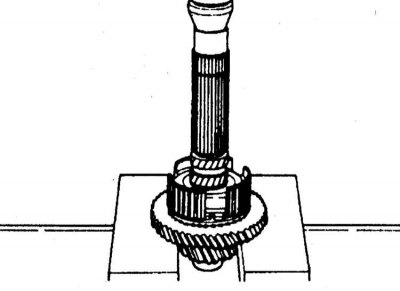
7. Remove the 1-2 synchronizer assembly and the 1st gear driven gear.
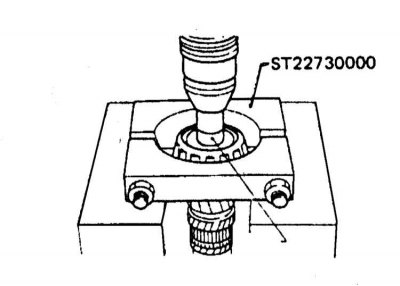
8. Press out the rear bearing
Checking the status of components
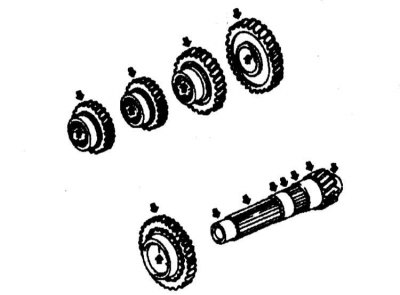
1. Check the shaft for cracks, deformations and signs of excessive wear, assess the condition of the gears.
2. Check synchronizer components for cracks, signs of excessive wear, cracks and other mechanical defects. Assess the condition of hubs, sliding clutches, locking rings, keys and other assembly parts.
3. Measure the gap between the synchronizer locking ring and the gear (for 4th and 5th gears). The nominal value lies within the range of 1.0÷1.35 mm with a wear tolerance of up to 0.7 mm.
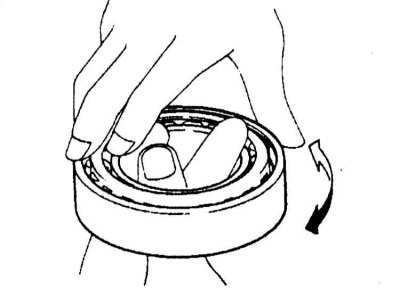
4. Assess the bearings for free rotation. Check the bearing assemblies for cracks, cavities, and other mechanical damage.
Assembly
1. Assemble the 1-2 gear synchronizer. Ensure that the components are engaged correctly.
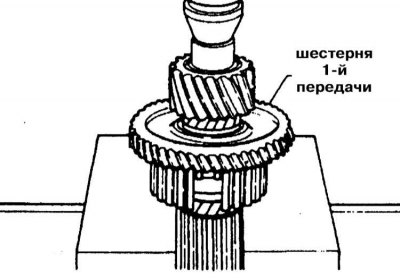
2. Install the 1st gear driven gear and the 1st gear synchronizer locking ring. Press the 1-2 gear synchronizer hub. Ensure that the components are oriented correctly.
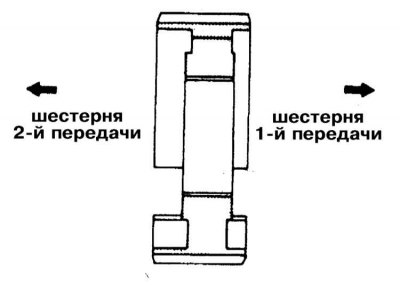
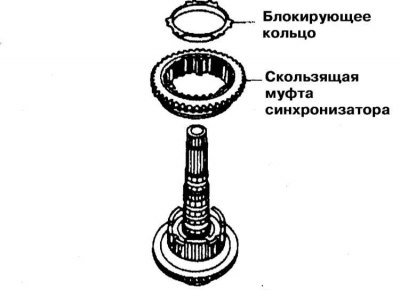
3. Install the 1-2 synchronizer sliding sleeve and its locking ring.
4. By selecting the thrust rings for the hub of the 1-2 gear synchronizer, achieve a minimum gap in the groove (0÷0.1 mm).
5. Place the 2nd gear driven gear onto the shaft assembly.
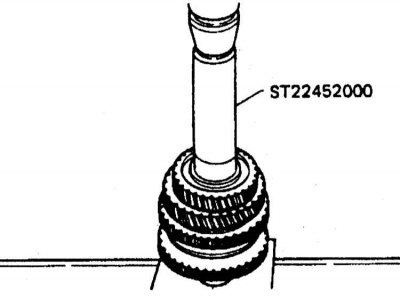
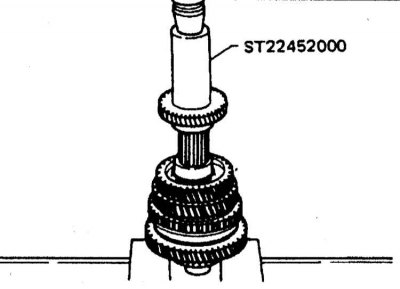
6. Install the 3rd gear, then 4th and 5th.
 |
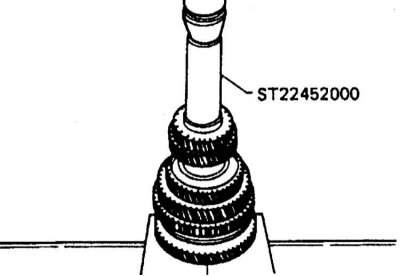 |
7. By selecting a thrust ring, achieve a minimum gap in the groove of the driven gear of the 5th gear (0÷0.15 mm).
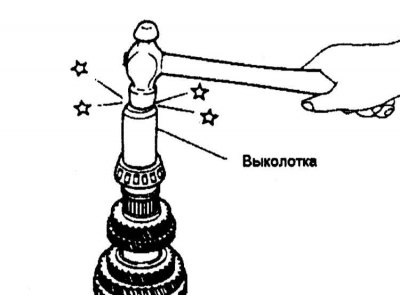
8. Press in the thrust washer and secondary shaft rear bearing.
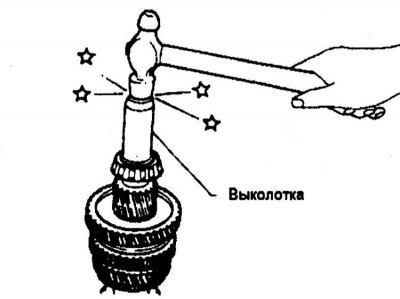
9. Install the front bearing.
Dismantling the main gear assembly
Disassembly
1. Loosen the mounting bolts and remove the driven crown gear of the main transmission.
2. Remove the speedometer drive.
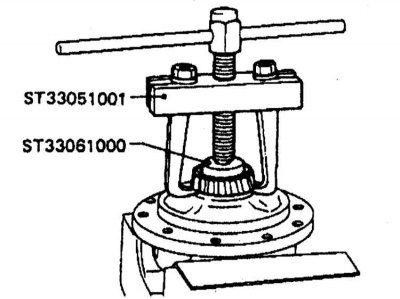
3. Press out the differential side bearings - remember that the right and left bearings are not interchangeable and must be installed strictly in their original places.
4. Release the mounting pin and remove the satellite shaft.
5. Remove the satellites and side gears from the differential box.
Checking the status of components
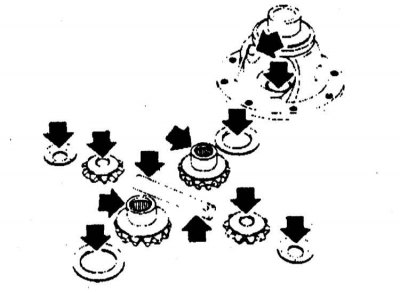
1. Check the condition of the mating surfaces of the differential box, side gears and satellites.
2. Assess the degree of wear of the washers.
3. Check the bearings for free rotation. Make sure there are no signs of mechanical damage or pitting.
Assembly
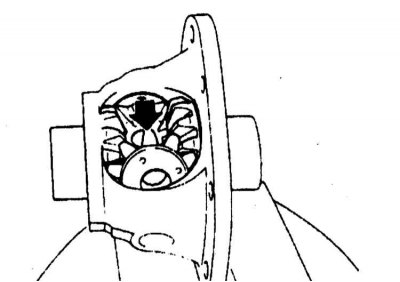
1. Install the washers on the differential side gears. Insert the side gears and satellites into their regular places in the differential box.
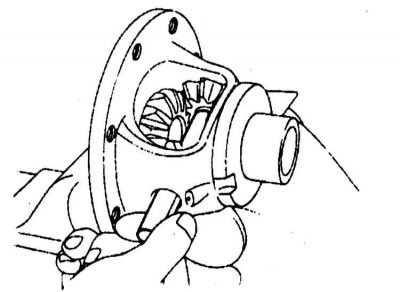
2. Insert the satellite axle.
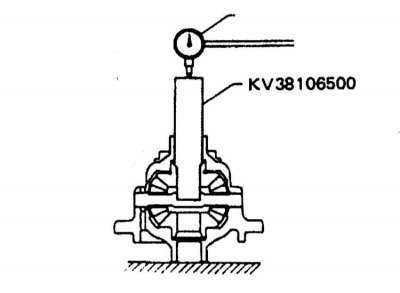
3. Using a special device and a plunger-type dial gauge, measure the amount of clearance in the side gear fit in the differential box.
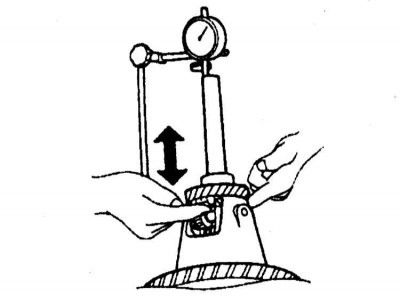
4. The measurement result should not exceed 0.1÷0.2 mm, otherwise achieve the required result by selecting new washers.
5. Install the pin.
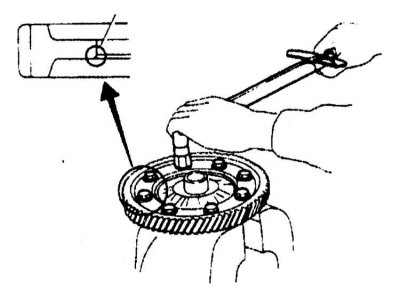
6. Install the final drive driven gear.
7. Install the speedometer drive.
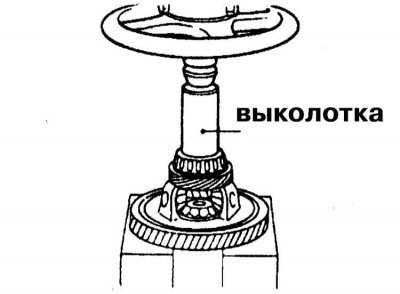
8. Press the side bearings onto the differential.
Checking the condition of the gear selection mechanism components
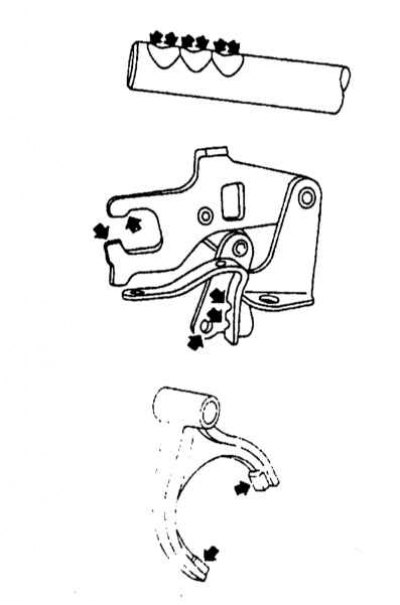
Check the sliding surfaces of the gear selection mechanism components for scratches, abrasions and other mechanical damage.