


Table of contents: Instrument cluster ↓ CRUISE If the vehicle is equipped…↓ Left combined steering column switch…↓ Right combination steering column…↓ Steering column switch for…↓ Tempostat Operation Management ↓ Adjustable steering column locking…↓ Parking brake lever ↓ Gear Shift/Selection Lever ↓ Seat adjustment ↓ Rear view mirrors ↓ Interior lighting devices ↓
The general layout of the controls is shown in the illustrations.
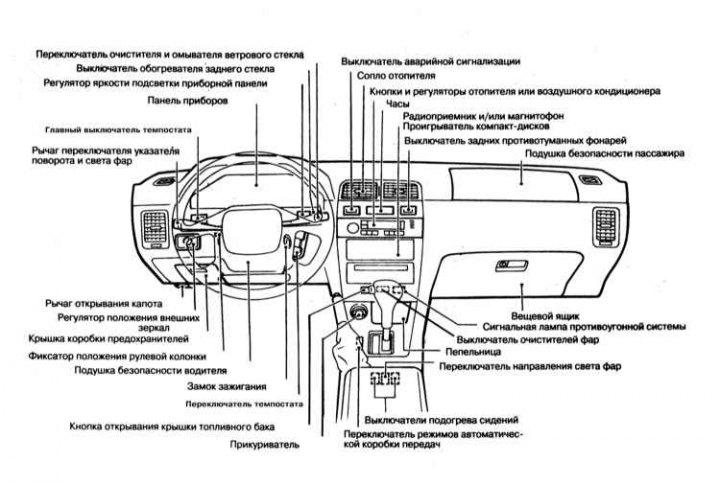
Instrument cluster
The instrument cluster of the vehicle's dashboard includes a set of basic gauges, control lamps and indicator lights.
Speedometer, odometer and trip meter
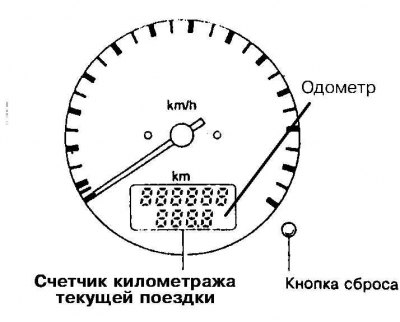
The speedometer indicates the vehicle's speed in km/h. Below the axis of the indicator arrow is a digital display, the upper field of which is reserved for the odometer readings (total mileage counter of a car), the lower one - for the mileage counter readings of the current trip.
Tachometer
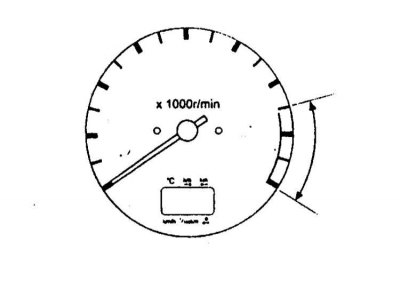
Next to the speedometer dial is an engine speed indicator, or tachometer. The meter's needle shows the driver the engine crankshaft speed in rpm. Make sure that the engine speed does not rise so much that the needle goes into the red-marked range of the meter's scale.
Coolant temperature gauge
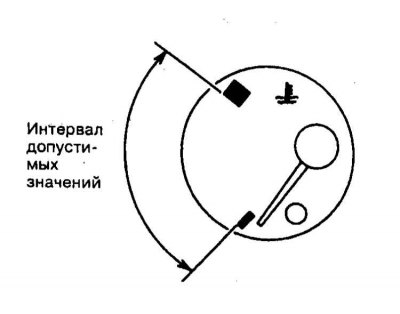
The gauge registers the engine coolant temperature. Gauge readings may vary depending on ambient temperature and driving conditions. If the gauge needle goes beyond the permissible scale range, stop driving immediately and let the engine cool down. Prolonged operation of an overheated engine may cause it to fail.
Fuel consumption meter
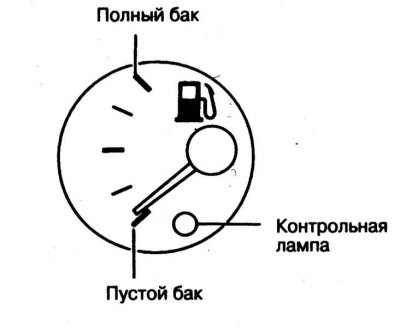
The fuel consumption meter indicates the current fuel level in the tank. When braking, accelerating, maneuvering and driving the car on an inclined plane, the meter readings may vary slightly. The meter connection diagram is such that it continues to output the working value even when the ignition is off. When the fuel level in the tank drops to a critical value, a control lamp mounted in the meter dial is triggered.
Control lamps and signal buzzers
The vehicle's instrument cluster assembly has a whole set of control lamps built in, with the help of which the driver receives important information about the serviceability/malfunction of the vehicle's main units and systems. Below, the reader's attention is offered information about the operating principle of each of the provided light indicators separately.
Designations of control lamps and indicator lights
| Indicator lamp designation | Purpose of the control lamp, (color) |
| AIR BAG | Airbag warning light (SRS) (red) |
 | Brake fluid level indicator light (red) |
 | Charging indicator light (red) |
 | Door ajar warning light (red) |
 | Oil pressure warning light (red) |
 | Parking brake engaged indicator light (red) |
 | Low Fuel Warning Light (Yellow) |
 | ABS warning light (orange) |
 | Low washer fluid level indicator light (orange) |
 | Engine status indicator light (orange) |
| O/D OFF | Overdrive cut-off indicator (orange) |
 | Rear fog light indicator (orange) |
 | High beam indicator (blue) |
| CRUISE | Temperature control lamp (green) |
 | Direction indicator light (green) |
Checking the lamps for proper operation
1. Set the parking brake and turn on the ignition (do not start the engine), - the charge, oil pressure and engine status indicator lights should light up on the instrument panel
The ABS and SRS warning lights should also come on briefly and then go out shortly
AIR BAG
2. If any of the listed lamps does not work, it is either out of order or there is a break in its electrical wiring. Try to identify and eliminate the cause of the failure.
Battery charge indicator light

The charge indicator lamp should light when the ignition is turned on and go out immediately after the engine starts. When this indicator lamp lights up with the engine running, it warns the driver of a malfunction in the charging system, i.e., the battery is going into discharge mode. You should immediately switch off all power consumers whose operation does not affect road safety and try to prevent the engine from stopping, since an attempt to restart it may result in the battery being completely discharged. The car should be immediately driven to the nearest service station for diagnostics of the failure and the necessary repairs.
Engine oil pressure warning light

The engine oil pressure indicator light should light up when the ignition is turned on and go out immediately after the engine starts. Flashing of the light when the engine is running indicates a pulsating decrease in the working pressure of the engine oil in the engine. When the indicator switches to a constant glow mode, it means that the oil pressure has dropped to a dangerously low level, which is fraught with serious internal damage to the engine, up to its complete failure. In both cases, urgent measures should be taken to adjust the oil level, identify and eliminate the causes of the pressure drop.
Engine status indicator light

The indicator lamp lights up briefly when the ignition is turned on. If it lights up at any other time, it indicates a possible malfunction of one of the electrical systems of the power unit. In the absence of visible signs of failure of the power unit systems and a decrease in the vehicle dynamics, the violations recorded by the indicator lamp may cause an increase in fuel consumption or an increase in the toxicity of emissions. Ignoring the indicator lamp signals is fraught with serious damage to the engine, up to and including failure of the unit. If the indicator lamp lights up while driving, you should immediately stop driving, park in a safe place and turn off the engine, then, after a short time, start the car, while observing the behavior of the indicator lamp. If the lamp does not return to normal operation and continues to light, the car should be driven to the nearest service station for detailed diagnostics and the necessary repairs. Until the malfunction of the engine systems is eliminated, try to drive at a moderate speed, avoiding sudden acceleration with full depressing of the gas pedal.
Note: Even if the indicator lamp returns to normal when the engine is restarted, (i.e., it goes out), you should contact a service station for advice at the earliest opportunity, especially if this type of indicator light is not the first time it has occurred.
Continued operation of the vehicle with the engine status indicator light on may result in premature failure of the catalytic converter. Remember that failures and damages resulting from operating the vehicle with the indicator light on are not covered by the manufacturer's warranty! In addition to the functions described above, on models with the appropriate configuration, this indicator light also functions as a NATS V2.0 anti-theft system indicator light.
High beam indicator lamp
This indicator light comes on simultaneously with the high beam headlights of the vehicle being switched on (see below).
Rear fog light indicator light
This indicator light confirms that the rear fog lights are functioning properly when they are turned on.
Brake fluid level indicator light
When this indicator lamp comes on, it informs the driver about a critical drop in the hydraulic fluid level in the brake system.
Parking brake engagement indicator light

This warning lamp lights continuously when the parking brake is applied, reminding the driver to release it before driving. Driving with the parking brake applied leads to rapid overheating and failure of the rear brake mechanisms and premature wear of the rear tire treads, and may also cause malfunction of the anti-lock braking system (ABS) (see below). One of the possible causes of a gradual decrease in the brake fluid level is normal wear of the friction linings of the brake shoes. When the warning lamp comes on, the car should be driven to the nearest service station to assess the condition of the shoes and check the tightness of the hydraulic circuit of the brake system.
The control lamp also lights briefly when the ignition is turned on (even with the parking brake released).
ABS warning light

If the vehicle is equipped with this indicator lamp, it lights up when the ignition is turned on and goes out immediately after the engine is started, thus confirming the proper functioning of the anti-lock brake system circuit. If the indicator lamp comes on in any other situation, it indicates that the self-diagnosis system has detected faults in the ABS circuit. The vehicle should be taken to the nearest service station without delay for a detailed diagnosis of the system and the necessary repairs.
Note: When the warning light comes on, the anti-lock brake system is disabled, but the vehicle's brakes continue to operate normally, providing adequate braking to the vehicle.
Supplemental Restraint System (SRS) Warning Light
This indicator lamp lights up when the ignition is turned on and should go out immediately after the engine is started. If the lamp remains lit when the engine is running (in constant or flashing mode), this indicates a malfunction of the SRS system components. If equipped, the activation of this indicator lamp may indicate a malfunction in the side airbag circuits or the automatic emergency seat belt tensioners.
Cruise control indicator light
CRUISE If the vehicle is equipped accordingly, this indicator lamp lights up when the automatic cruise control system is switched on (tempostat) (see below).
Door Not Closing Warning Light
When this indicator light comes on, it warns the driver that not all of the vehicle's doors are closed tightly.
Direction indicator light
The indicator confirms the fact and proper functioning of the vehicle's turn signals and operates in a flashing mode with a frequency corresponding to the blinking frequency of the indicators. Rapid blinking of the indicator usually indicates that one of the turn signal lamps has burned out. The burned-out lamp should be replaced as soon as possible to avoid creating emergency situations on the roads.
Flashing of this indicator usually also accompanies the activation of the hazard warning lights.
Low Fuel Warning Light
This warning light comes on when there is less than 9.0 liters of fuel left in the fuel tank and warns the driver of the need to urgently refuel the vehicle.
Overdrive cut-off indicator lamp
O/D OFF
This indicator lamp comes on when the overdrive switch is moved to the OFF position.
Warning buzzer "Remove key from ignition switch"
The buzzer sounds when the driver's door of the car is opened with the key left in the ignition switch in the ACC or LOCK position.
Warning buzzer "Don't forget to turn off the headlights"
The buzzer sounds when the driver's door is opened with the headlights on.
Controls located on the steering column, control panel, center console and overhead console
The layout of some of the controls is shown in the illustration.
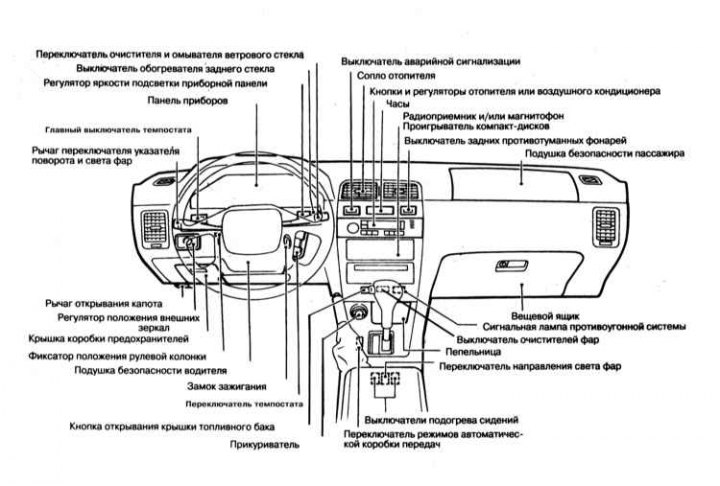
Left combined steering column switch for controlling the operation of external lighting/signaling devices
Switching on daytime running lights and low/high beam headlights
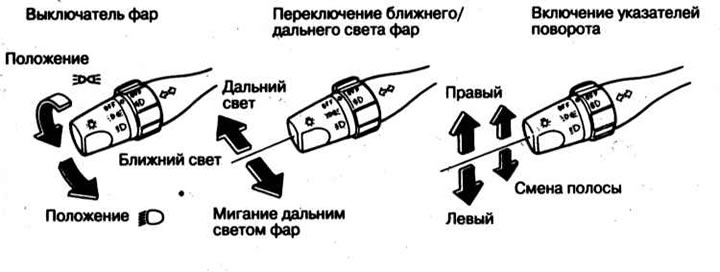
1. The main lighting control switch is designed as a lever mounted on the left side of the steering column directly under the steering wheel. 2. To turn on the exterior lighting, turn the end handle of the main switch lever to the first fixed position
 . This will turn on the front and rear side lights, license plate lights and instrument panel lights. To turn on the low beam headlights, turn the end handle of the main switch to the second fixed position
  .
.
3. Brief switching of the headlights from low beam to high beam and back is done by pulling the switch lever towards you. To permanently turn on the high beam, pull the lever away from you until you hear a click, then release it.
Note: The high beam is switched on briefly regardless of the position of the main switch knob. 4. Some of the models of vehicles covered by this Manual are equipped with an automatic daytime running light (DRL) system. The daytime running light switches on and off automatically when the ignition key is turned to the "ON" position, and can be switched off by turning the central light switch knob to the first or second detent position.
Turning on the direction indicators
1. The indicators are switched on using the main lighting switch lever. The lever is moved up or down, depending on the selected direction of course change. When the lever is moved to the extreme upper/lower position (until it clicks), the corresponding direction indicators will continue to function until the steering wheel is returned to the straight-ahead position.
2. Brief activation of the indicators, for example, when intending to change lanes, is done by lightly pulling the lever up or down, respectively.
Turning on the fog lights
Note: Fog lights should only be used in poor visibility conditions!
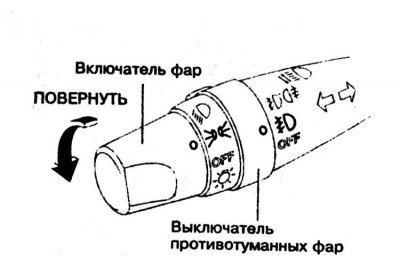
1. Turn the fog lights on/off by turning them to the appropriate position
 ring switch on the handle of the left combination switch assembly lever.
Note: Daytime running lights must be on.
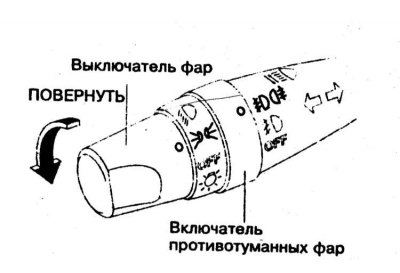
2. The rear fog lights are also turned on using the ring switch. The running lights must also be on.
Right combination steering column switch
Windscreen cleaner operation control switch
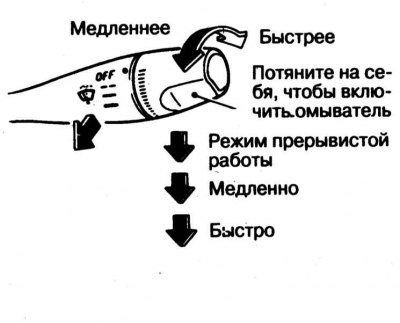
The windscreen wipers/washers can only be switched on when the ignition is on (oN and ACC positions). The windshield wiper operating modes are selected by moving the switch lever down/up. Windshield wiper interval operating mode parameters (in the range of 2-20) can be selected using the end handle at the end of the lever.
Warning! Do not turn on the washers for more than 30 seconds. Do not attempt to turn on the washers when the system reservoir is empty. In frosty weather, the windshield wipers should be turned on only after the windshield has been warmed up.
Steering column switch for controlling the cruise control
Speed control system main switch
The cruise control system (tempostat) is included in the standard equipment of some models, and can be installed additionally on others. The system allows you to automatically maintain the selected cruising speed of the car without using the gas pedal. The cruising speed should not exceed 40 km/h. Using the cruise control becomes especially convenient during long trips on lightly loaded straight country highways. For safety reasons, it is not recommended to turn on the cruise control when driving in the city, on winding roads with many turns, on slippery road surfaces, in heavy rain or in other adverse weather conditions. In the above cases, the driver must be able to fully control the vehicle's driving mode.
Warning! Incorrect use of the cruise control may cause a traffic accident. Only activate the cruise control system when driving on freeways and in favorable weather conditions. When the system is operating, the accelerator pedal may move automatically; however, do not hold it with your foot to avoid damage to the support and axle mechanisms.
The lever switch for controlling the cruise control is located on the right above the steering column, below the right combined steering column switch assembly. The system is switched on/off using a button mounted in the end of the switch lever handle and is accompanied by the activation of the corresponding indicator lamp on the vehicle's instrument panel.
Instrument cluster backlight brightness control
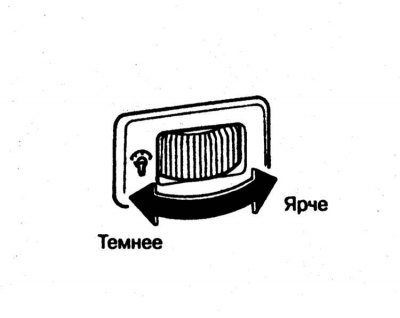
The backlight brightness regulator is mounted in the car's instrument panel to the right of the steering column. The required intensity of the panel backlight is achieved by rotating the potentiometer.
Note: The regulator starts to function only when the running lights are on (see above).
Regulator for adjusting the direction of the optical axes of the headlights
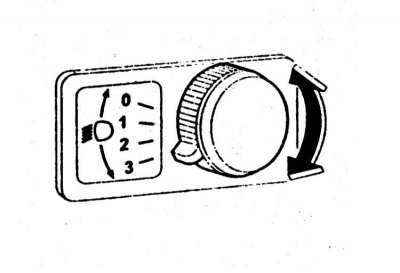
The regulator is located on the central console of the car between the seat heating switch keys and provides the ability to adjust the direction of the optical axes of the headlights in the low beam mode and achieve the best conditions for road lighting with different vehicle loads. The adjustment is made depending on the number of passengers, the presence and weight of cargo in the luggage compartment. The regulator should be moved to a position corresponding to the actual vehicle load or as close to it as possible:
- a) Position "0" - one driver or driver and passenger in the front seat;
- b) Position "1" - driver and four passengers in the front and rear seats;
- c) Position "2" - driver, four passengers in the front and rear seats, plus a load of about 185 kg in the luggage compartment (the gross vehicle weight is within the permissible range);
- d) Position "3" - one driver and a load of about 380 kg in the luggage compartment (the loads on the front and rear axles of the vehicle are within the permissible limits, the gross vehicle weight does not exceed the maximum permissible value). Also when towing a trailer.
Heated seats
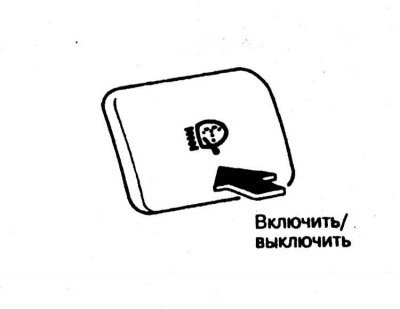
1. The front seats of the car are equipped with built-in heaters. The seat heating control switches are located on the central console of the car. 2. Start the engine - turning on the seat heating with the engine off leads to a rapid discharge of the battery.
3. Use the selector button to select the required heating intensity mode (LO - low intensity or HI - maximum intensity). The corresponding indicator should light up on the button. The heater is controlled automatically by the thermostat. Do not forget to turn off the heating before leaving the car.
4. Do not cover the seats with heat-insulating materials such as blankets, ottomans or thick covers. Do not place hard or sharp objects on the seats, try not to damage the upholstery and the heating element located underneath. Any liquid spilled on the seat should be immediately wiped off with a dry cloth. Do not use any solvents to clean the seat upholstery - use mild detergents. If the heater fails to function, seek help from a car service center.
Hazard warning light switch
1. The hazard warning lights are turned on by pressing the push-button switch mounted in the central part of the vehicle's instrument panel (under the deflectors of the central air ducts for ventilation/heating of the passenger compartment) and is usually equipped with a warning lamp with a pictogram depicting two triangles inscribed one within the other. 2. Switching on the hazard warning lights causes all four direction indicators to come on simultaneously (and their control lamp on the car's dashboard) The alarm is designed to warn other road users about a forced stop of the vehicle and is also used in other dangerous situations provided for by traffic regulations.
Warning! When the hazard warning lights are on, the direction indicators will not function!
Control of the operation of the upper hatch drive
1. The electric drive of the upper hatch functions only when the ignition is on.
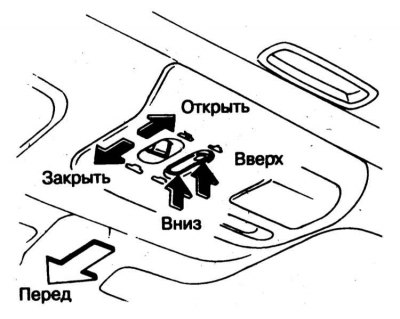
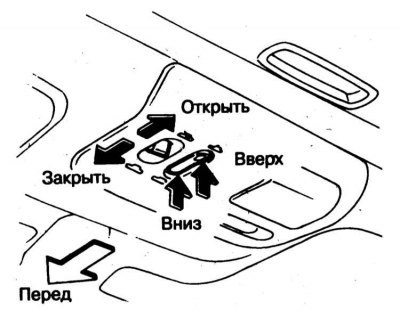
2. The control panel for the electric drive of the upper sunroof is located on the roof console of the car. 3. In order to move the sunroof cover, press the button of the panel switch, designated by the pictogram
 and hold it in this position. The hatch is closed using the switch marked with the pictogram
  .
.
4. To move the sunroof to the tilt position, first close it completely, then press and hold the switch button marked with the pictogram
 . The lid is lowered using the switch indicated by the pictogram
  .
.
5. Additionally, the upper hatch is equipped with a sunshade. When the hatch cover is moved, the sunshade is retracted automatically.
6. Make sure that passengers do not lean out of the sunroof while the vehicle is moving. Before opening the sunroof, clean the cover from moisture, snow, dust and other foreign deposits. Do not place any heavy objects on the sunroof cover or the surface of the vehicle roof near the sunroof.
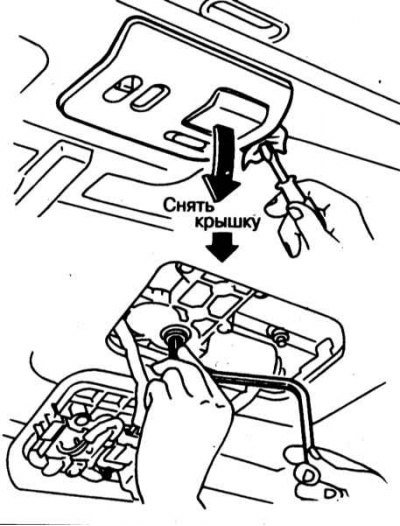
7. If the electric drive fails, the hatch cover can be moved to the closed position manually. Remove the trim panel of the electric drive control panel - access to the end of the drive motor shaft should open. Using a rod wrench of the appropriate size, turn the shaft clockwise until the hatch cover is completely closed. To lower the cover from an inclined position, turn the shaft counterclockwise. To eliminate the causes of the electric drive failure, contact a service station.
Electrically adjustable exterior rearview mirrors
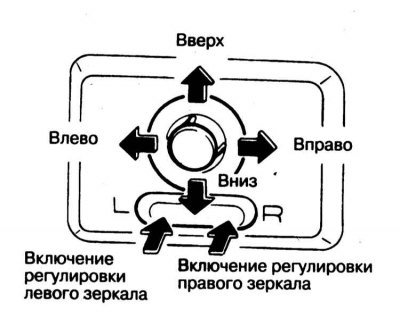
1. The control assembly for the electric drive of the outside rear-view mirrors is mounted in the vehicle's instrument panel, to the left of the steering column. The mirrors are adjusted using the slider and key switches on the panel as follows:
- a) Turn on the ignition (oN and ACC key positions);
- b) Move the slide switch lever to the left (L) or right (R) to select the mirror to be adjusted;
- c) Press the upper, lower, left or right sectors of the key switch to adjust the position of the selected mirror;
- d) After finishing adjusting both mirrors, move the slide switch lever to the middle position, in which the adjustment button does not work. This is necessary so that if the button is accidentally pressed, the adjustment of the outside mirrors is not disturbed.
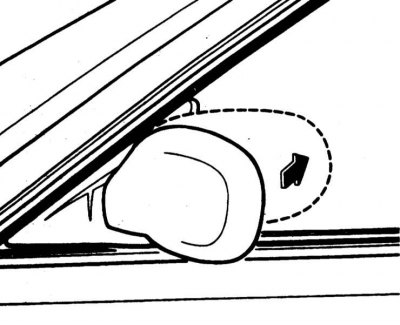
2. It is also possible to fold the mirrors into the parking position. To do this, press the mirror in the "back" direction.
Rear window/external rear view mirror heating switch
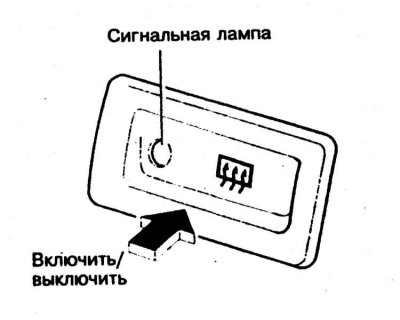
1. Turning on the electric heating allows you to remove condensation, frost, and even thin ice from the surfaces of the rear window/door rear-view mirrors. When the electric heating is turned on, the light indicator built into the switch button lights up. The heating is turned off by pressing the button again.
2. The thread-like mesh of the heater heating element is glued to the inner surface of the rear window and requires careful handling - try not to damage the mesh when wiping the glass. Wiping should be done only along the threads of the heater.
3. The operation of the heater is associated with an increased level of energy consumption, therefore, in order to avoid draining the battery, a timer is included in the control circuit of the device, which automatically switches off the system after 15 minutes of continuous operation.
4. Don't forget to check the quality of the view through the rear window of the car before starting to drive.
Electric drive of outside rear view mirrors
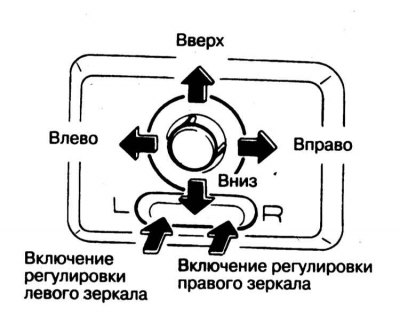
The control assembly for the electric drive of the outside rear-view mirrors is mounted in the vehicle's instrument panel, to the left of the steering column. The mirrors are adjusted using the slider and joystick switches on the panel as follows:
- a) Turn on the ignition (oN and ACC key positions);
- b) Move the slide switch lever to the left (L) or right (R) to select the mirror to be adjusted;
- c) Use the joystick switch to adjust the position of the selected mirror;
- d) After finishing the adjustment of both mirrors, move the slide switch lever to the middle position, in which the adjustment button does not work. This is necessary so that the adjustment is not disturbed if the button is accidentally pressed.
Electric window lifters
The electric window lifter operates only when the ignition is on. To lower/raise the glass, use the corresponding individual switch. It is possible to control the window lifters of all doors from the driver's seat. There is also a button that allows the driver to lock the regulators of all passenger doors. To disable the lock, press the lock button again. To lower/raise the glass, press the corresponding switch button and hold it in this position.
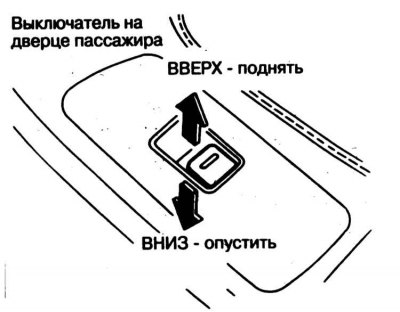
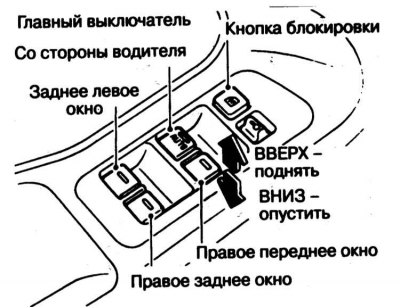
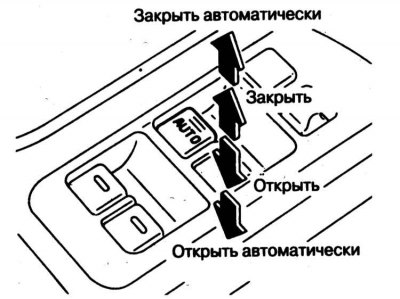
It is possible to automatically move the driver's door glass to one of the extreme positions (fully open or fully closed), it is enough to press briefly the AUTO button on the driver's door control panel. In order to pause the process of opening/closing the glass, press the button again.
Headlamp lens wiper/washer switch
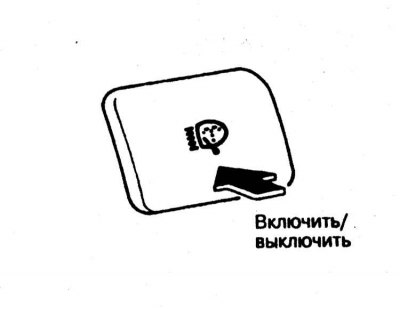
The push-button switch is mounted in the central section of the car's instrument panel trim between the cruise control switch and the anti-theft alarm control lamp. The system is activated only when the ignition is on. The fluid is supplied to the headlight lenses from the same reservoir as the windshield - check its level periodically.
Attention! Turning on the washers when the tank is empty may result in failure due to overheating of the submersible pump electric motor!
Tempostat Operation Management
Attention! Do not use cruise control when driving on busy roads, on serpentine roads, in hilly or mountainous areas, on slippery road surfaces or in strong winds.
1. The speed control system (tempostat) provides the ability to automatically maintain the vehicle's speed in the range from 48 to 160 km/h without using the gas pedal.
2. To turn on the cruise control, turn the main switch located on the vehicle's instrument panel to the left of the steering column to the ON position.
3. Accelerate the car to the required speed and press the SET/COAST button on the cruise control panel - the inscription CRUISE should light up on the display of the on-board processor.
4. Remove your foot from the accelerator pedal. The system will automatically maintain the selected cruising speed of the vehicle.
5. To overtake, press the gas pedal. Once the pedal is released, the car will return to the previously selected cruising speed.
6. When driving downhill or uphill, the cruise control does not maintain the vehicle's cruising speed and must be turned off.
7. Cancelling the selected cruising speed can be done in three different ways:
- a) Press the CANCEL button - the CRUISE inscription should go out;
- b) Lightly depress the foot brake pedal - CRUISE inscription
- c) Use the main cruise control switch - the CRUISE inscription and the indicator lamp built into the switch key should go out.
8. If the foot brake pedal was depressed while the ACCEL button on the control panel was pressed, the cruise control should be switched off using the main switch and reactivated after the required speed has been reached.
9. The cruise control switches off automatically when the vehicle speed drops to 13 km/h
10. The speed control system can also be switched off by depressing the clutch pedal (models with manual transmission) or moving the selector lever to the "N" position (models with AT).
11. Increasing the cruising speed of a vehicle can be done in three ways:
- a) Press the accelerator pedal, when the vehicle accelerates to the desired speed, press and release the SET/COAST button on the control panel;
- b) Press and hold the ACCEL button on the cruise control panel. Release the button when the vehicle has reached the desired speed;
- c) By briefly pressing the ACCEL button, you can accelerate the car in steps of 1.6 km/h.
12. To reduce cruising speed:
- a) Lightly depress the foot brake pedal. When the vehicle speed drops to the desired value, press the SET/COAST button;
- b) Press and hold the SET/COAST button until the vehicle slows down to the desired speed;
- c) By briefly pressing the SET/COAST button, you can gradually reduce the vehicle's cruising speed in increments of 1.6 km/h.
13. To return to the previously selected cruising speed, briefly press the RESET button. As soon as the car accelerates above 48 km/h, the cruise control will automatically bring it to the previously selected cruising speed, which it will then maintain.
Adjustable steering column locking lever
Note: See information regarding the correct and safe position of the steering column. 1. The position of the steering column on vehicles with the appropriate equipment can be adjusted at the driver's discretion. Adjustment is made before driving.
Warning! Adjusting the steering column position while driving may result in loss of control of the vehicle and may lead to serious traffic accidents!
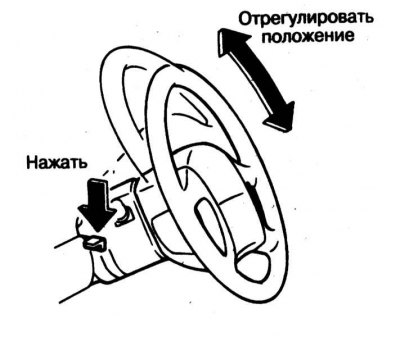
2. To adjust the height of the steering column, you must:
- a) Lower the steering column lock lever located on the left under the steering wheel until it stops;
- b) The steering wheel height is adjusted by moving it to the required position in the vertical plane. A properly adjusted steering wheel should not obstruct the view of the instrument panel;
- c) After completing the adjustment, lock the steering column by returning the lock lever completely to its original position;
- d) Check that the column is securely fixed by trying to move it up and down.
Parking brake lever
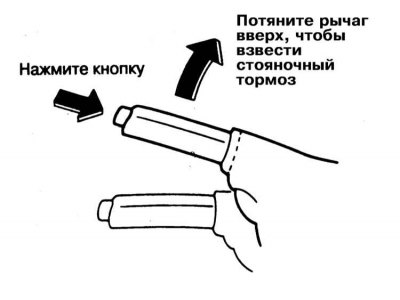
To set the parking brake, fully lift the lever located between the front seats. To release the parking brake, do the following: pull the lever up slightly, press the locking button located on the end of the handle, then lower the lever down. When releasing the parking brake, the corresponding indicator lamp mounted in the vehicle's instrument panel should go out (see above in this Section).
Warning! Driving with the parking brake engaged may result in failure of the brake mechanisms and rear wheel hub bearings!
Gear Shift/Selection Lever
Models with manual transmission
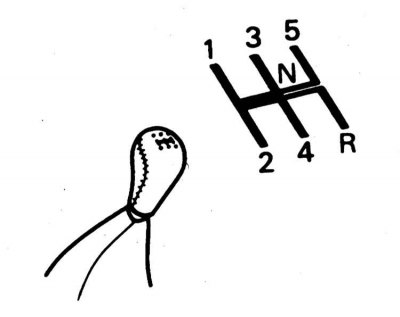
The manual transmission gear shift lever is located on the central console of the car. The gear shift diagram is printed on the top of its handle.
Models with AT
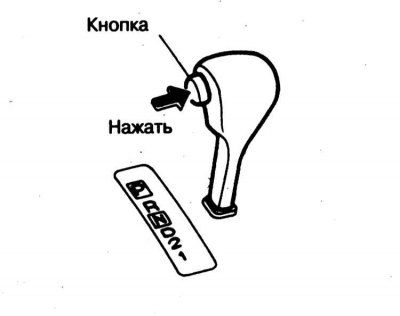
The AT gear selector lever is also located on the central console of the car. On the side of the lever handle there is a lock release button, which should be pressed when switching the transmission to the "P", "R", "2" and "1" positions.
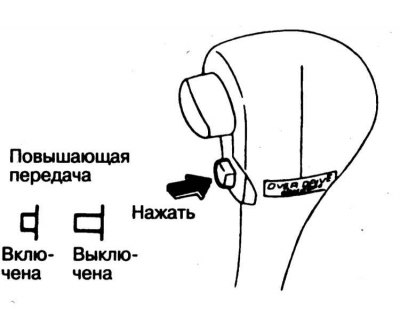
Below the lock release button is the overdrive switch (O/D). Pressing the "O/D" button disengages the overdrive (the "O/D OFF" indicator light comes on at the same time). To turn O/D on, press the button again.
Note: The overdrive only functions when the engine is warmed up to normal operating temperature. When the cruise control is on, the overdrive disengagement button is no longer functional.
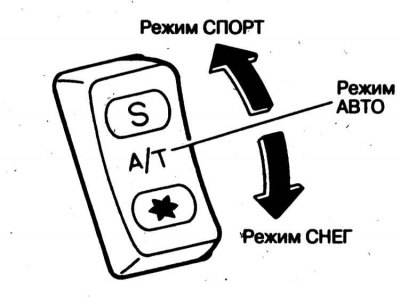
Models with automatic transmission have the ability to select transmission operating modes. The mode switching button is located on the central console of the car, to the left of the automatic transmission selector lever, and allows you to select one of the following three modes: AUTO, SNOW, and SPORT (for more details, see Section Exploitation techniques).
Seat adjustment
Front seats
Manual seats
1. In Section Elements of vehicle safety systems provides important information on safety issues and the correct adjustment of seats, their backs and headrests.
2. Adjust the seat position before starting to move.
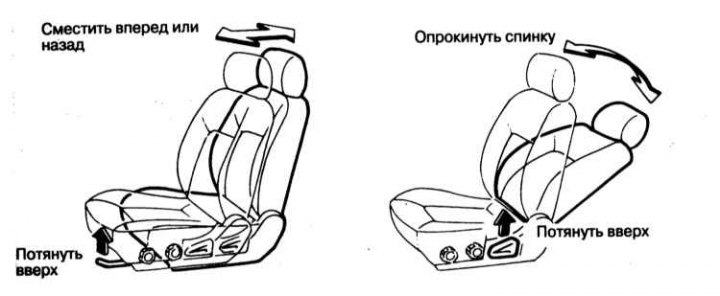
3. To adjust the seat position in the longitudinal direction, pull up the bracket located at the front under the seat cushion and, holding it in the raised position, move the seat assembly forward or backward to a comfortable position for you. Release the bracket, to check the reliability of the seat fixation, try to move it forward and backward.
4. To change the angle of the seat back, pull it forward, lift the lever located on the side of the seat cushion base on the door side, then, holding the lever in the raised position, adjust the angle of the back. The back will lock in the new position automatically after releasing the lever.
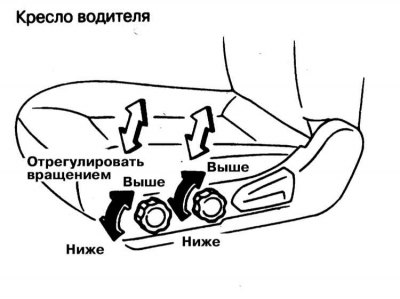
5. Some versions of the car provide the ability to adjust the height of the seat cushion. The adjustment is made using two handles located on the outside of the cushion.
Models with electric adjustment of the driver's seat
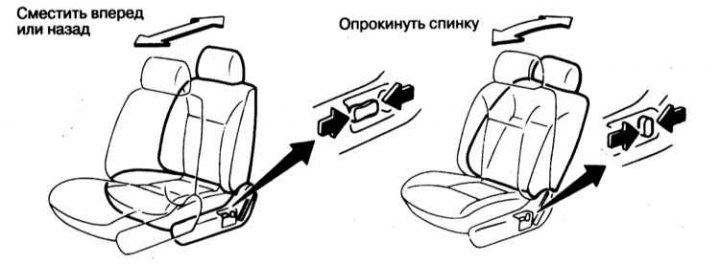
1. Some models are equipped with an electric drive for adjusting the driver's seat. The control panel for the electric drive with two switches is located on the left side surface of the seat cushion. The combined extended slide switch is used to adjust the seat position in the longitudinal and vertical directions. The smaller switch is used to adjust the backrest tilt.
2. The seat adjustment can be made in any position of the key in the ignition switch and must be done before starting to move.
3. To adjust the seat position in the longitudinal direction, move the extended slide switch on the electric drive control panel to the appropriate side.
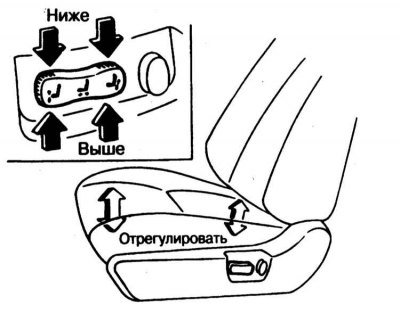
4. The height of the front and rear edges of the seat cushion is adjusted by pressing the front or rear ends of the slide switch (1) in the appropriate direction. The height of the cushion assembly is adjusted by moving the entire switch up or down.
5. The backrest tilt is adjusted using the smaller switch (2), located behind the first extended switch.
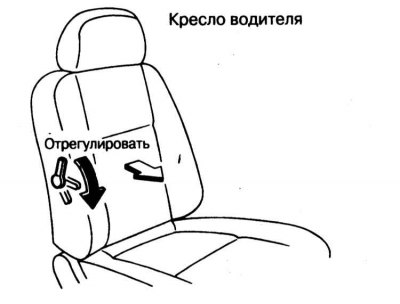
6. Adjusting the lumbar curvature of the backrest (with appropriate equipment) is carried out using a lever located on the assembly back of the seat.
Electric heated seats
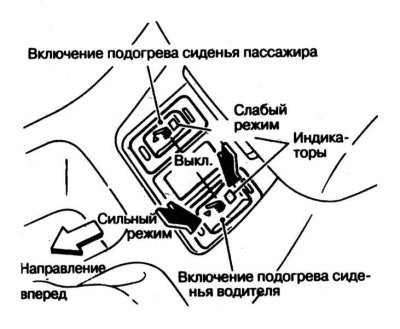
Some models have the option of heated front seats (see above).
Note: Do not turn on the heated seats when the engine is not running, and try not to use them for long periods of time when the engine is idling to avoid draining the battery.
Back seat
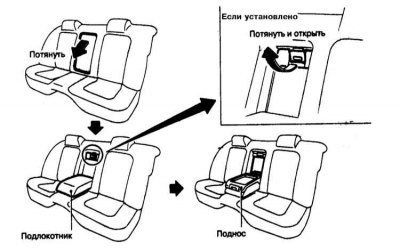
On some models, the rear seat is equipped with a central armrest. The armrest is located in the central part of the seat and is folded out by removing it from a niche in the backrest and lowering it to a horizontal position. After lowering the armrest, access to the car's luggage compartment is opened.
Headrests
Head restraints help prevent neck and head injuries in a rear-end collision. In order for head restraints to effectively perform their protective functions, they must be properly adjusted. Adjust the height of the head restraints so that the top of the head restraint cushion is level with the top of the ear. If tall passengers are unable to achieve this, the head restraint should be set to the highest position.
Some vehicle modifications have the ability to adjust the headrests in height and angle. The headrest position is adjusted with both hands at the same time, so do not try to adjust the headrest while the vehicle is moving. To raise the headrest, simply pull it up; to lower it, press it down; the angle of the headrest is changed by bending it to the appropriate position.
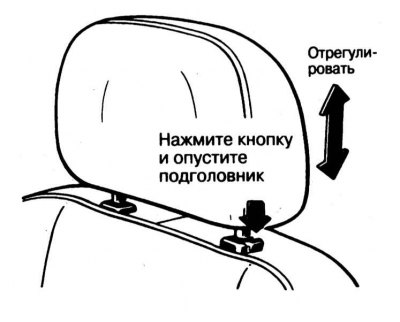
Some versions of the car provide for the presence of a push-button headrest lock. With this design, in order to raise the headrest, it is enough to simply pull it up, and lowering it can only be done after pressing the lock button.
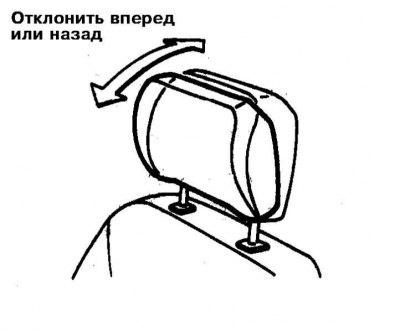
The headrest angle is adjusted manually.
Rear view mirrors
To ensure adequate visibility of the area behind the vehicle, the interior and exterior rear-view mirrors should be kept clean and checked for proper adjustment at all times. Before driving, make sure that the rear-view mirrors are adjusted properly.
Interior rear view mirror
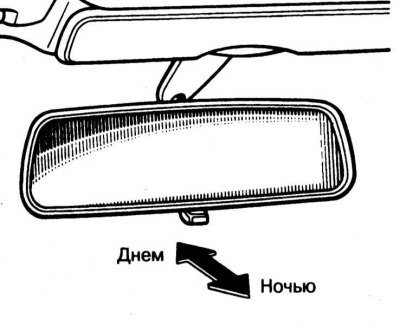
There are two standard positions of the interior rearview mirror: one is intended for driving in daylight hours, the other - in the dark. In the second position, the reflectivity of the mirror is reduced, which helps to reduce the blinding effect of the headlights of vehicles moving behind. The mirror is switched from daytime to nighttime and back using a special lever mounted in the assembly from below. By pressing the lever forward or backward, select the desired position of the mirror.
Exterior mirrors
The operating principle of the electric drive of the outside rear-view mirrors is described in the second subsection of this Section (see above).
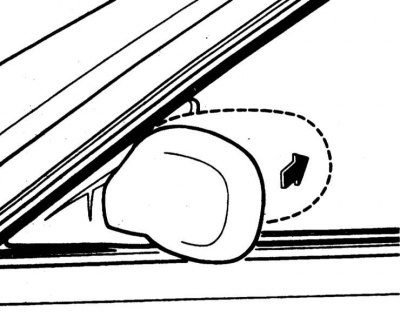
It is also possible to fold the mirrors into the parking position. To fold the rearview mirror into the parking position, simply press it against the car door glass.
Clock/thermometer
The clock is mounted in the upper part of the central section of the instrument panel and functions only when the ignition is on or in the ACC position of the key.
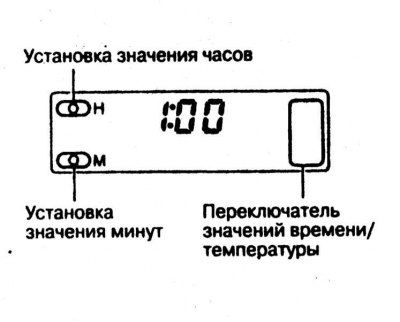
The hour display is set using the "H" button, and the minute display is set using the "M" button.
After the battery is disconnected, the clock is automatically reset and must be adjusted.
Note: When the instrument panel lighting is turned off, the brightness of the clock indicator is reduced.
The clock display is also used to display the readings of the outside air temperature meter; the display mode switch is located on the left side of the clock assembly.
On-board processor display
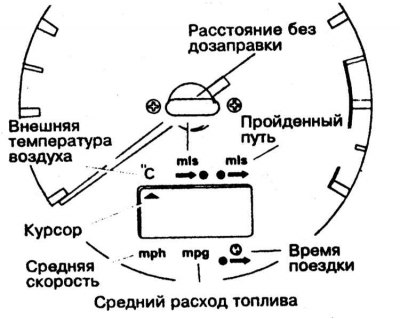
If the vehicle is equipped accordingly, the on-board processor display is built into the tachometer dial. When the ignition is on, one of the possible display modes can be selected. The selected mode is indicated by a special cursor in the form of a triangle. The display can be used to display the time, outside air temperature, distance that can be traveled without refueling, length of the path traveled, travel time, average speed and average fuel consumption.
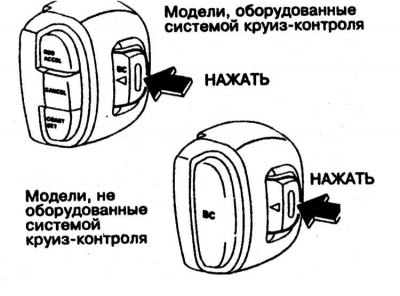
Switching between display modes is done using a special button.
The air temperature is measured in degrees Celsius. When the temperature drops below 3°C, the display automatically switches to thermometer mode, and its readings start flashing, attracting the driver's attention. By pressing the mode switch, the display returns to the original mode. At temperatures below 4°C, the thermometer cursor continues to flash continuously.
When the distance display mode is turned on, the display changes every 30 seconds. There is a function for automatically switching the display when the critical minimum fuel reserve is reached. The display readings also blink, attracting the driver's attention. The cursor will continue to blink until the car is refueled. If the fuel level decreases further, the display readings are reset to zero and the value "----" is displayed on the display.
When the distance display mode is turned on, the display can be reset by holding the switch for 1 second. At the same time, the trip time display will be reset (see below).
To reset the travel time, hold the switch button down for at least 1 second. The distance traveled is reset at the same time.
In the average fuel consumption mode, the display changes every 30 seconds. To reset the display, hold the switch button down for 10 seconds. During the first 500 meters of driving after resetting the display, the display will show "----".
In the average speed mode, the display will also change every 30 seconds. The display is reset by holding the switch button for a second. During the first 30 seconds after resetting the display, the value "----" will be displayed. Resetting the average speed value also resets the average fuel consumption value.
Business card holder and cup holder
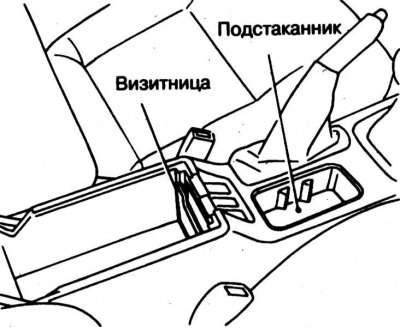
The business card holder and cup holder are built into the center console assembly behind the parking brake control lever.
When using the holder, be careful not to burn yourself or other passengers with hot drinks. Keep in mind that many drinks can spoil the appearance of floor mats, seat upholstery and interior door panels. Liquid splashes on electrical contacts can cause damage to the electrical equipment in the passenger compartment.
Center console storage compartment
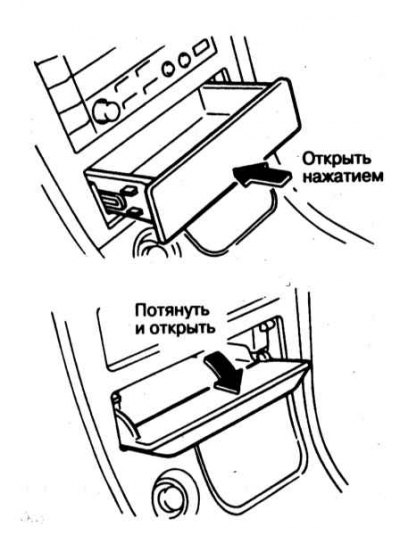
In the front part of the central console, under the audio system assembly, a small storage box is mounted, designed for storing small items. There are two designs of the small storage box - sliding and folding.
Cigarette lighter and ashtrays
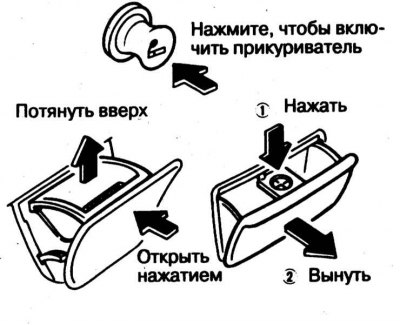
The cigarette lighter functions only in two positions of the key in the ignition switch: "ACC" or "ON", when the ignition or power supply of auxiliary power consumers is on. To turn on the cigarette lighter, press its button until it clicks. After the coil is heated, the button will automatically return to its original position with a click.
Attention! To avoid damage to the cigarette lighter, do not hold its button while the coil is heating!
The front ashtray is integrated into a single assembly with the cigarette lighter, the rear one is located under the central armrest assembly.
Sun visors
Two folding sun visors are located above the upper edge of the windshield and serve to protect the eyes of the driver and front passenger from direct sunlight. If the rays fall from the front, the visor should simply be lowered by turning it downwards on the axial hinges. To protect against light falling from the side, the visor should be released from the inner hinge and turned towards the door. If necessary, the visor can be extended by pulling out an additional shield.
Attention! Pulling out the additional shield in the first position of the visor may result in the rear-view mirror being covered!
Toilet mirror
The vanity mirror is installed in the sun visor and protected by a cover.
Interior lighting devices
Main salon light
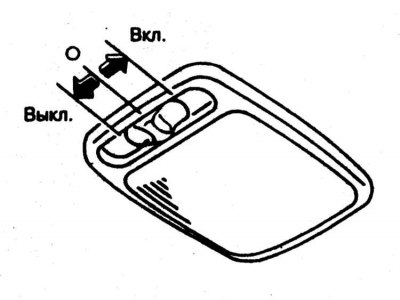
1. The front (main) interior light switch has three fixed positions. In position "0" the interior lighting is switched on when any of the interior doors is opened.
2. The built-in timer ensures that the lighting turns on automatically for 30 seconds in the following cases:
- a) When the driver's door is not locked with the ignition key removed;
- b) When the key is removed from the ignition switch with the driver's door closed;
- c) When the driver's door is opened and then closed again with the key removed.
3. Automatic switching off of the lighting by timer is carried out when the driver's door is locked and when the ignition key is turned to the ON position.
Local lighting fixtures
 |
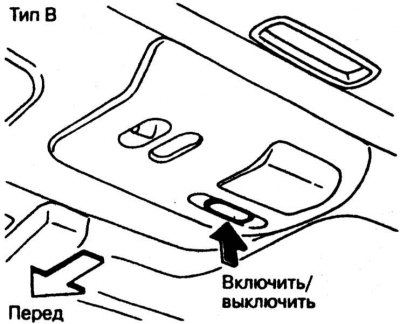 |
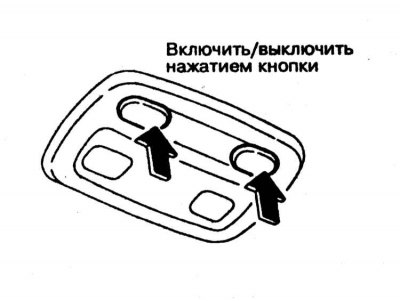
The car's ceiling console also has two directional individual lights. The switches for the individual lights are located next to the lampshades of the corresponding lamps (left and right). To turn on the lamp, press the button of the corresponding switch. To turn off the lighting, press the same button again. Individual lamps function in any position of the key in the ignition switch.
Ignition switch illumination
Some models are equipped with ignition switch illumination. The illumination turns on when the driver's door is opened and remains on for a few seconds after it is closed.
Power take-off socket
The power take-off socket is designed to supply power to auxiliary electrical devices. The key must be turned to the ON or ACC position.
Attention! The voltage of the on-board power source is 12 volts, do not connect consumers with parameters over 12 V/120 W to the power take-off socket. When not in use, the socket should be covered with a special cover.