


Table of contents: General information ↓ Seat belts ↓ Rules for using a three-anchor…↓ Rules for using the two-anchor rear…↓ Driver and passenger airbags ↓ Position of seats and their backs ↓ Rules for the use of passive safety…↓
General information
The vehicles covered by this Manual are equipped with a range of safety features designed to protect the driver and passengers in the event of a road accident. These include seat belts installed on all vehicle seats and other devices that effectively supplement the belts.
Some components of the safety system, being an integral part of the vehicle design, do not require additional attention from the vehicle owner. These include a strong steel frame that forms the structure of the cabin, inside which the passenger compartment is located; front and rear crumple zones that absorb impact energy during a collision; trauma-safe, impact-folding steering column; as well as automatic seat belt tensioners (additional equipment), which automatically tighten the belts in the event of an impact.
Seat belts
General information
When worn and properly adjusted, seat belts help protect the driver and passengers from possible injury in the event of an accident or significantly reduce the severity of an accident. Nissan strongly recommends that drivers and passengers always fasten their seat belts before driving, even if the occupant is equipped with an air bag. In some countries and regions, wearing seat belts while driving is mandatory.
Seat belts are designed to distribute the load evenly across the body. The lumbar section of the belt should cover the upper thighs of the occupant, and the shoulder section should go across the chest and shoulder. Incorrectly fastened belts significantly increase the risk of serious injuries in road accidents.
Under no circumstances should the seat belts be modified or altered, as this may interfere with the operation of the belt slack adjustment mechanism.
To ensure the effectiveness of their protective function, seat belts should be adjusted for comfort, but as tightly as possible. A loose belt significantly reduces the effectiveness of the occupant's protection.
It is necessary to avoid contact of the belt web with polishing agents, oil, chemicals and especially battery acid. Belts can be cleaned with a mild soap solution. In case of wear, heavy contamination or damage to the web, the belts should be replaced.
It is strongly recommended that the entire set of seat belts be replaced if they have been subjected to a severe impact in a traffic accident, even if the belts are not visibly damaged.
Make sure that the seat belts are not twisted.
The seat belts for one seat must be used by one person only. A child seated on a passenger's lap must not be belted.
The use of seat belts while driving is strictly mandatory for both the driver and all passengers. When transporting infants and small children, use special child seats.
Following a collision, even if the force of the impact was minor, all seat belt assemblies, including the reel and the mounting structure, should be inspected by a Nissan service center. Nissan recommends replacing all seat belt assemblies that were subjected to impact loads in a collision unless the collision was relatively minor, there are no signs of damage, and the belts continue to function properly. Seat belt assemblies that were installed in the vehicle but were not in use at the time of the collision should also be inspected and replaced if damaged or faulty.
Once triggered, the belt tensioner cannot be reused. It must be replaced together with the inertia drum - contact an authorized service station.
The car is equipped with five seats and five sets of seat belts - two in the front seats and three in the back seats. All people in the car must wear seat belts while driving.
The shoulder section of the belt should go over the shoulder and chest. It should not go under the arm. Incorrectly fastened belts significantly increase the risk of serious injury in road accidents.
Never pass the lumbar section of the belt over your waist!
Older children should use standard seat belts. According to accident statistics, children are safer in the back seat than in the front. If the shoulder belt is too close to the child's face or neck, it is recommended to use a special booster seat, which can be purchased separately. It is designed to raise the child so that the shoulder belt lies exactly in the middle of the shoulder, and the lap belt - on the hips. The booster seat must be compatible with the installed seat. If after a while it turns out that the shoulder belt is no longer close to the child's face and neck when he or she is sitting in the main seat, then the booster seat should not be used. Do not allow children to stand or kneel, or to sit in the cargo area while the car is moving.
Pregnant women should also use seat belts. You can get special recommendations from your doctor. The lap belt should be fastened so that it does not interfere and is as low on the hips as possible.
When transporting injured passengers, the seat belt should be positioned according to the nature of the injury. Consult your physician.
Seat belt maintenance
To clean the webbing, use a brush and mild soap or any solution recommended for cleaning upholstery and carpets. After cleaning, wipe the webbing with a cloth and let it dry in the shade. Do not allow the webbing to be wound until it is completely dry.
Periodically inspect the webbing of the belts and metal parts: buckle, tongue, inertia reel, flexible wiring and fastening bolts. If abrasions, deformations, cuts and other damage to the webbing are detected, the entire set of belts must be replaced.
Rules for using a three-anchor inertia-type seat belt
(Data posted on the website: NISSANBOOK.RU)
Fastening
1. Adjust the seat position. The seat back should not be reclined more than is necessary to ensure the occupant's comfort. Seat belts work most effectively when the occupant's back is upright and pressed firmly against the seat back. Avoid reclining the seat back excessively, as this creates the risk of the occupant slipping under the lumbar section of the belt in the event of an accident.
2. Slowly pull the belt out of the return mechanism casing, throw its sections over the pelvic and thoracic sections of the body and snap the bracket tongue into the buckle lock. The design of the return device stops the inertial drum during overloads that occur during sudden braking or a collision. At the same time, when slowly pulled out, the drum rotates without interference and the belt does not restrict the freedom of movement of the occupant.
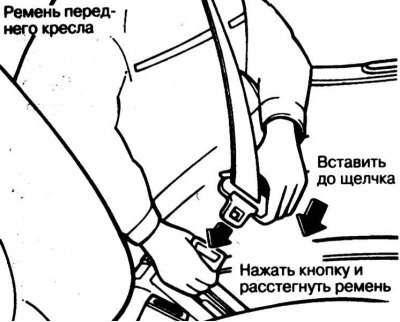
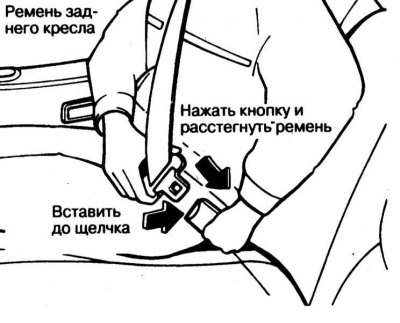
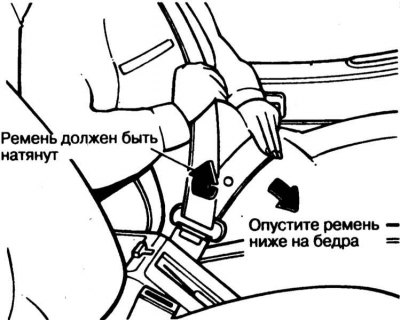
3. Place the waist section of the belt down on your hips, pulling the shoulder section up, allowing the return mechanism to take up the slack in the belt. Make sure the shoulder section goes over your shoulder, not across your neck. Remember that the belt should not be twisted.
Undoing
To unfasten the belt, press the button on the buckle. After releasing the lock, the belt automatically rewinds onto the retractor drum.
Checking the proper functioning and adjusting the seat belts
1. The design of the return device ensures that the belt is locked in two cases:
- a) When the belt is quickly unwound from the drum;
- b) When the vehicle brakes suddenly.
2. Grasp the shoulder section of the belt and pull sharply - the return device should lock, otherwise you should contact a service station.
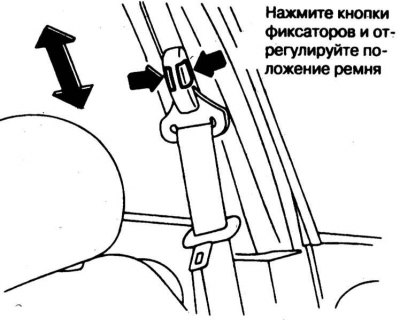
3. To adjust the position of the upper anchor of the shoulder section of the seat belt, press the locking button and remove the anchor unit along the guide in the desired direction (up or down). Remember that the belt should go over the shoulder.
Rules for using the two-anchor rear seat belt
Fastening
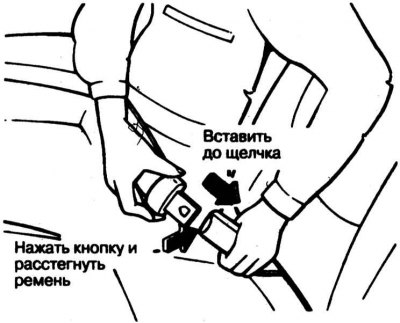
1. The center rear seat belt has a two-anchor design. Snap the tongue of the bracket into the buckle lock marked "CENTRE".
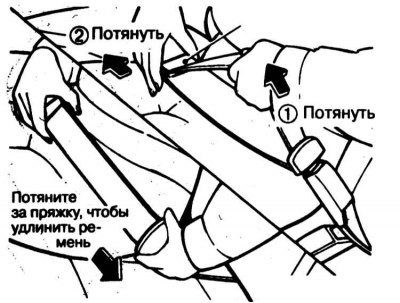
2. To lengthen the belt, pull it out, holding the bracket at a right angle to the belt webbing. To shorten the belt, pull the free end of the belt away from the bracket and move the clamp to take up slack. Move the belt down over your hips.
Unfastening the belt
1. To release the belt lock, press the button on the buckle.
2. To avoid getting caught in the doors, fasten the belt even when not in use.
3. When fastening the belt, be careful - the buckle of the two-anchor belt is marked with the inscription "CENTRE", the tongue of the bracket fits only this buckle.
Supplemental Restraint System (SRS)
The devices and components that make up the supplemental safety system (SRS) include:
- a) Two front airbags. The driver's airbag module is housed in the steering wheel hub. The front passenger airbag is housed in a special cavity on the right side of the vehicle's instrument panel. The locations of both airbags are marked with warning signs "SRS/AIRBAG";
- b) Directional overload sensors that are triggered in the event of a severe frontal/side impact;
- c) Electronic self-diagnosis system, which, when the ignition is on, provides continuous testing of the overload sensors, control unit, airbag gas generators and connecting electrical wiring of the corresponding circuits;
- d) Automatic emergency tensioners for front seat belts (see above);
- e) SRS malfunction indicator lamp, mounted in the instrument panel;
- f) A spare, independent power source designed to duplicate the main power supply system in the event of its failure in a collision.
Driver and passenger airbags
General information
1. Some models come standard with the SRS Additional Safety system, better known as airbags, designed to protect the driver and front passenger from hitting their head or chest against the steering wheel/instrument panel in the event of a severe frontal impact.
2. Additional equipment may also include side airbags to provide protection for the driver and front passenger in the event of a side impact.
3. The owner of a vehicle equipped with the SRS system is obliged to know the most important information about the design and operating principle of the system elements:
- a) The presence of airbags can in no way justify a disregard for the use of seat belts. SRS should only be used in conjunction with seat belts and other passive safety equipment;
- b) The front airbags do not provide protection in the event of a side impact, or in a rear impact. In addition, the modules are activated only in case of high-intensity directional impacts, i.e. the system does not provide protection in case of weak frontal collisions;
- c) Side airbags do not provide protection in the event of a frontal or rear impact, and they also only deploy when the energy of a side impact exceeds a certain threshold of intensity, which is not always the case when the vehicle rolls over;
- d) Airbag deployment may cause injury.
4. In order to effectively perform its protective function, the airbag must deploy from the folded state to the working state in a very short time. Therefore, the airbag, while protecting the driver/front passenger from serious injuries, in some cases saving their lives, can cause injury, and sometimes serious injuries up to and including death, if the driver or front passenger were not properly fastened with seat belts or occupied an abnormal position in the seats.
5. To reduce the risk of injury from an airbag, always wear your seat belt and sit as far away from the steering wheel/instrument panel as possible.
Operating principle of front airbags
Directional overload sensors react to the excess of a certain limit value, which can be reached by overload during a strong frontal collision. At the signal of the sensors, the control unit switches on the gas generators of the airbags, causing their immediate filling.
Warning! There is also a possibility that the front airbags may be triggered if you hit a curb at high speed, drive into a deep pothole, or drive off/fall off a ledge.
During a collision, the seat belt keeps the lower part of the occupant's body from moving. Front airbags help prevent injury to the driver and front passenger when their heads and chests hit the steering wheel/dashboard.
Since the signals for both airbags to operate come from the same sensors, they are initiated simultaneously. However, it is possible that only one of the airbags will be activated. This becomes possible when the magnitude of the directional overloads that arose during the collision was on the edge of the gas generators' operating range. In this case, the seat belts provide sufficiently reliable protection for the driver and front passenger, while the effect of the airbag's operation will be minimal.
Immediately after the airbags are triggered and perform their functions, the gas is released from them, which allows the driver to maintain visibility and freely manipulate all vehicle controls.
The entire duration of the process from the moment the overload sensors send a signal to the release of gas from the airbags takes a fraction of a second. The airbags are triggered so quickly that the human ear is simply unable to perceive the pop of the gas generators.
After a traffic accident in which the safety modules were triggered, the volume of the car's interior looks slightly smoky. In fact, this is a suspension of fine powder, which is usually sprinkled on the folded airbag shells. People with respiratory diseases may experience some discomfort from the products contained in the air, emitted by the airbag gas generators.
Side airbags
On some models, driver and front passenger side airbags may be installed as an additional configuration. The airbag modules are mounted in the outer ends of the front seat backs. The locations of both side airbags are marked with inscriptions "SIDE AIRBAG". The SRS warning lamp on the vehicle's instrument panel also comes on when faults are detected in the side airbag initiation circuits.
In the event of a severe side impact, the directional overload sensors record the excess of a certain threshold value by the loads that arise and send an information signal to the control unit, which generates a command to trigger the gas generator of the corresponding side airbag. In this case, if the impact occurs from the passenger seat, the passenger side airbag will trigger even if there is no passenger.
To ensure that the airbags provide the most effective protection, the driver and passenger sitting in the front seat must be in an upright position and be wearing seat belts.
Automatic emergency seat belt tensioners
On some models, to provide additional driver/passenger protection, the front seat belts are equipped with devices that, when activated, automatically tighten the belts, which helps to eliminate the possibility of dangerous movement of the driver and passenger in the event of a traffic accident.
The automatic emergency tensioners are triggered by directional overloads that occur during a severe frontal collision. At the same time, the front airbags are ejected.
When the device is triggered, the seat belt remains in a tensioned position until the buckle clip is removed from the lock last.
The Supplemental Restraint System (SRS) indicator light illuminates to alert the driver to potential problems with the automatic seat belt tensioners.
SRS Malfunction Indicator Lamp Operation Procedure
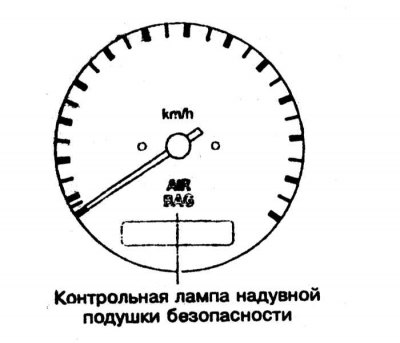
1. The SRS indicator lamp is mounted in the dashboard of the vehicle and is designed to warn the driver of failures in the additional safety system detected by the self-diagnosis system. On some vehicle modifications, the indicator lamp's activation indicates possible malfunctions in the side airbag units or automatic emergency seat belt tensioners. 2. When the ignition is turned on (the key is turned to the "ON" position), the indicator lamp lights up briefly and then immediately goes out, which confirms that all system components are functioning properly.
3. If the warning light comes on at any other time, the vehicle owner should contact a Nissan service station for assistance as soon as possible. Such situations include the following:
- a) The indicator lamp does not come on when the ignition key is turned to the (ON) position;
- b) The indicator lamp remains on after the engine has been started;
- c) The indicator lamp switches on and lights up in a constant or flashing mode while the vehicle is moving.
If the above symptoms are present, the additional safety system may fail in an emergency situation. Warning: Disregarding the SRS warning light signals may lead to the most serious consequences if the airbags fail during a traffic accident.
Maintenance of SRS components
- Airbags and automatic emergency seat belt tensioners require virtually no regular inspection or maintenance. However, the owner of a suitably equipped vehicle should keep the following points in mind:
- a) After the airbags have been deployed, they must be replaced together with the system control unit. Do not attempt to dismantle the airbags on your own. These operations must be performed only in a car service workshop;
- b) If the SRS warning light comes on and indicates that there is a fault in the system, you should immediately contact your nearest Nissan service station for a complete diagnosis and any necessary repairs to the system. Otherwise, the air bags may not deploy in an accident and may not perform their protective function;
- c) Only trained personnel are allowed to work on the additional restraint system components. It is prohibited to remove the airbags and emergency seat belt tensioners from the vehicle on your own. In the event of SRS failure or after the airbags and seat belt tensioners have deployed, contact a Nissan service station to repair or replace the system components;
- d) Do not open modules or modify the wiring of the airbag systems and automatic emergency seat belt tensioners - such intervention may lead to inadvertent deployment of the airbags and tensioners and cause injury to the operator or nearby people;
- e) Do not replace the front seats without first consulting a Nissan service station. Careless or incorrect replacement or removal of covers may result in the failure of the side airbags to operate in the event of a traffic accident.
Position of seats and their backs
The design of the car seats guarantees maximum comfort for the person sitting in them, while simultaneously providing conditions for the most effective performance of their functions by the seat belts and airbags. Soft padding of the cushions and backrests provides additional protection for the occupant in emergency situations.
The position of the seat also affects the safety of the occupant. For example, if the seat is too close to the steering wheel/dashboard, the risk of injury from airbag deployment increases, as does the risk of the occupant being thrown through the windshield.
Increasing the angle of the seat back will worsen the body's fixation with the seat belt - the more the seat back is tilted back, the greater the likelihood of the body sliding under the lap section of the seat belt in a severe frontal impact, and the more severe the injuries may be.
Fix the position of the front seat in the position farthest from the steering wheel/instrument panel, bring the backrest to the vertical position.
Headrests
Head restraints prevent injury to the cervical spine and head in the event of a rear impact. The head restraint should be adjusted in height so that its upper edge is level with the upper edge of the occupant's ear.
Rules for the use of passive safety equipment for drivers and passengers
General information
The following instructions will provide the reader with ways to ensure maximum protection for all vehicle occupants.
Doors
After the driver and all passengers have taken their seats in the vehicle, make sure that all vehicle doors are tightly closed.
The car is equipped with a special control lamp that lights up when one or more car doors are not closed tightly.
Front seats
A driver who sits too close to the instrument panel is at increased risk of injury, including serious injury or death, from being struck by the steering wheel or from an airbag deployment in the event of an accident.
To avoid the risk of injury, fasten your seat belt properly, adjust the seatback to an upright position and press your back firmly against it, while moving the seat as far away from the steering wheel as possible. Of course, the driver must ensure a good view and the ability to comfortably operate all vehicle controls. Make sure that the front passenger seat is also as far away from the instrument panel as possible. Warning: If the driver and front passenger seats are too close to the steering wheel/instrument panel in the event of an accident, serious injury or even death may occur.
Always try to position the front seats as far away from the airbag modules as possible.
The vast majority of drivers (even of short stature) can move the driver's seat as far away from the steering wheel as possible, while still being able to reach the pedals freely. However, if you are concerned about the driver's seat being too close to the steering wheel, the authors of this Guide recommend that you pay attention to certain types of auxiliary equipment - Nissan service stations always provide comprehensive information on this issue.
Adjust the steering wheel height. Once you have verified that the seat is in the correct position, check that it is securely locked. For instructions on adjusting the front seats, see Section 3.
Adjust the angle of the driver's seat back to the most comfortable position for your body type, as close to vertical as possible, while leaving sufficient space between your chest and the steering wheel hub, in which the airbag is mounted. Remember that excessively close positioning of the driver/front passenger to the instrument panel significantly increases the risk of injury when the airbags deploy.
If the seat back is tilted too far back, the shoulder section of the belt will not be pressed against the chest, which significantly reduces the effectiveness of the belt's protective functions. The more the seat back is tilted back, the greater the likelihood of the occupant's body sliding under the lumbar section in the event of a severe frontal impact, and the more severe the injuries may be.
Headrests
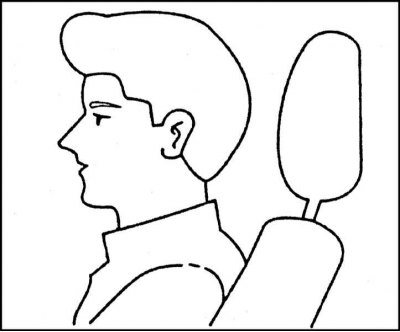
Before driving, make sure that the position of the head restraints on each seat meets the necessary requirements, ensuring proper protection of the cervical spine and head of the occupant in a rear impact. The head restraint should be adjusted in height so that its central part is level with the back of the head. If this cannot be achieved, the head restraint should be set to the highest position.
Warning! Incorrect positioning of head restraints reduces the effectiveness of their protective functions and increases the risk of serious injury in a traffic accident.
Steering column
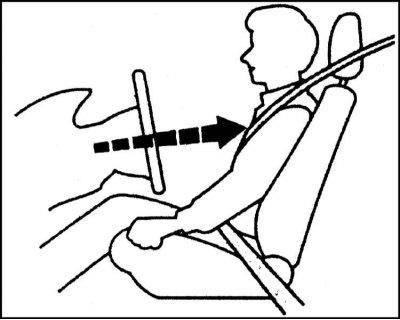
The steering column should be adjusted so that the steering wheel is opposite the driver's chest. A position in which the steering wheel hub is opposite the driver's face is incorrect, since it reduces the protective functions of the front airbag built into it.
Landing on the seat
After the driver and all passengers have taken their seats in the car, adjusted their seats and put on their seat belts, they must position their bodies correctly, with their backs pressed firmly against the seat back and their feet firmly on the floor of the car. Their feet should not come off the floor until the car has come to a complete stop and the engine has been turned off.
Failure to sit correctly while driving increases the risk of injury in a traffic accident. For example, if passengers sit hunched over, lie down, turn to the sides, lean forward or to the side, climb onto the seat with their feet, the risk of them getting seriously injured in an accident increases significantly.
In addition, front passengers who are not seated properly may be seriously injured by interior trim breaking during a crash or by the deployment of the front airbag.
If the front passenger's head is tilted sideways while driving in a vehicle equipped with side airbags and is within the range of the airbag actuation, the risk of serious injuries and injuries is extremely high.
Try to maintain proper seating position throughout the entire journey, keeping your back pressed firmly against the seatback and your feet flat on the floor. Remember that sitting upright and using seat belts correctly will improve the effectiveness of all safety features in your vehicle.
Risk of Carbon Monoxide (CO) Poisoning
The composition of engine exhaust gases includes highly toxic carbon monoxide (CO). If the exhaust system is in good working order and the vehicle is operated correctly, engine exhaust gases should not enter the vehicle interior. Try to check the technical condition of the exhaust system and the tightness of its pipeline connections in the following cases:
- a) When changing the engine oil, when the car is installed on a lift;
- b) If there is a noticeable change in the nature of the noise emitted by the exhaust system;
- c) After an accident in which parts located under the vehicle may have been damaged.
Warning! Carbon monoxide is a toxic gas. Inhaling CO causes unconsciousness and can be fatal. Avoid being in a closed, unventilated room or doing work that forces you to breathe air containing high concentrations of carbon monoxide! In closed rooms with poor ventilation, such as a garage, the concentration of CO can quickly increase to a dangerous level. Therefore, it is prohibited to leave the engine running with the garage door closed (even with the gate open, do not leave the engine running for a long time). Immediately after starting the engine, you should leave the garage and continue warming up the unit outside.
When driving with the trunk lid open, engine exhaust gases may enter the vehicle interior and create a dangerous situation. If closing the lid for any reason is not possible, you should fully open all windows and turn on the ventilation and air conditioning system
When inside a vehicle with the engine idling (even in an open area), make the following inclusions:
- a) Switch the interior ventilation system to fresh air intake mode;
- b) Turn on the heater fan to maximum speed;
- c) Use the regulator to set a comfortable air temperature level.