


Table of contents: Carefully! (front passenger airbag) ↓ Carefully! (for vehicles equipped…↓ Carefully! (for vehicles equipped…↓ The device of inflatable airbags ↓
The Supplemental Restraint System section contains important information about the driver and front passenger airbags, side airbags, and seat belts.
Driver and front passenger airbags:
- They are designed to reduce the force of impact on the driver and front passenger in the event of a frontal collision in a traffic accident.
Side airbags:
- They are designed to reduce the force of impact on the driver and front passenger in the event of a side impact in a traffic accident.
- Air bags supplement seat belts, not replace them. It is absolutely necessary to wear seat belts correctly and at all times while driving. The driver and front passenger should be kept at a certain distance from the steering wheel and dashboard (safety precautions and rules for using seat belts are described in the section ("Seat belts").
- When the ignition key is turned to the ON position, the airbag indicator light comes on and goes out after 7 seconds if the system is operating normally.
Carefully! (front passenger airbag)
The airbag will not normally inflate in a side impact, rear impact, rollover or moderate frontal collision. Therefore, to reduce the risk and severity of injury in all types of accidents, not just severe frontal collisions, you should always wear seat belts.
Seat belts and airbags work most effectively when the occupant's back is straight and firmly against the seatback. Airbags deploy with a certain amount of force, so there is a risk of injury when an airbag deploys if you are sitting close to the airbag module or leaning forward in an unnatural position.
Carefully! (for vehicles equipped with a front passenger airbag)
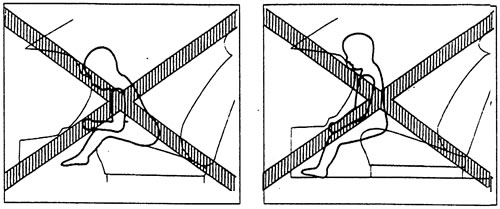
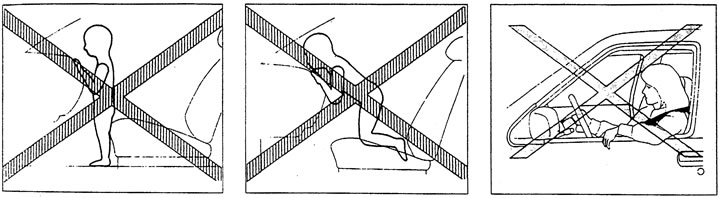
It is not permitted to transport children in the front seat as shown in the illustrations.
Children can be seriously injured if the airbag deploys unless they are wearing seat belts or are in child safety seats.
Do not install child safety seats in the front seat with their backs to the airbag module.
Carefully! (for vehicles equipped with side airbags)
Side airbags generally do not operate in the event of a frontal impact or rear impact, as well as in the event of a weak side impact. Always wear seat belts to reduce the risk of injury in a road accident.
Seat belts and air bags work most effectively when the occupant's back is straight and tightly pressed against the seat back. Air bags deploy with sufficient force, so do not place your arms, head, or other body parts near the side air bag module or the back of the front seat. Do not sit in the front seat with your arms or other body parts hanging out the window.
Do not sit in the back seat with your arms wrapped around the back of the front seat. Otherwise, the passenger may be injured when the side airbag deploys. Pay special attention to children, who must be properly protected.
Do not use front seat covers. They may prevent the side airbags from deploying.
The device of inflatable airbags
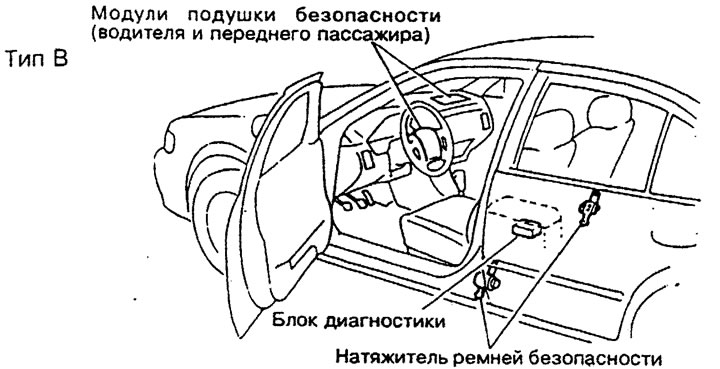
The vehicle may be equipped with airbags as follows: (see pictures):
Type A
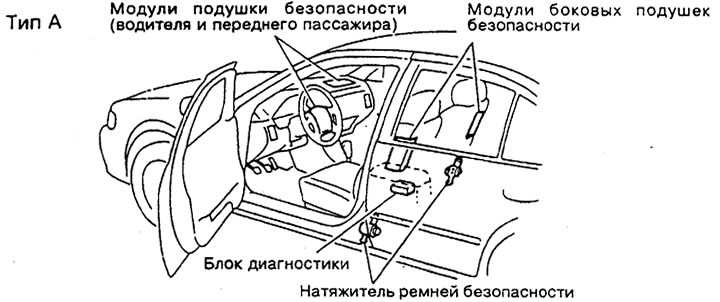
The car is equipped with driver, front passenger and side airbags.
Type B
Read more on the website: Nissanbook.ru
The car is equipped with driver and front passenger airbags.
Type C
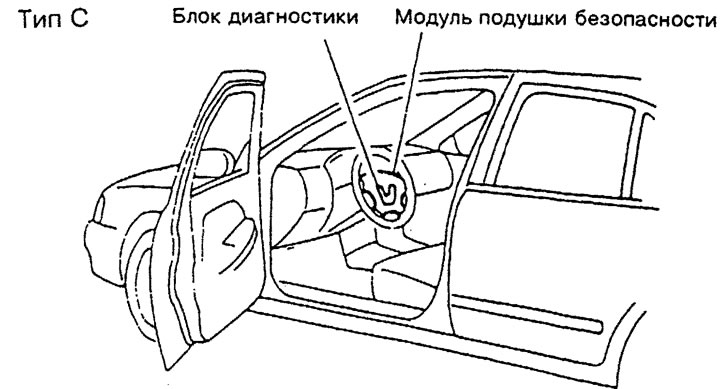
The car is equipped with a driver's airbag.
Driver and front passenger airbags (type B and C):
- The driver's airbag is located in the center of the steering wheel. The front passenger airbag is located in the upper part of the dashboard above the glove compartment. The airbags will deploy in both a severe frontal collision and in other types of collisions if the force of the impact is comparable to that of a severe frontal collision. The airbags may not deploy if the force of the impact is not sufficient to deploy the airbags.
Side airbags (type A):
- Side airbags are located on the outer side of the front seats. The airbags are designed to deploy in the event of a severe side impact, but they can also be deployed in other types of impacts that are comparable in force to the force required to deploy the airbag.
- During the airbag deployment process (both front and side) a popping sound is heard, followed by a burst of smoke. This smoke is harmless and does not indicate a fire, but it should not be inhaled, as it can cause irritation and spasms of the throat. After the airbags have deployed, it is necessary to ensure an influx of fresh air.
- Airbags, working in conjunction with seat belts, significantly soften the impact on the face and chest of front seat occupants, preventing serious injuries in a collision. Airbags do not protect the lower body.
- When driving, it is necessary to use seat belts, and the driver and front passenger must sit at a certain distance from the corresponding airbag modules, since due to the fact that the airbags operate quite quickly, there is a risk of injury. The airbags quickly deflate after deployment.
CAREFULLY!
- Some parts of the inflatable pillow device become very hot immediately after inflation. To avoid burns, do not touch them.
- It is not permitted to make any changes to the device or electrical wiring of the inflatable cushion. This may lead to accidental deployment of the cushion or its failure.
- Decorative finishing of areas adjacent to airbag modules, such as fabric covering of the zero wheel or the front panel, is not permitted. This may result in serious injury in the event of an accident.
- Do not attach or place any objects on the steering wheel or dashboard. Such objects may cause injury when the airbag inflates.
- Only a Nissan dealer may perform any work near or on the airbag module, including the installation of any electrical equipment. Do not modify or disconnect the yellow SRS wiring or use any testing or inspection equipment on the airbag module that has not been certified or tested.