


Table of contents: Airbags ↓ Airbag malfunction indicator light ↓ Repair and replacement of system…↓ Front passenger front airbag off…↓ Disabling the front passenger airbag ↓ Activation of the front passenger…↓
Front airbags
These airbags are designed to soften the impact to the face and chest of the driver and front passenger in a frontal vehicle collision.
Note: The front passenger airbag can be turned off. See "Front passenger airbag off indicator" below
Side airbags (if any)
These airbags are designed to soften the impact of the driver and front passenger's chest in a side collision of the car. In a traffic accident, only the side airbag located on the side of the impact inflates.
Safety curtains (if any)
They are designed to protect the heads of the front and rear outer passengers. In the event of a traffic accident, only the side curtain located on the side of the impact inflates.
Inflatable airbags only supplement the driver and front passenger seat belts, but do not replace them. The driver and passengers must always wear seat belts. It is important that the driver and front passenger are positioned in their seats at a sufficient distance from the steering wheel and dashboard, as well as from the front doors and side pillars of the body.
The air bag malfunction indicator lamp comes on after the ignition key is turned to the ON or START position. If the air bags are functioning properly, the indicator lamp should go out after about seven seconds. See "Air bag malfunction indicator lamp" and "Indicator lamps, indicators, and buzzers" in the "Instrument panel and controls" section.
The airbags are ready to operate when the ignition key is in the ON or START position.
Airbags
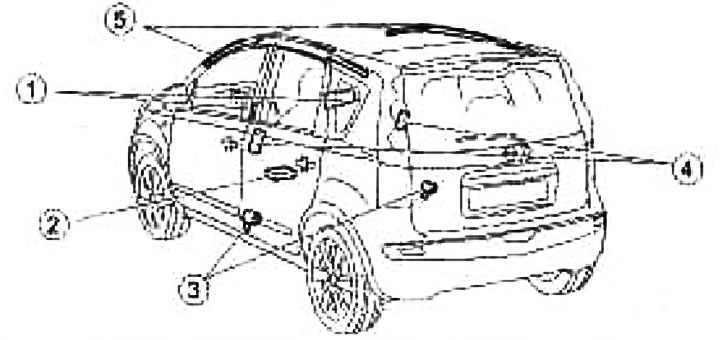
1 Front airbag modules
2 Airbag control unit
3. Seat belt pretensioner*
4. Side airbags (if any)
5. Side airbags (if any)
* The driver's seat is equipped with a seat belt with two pretensioners (shoulder and waist belt)
Front airbags
The driver and front passenger airbag modules are built into the steering wheel hub and the dashboard above the glove box, respectively. The airbags are designed to deploy only in severe frontal impacts. However, the airbags may also deploy in other situations if the vehicle experiences forces similar to those experienced in a severe frontal impact.
The airbags may not deploy in a frontal impact of a certain nature. The deployment of the frontal airbags is accompanied by a loud bang and the release of smoke. The smoke is not harmful to humans, and its appearance does not indicate a fire. However, you should not breathe it in, so as not to cause irritation of the respiratory tract and spasm in the throat. People suffering from respiratory diseases should quickly get out into the fresh air.
Vehicles equipped with side airbags and side curtain airbags (if any)
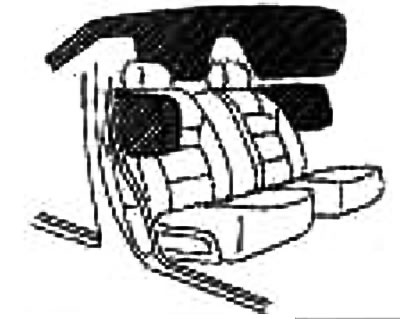
The side airbag modules are built into the front seat backs (from the door side) The side curtain airbags are located under the headliner above the door openings. Side and curtain airbags are designed to deploy only in severe side impacts. However, the airbags may also deploy in other accident situations if the vehicle experiences impacts similar to those experienced in a severe side impact. In an accident, only the airbags on the side of the impact deploy. The airbags may not deploy in certain types of frontal impacts.
The inflation of the side airbags and curtain airbags is accompanied by a loud bang and the release of smoke. Smoke is not harmful to humans, and its appearance does not indicate a fire. However, you should not breathe it in, so as not to cause irritation of the respiratory tract and spasm in the throat. People suffering from respiratory diseases should quickly get out into the fresh air.
Side airbags, when used with seat belts, help reduce chest injuries for the driver and front passenger. Curtain airbags are designed to protect the heads of the front and rear outer occupants. Airbags and curtain airbags can save lives or reduce the severity of injuries in a crash. However, the cover of a side airbag or curtain airbag can cause facial abrasions or other injuries. Side airbags and curtain airbags do not protect the lower body.
Airbag malfunction indicator light

The control lamp located on the instrument panel allows you to monitor the condition of the electrical circuits of the airbag system and pyrotechnic pretensioners of the seat belts. In addition, the control lamp provides the ability to monitor the serviceability of the diagnostic unit and sensors, front airbag modules, side airbag modules (if any), modules of inflatable curtains (if any), impact sensors, pyrotechnic belt pretensioners and associated wiring.
The airbag malfunction indicator lamp comes on after the ignition key is turned to the ON position. If the airbags are functioning properly, the indicator lamp should go out after approximately 7 seconds.
If any of the following conditions occur, the front, side airbag system (if any), window curtains (if any) and seat belt pretensioners need repair:
- The indicator lamp continues to light 7 seconds after the ignition is turned on.
- The airbag malfunction indicator light is flashing.
- The airbag malfunction indicator light does not come on
Under the specified conditions, frontal and side airbags (if any) and window security curtains (if any) and/or seat belt pretensioners may be inoperative. The appropriate repairs must be made.
Repair and replacement of system elements
Main elements of the airbag system (front, side airbags and inflatable curtains) and pyrotechnic seat belt pretensioners are single-use devices. After the airbags have been deployed, a warning light comes on and stays on, reminding you of the need to replace the system components.
Front passenger front airbag off indicator
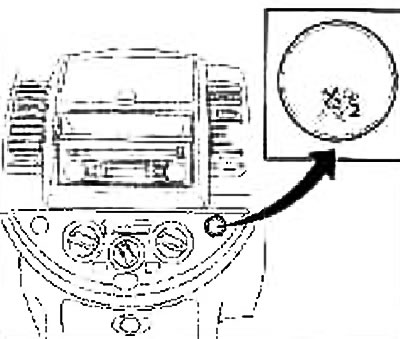
The picture shows the option for left-hand drive models
Indicator
 the front passenger airbag deactivation indicator, located on the center console, comes on after turning the ignition key to the ON position and should go out after about 7 seconds. This behavior of the indicator means that the system is working properly.
This indicator informs about the status of the front passenger front airbag. If the airbag is deactivated, the indicator lights up and remains lit continuously while the front passenger airbag is deactivated.
Disabling the front passenger airbag
Ⓐ Vehicles equipped with the system "Intelligent Key"
Ⓑ Vehicles not equipped with the system "Intelligent Key"
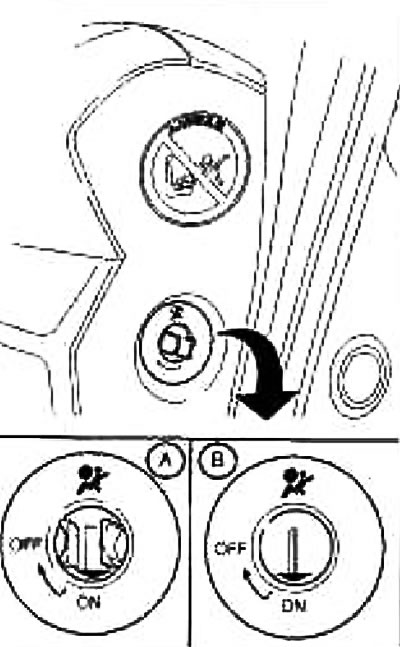
To install a child safety seat in which the child is sitting against traffic, the front passenger seat must first be disconnected from the front passenger airbag, which is done as follows:
- 1. Set the ignition switch to the LOCK position (the engine is turned off) and open the passenger door
- 2. Insert the main or spare ignition key (for vehicles equipped with the system "Intelligent Key") into the front passenger airbag switch, which is located on the right side of the center console. Press the key and turn it to the OFF position
- 3. Turn the ignition key to the ON position and make sure the air bag off indicator is on.
If the indicator light is constantly on, it means that the front passenger airbag is deactivated.
Activation of the front passenger front airbag
If you do not intend to use a child seat in the front seat, you must reactivate the front passenger airbag.
To activate the front passenger airbag, do the following:
- 1. Set the ignition switch to the LOCK position (the engine is turned off) and open the passenger door.
- 2. Insert the main or spare ignition key (for vehicles equipped with the system "Intelligent Key") into the front passenger airbag switch and turn the key to the ON position.
- 3. Turn the ignition key to the ON position and check that the air bag off indicator comes on for a few seconds and then goes out.