


Table of contents: Permitted locations for child seats ↓ List of approved child seats of the…↓ Installing a child seat in the back…↓ ISOFIX standard mounting system ↓ Upper child seat anchorage strap ↓
Permitted locations for child seats
| Weight (age of the child) | Positioning of child seat | ||
| In the front seat (only after disabling the front passenger airbag) | The outermost place in the back seat | Central location in the back seat | |
| Up to 10 kg (from 0 to 9 months) | U (1) | U and or I (1) | L (1) |
| Up to 13 kg (up to 2 years) | U (1) | U or I (1) | L (1) |
| From 9 to 18 kg (from 9 months to 4 years) | U | U or I | L |
| From 15 to 36 kg (from 4 to 12 years old) | U | U | L |
U: Universal child seats are permitted, in which the child is positioned both forward and rearward facing. The child seat must correspond to the child's age group.
I: Installation of seats with ISOFIX mountings is permitted (with additional upper fastening straps).
L: The installation of certain types of child seats listed in the table below is permitted. Child restraints may be specific to a specific vehicle model, have restrictions on use, or be classified as "Semi-wagon" or "Wagon".
X: Child seats for children of this age group are not permitted.
(1): Only rear-facing seats (against the flow).
Note:
- When installing a forward-facing child restraint system in the rear seat, move the front passenger seat as far forward as possible and the rear seat as far back as possible.
- When installing a rear-facing child restraint system, move the front passenger seat as far back as possible and move the rear seat as far forward as possible.
- If a rear-facing child seat is installed in the front passenger seat, the seat must be moved forward until it rests against the instrument panel.
List of approved child seats of the "universal" category and with ISOFIX fastenings
| Weight (age of the child) | Positioning of child seat | |
| The outermost place in the back seat | Central location in the back seat | |
| Up to 10 kg (up to 9 months) | FairGO/1 (1) (2) | Romer Baby Safe (1)(3) |
| Up to 13 kg (up to 2 years) | FairGO/1 (1) (2) | Romer Baby Safe (1)(3) |
| From 9 to 18 kg (from 9 months to 4 years) | FairGO/1 (2) | Romer Lord (3), Romer Duo Plus (3) |
| From 15 to 36 kg (from 4 to 12 years old) | Romer Kid (3) | Romer Kid (3) |
(1) The child seat can only be installed rear-facing (2) The child seat can only be installed in a vehicle equipped with the ISOFIX anchorage system. For information about the anchorage system installed in your vehicle, contact your authorized NISSAN dealer. (3) Only child seats of the "Universal" category.
Installing a child seat in the back seat
A chair in which the child sits facing forward
When installing a forward-facing child seat in the outer or center rear seat, follow these steps:
- 1. Set the adjustable rear seat to its rearmost position and the front passenger seat to its forwardmost position
- 2. Install a forward-facing child seat in the back seat
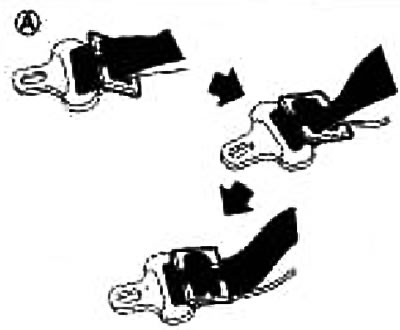
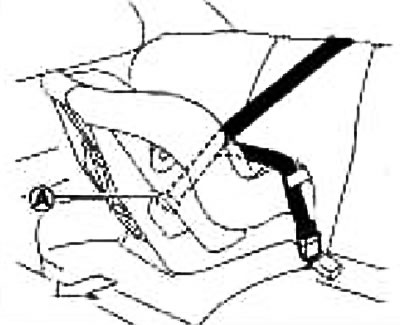
- 3. Thread the seat belt with the locking clip through the child seat and insert the clip into the belt buckle until it clicks into place
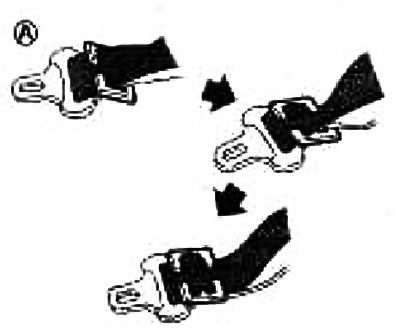
- To prevent the lap belt from coming loose, secure the diagonal belt with the fastener Ⓐ. Use the fastener supplied with the child seat or an equivalent.
- 4. Check the child seat before placing your child in it. Rock the seat from side to side. Try to pull the seat forward and check how well the seat belt holds it in place.
- 5. The child seat attachment should be checked before each use.
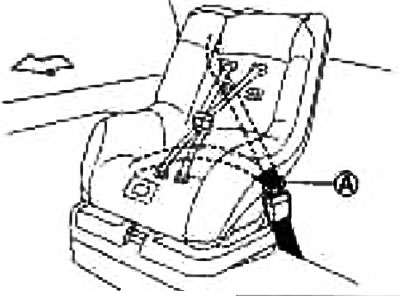
Child seat in the outer rear seat |
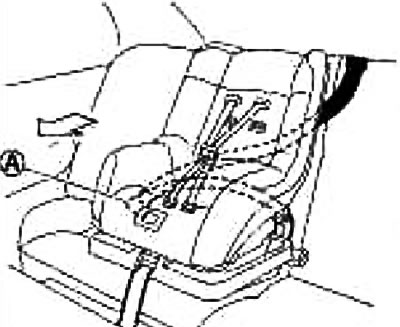
Child seat in the center of the rear seat |
A child seat where the child sits facing backwards
When installing a rear-facing child seat in the outer or center rear seat, follow these steps:
- 1 Move the front passenger seat to its rearmost position and the adjustable rear seat forward
- 2. Install a rear-facing child seat in the back seat
- 3. Thread the seat belt with the locking clip through the child seat and insert the clip into the belt buckle until it clicks into place.
- To prevent the lap belt from coming loose, secure the diagonal belt with the fastener Ⓐ. Use the fastener supplied with the child seat or an equivalent.
- 4. Check the child seat before placing the child in it. Rock the seat from side to side. Try to pull the seat in front to see how well the seat belt holds it in place. Then move the rear seat forward until the edge of the child seat touches the front seat
- 5 The child seat fastening should be checked before each use
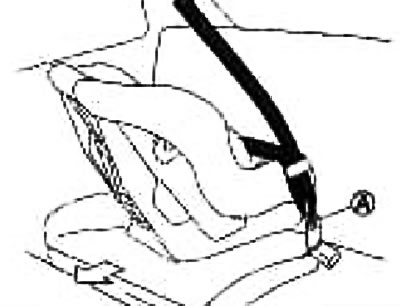
Child seat in the outer rear seat |
Child seat in the center of the rear seat |
ISOFIX standard mounting system
Some child seats are equipped with two fastening units that can be installed on the seat either rigidly or on straps. This fastening system is known as ISOFIX or ISOFIX-compatible. This system allows you not to use the standard seat belt to fasten the child seat. Your car is equipped with special fastening units that ensure the installation of child seats unified with the ISOFIX system. Check the marking on the child seat to see if it is unified with the ISOFIX fastening system. Information about this may also be provided in the operating instructions for the child seat. If the child seat is equipped with the ISOFIX fastening system, refer to the figure, which shows the location of the fastening units that can be used to install the child seat.
ISOFIX anchorages are located behind the rear seat cushion (at the base of the back), see picture. To make it easier to find, there are labels on the back of the rear seat indicating the location of the ISOFIX mounting points.
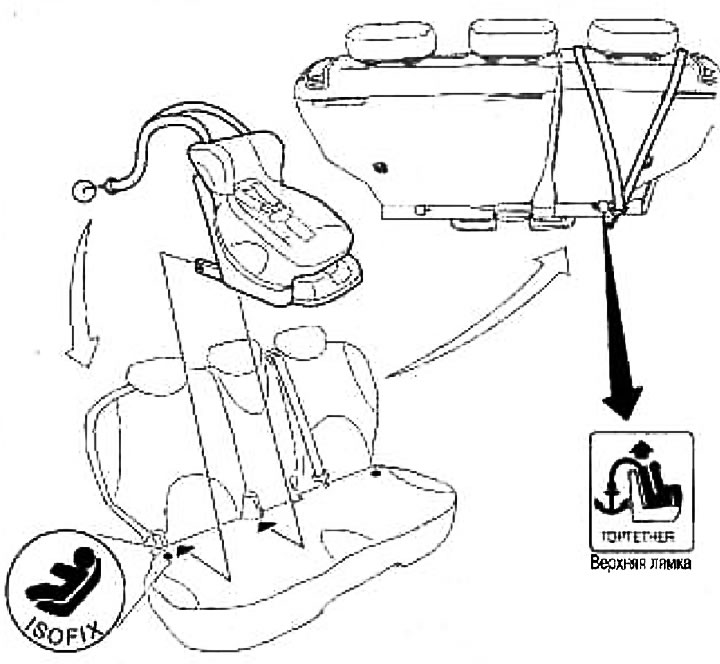
When installing a child seat with ISOFIX standardised mountings on the mounting points located on the rear seat, proceed as follows:
- Check the ISOFIX anchor points on the rear seat by placing your hand behind the rear seat cushion and making sure that the ISOFIX anchor points are not obstructed (for example, a belt strap or seat upholstery). The child seat will not be properly secured if the anchor points are obstructed in any way.
- 1. To install a child seat with the ISOFIX mounting system, insert the locking pins into the anchor points located on the rear seat. For instructions on using the strap, see below under "Child seat upper tether".
- 2. Install the guide elements (which can be supplied with an ISOFIX seat) onto the vehicle's ISOFIX mounting brackets, located on the side at the base of the rear seat cushion.
- 3. After installing the child seat and before placing your child in it, rock the seat firmly from side to side and pull it forward to check that it is securely fastened. Make sure that both ISOFIX anchorages are securely engaged.
- 4. The child seat attachment should be checked before each use.
When installing an ISOFIX child seat in the rear seat, in which the child is facing forward, move the front passenger seat as far forward as possible and the rear seat as far back as possible.
When installing an ISOFIX child seat in a rear-facing position, move the front passenger seat as far back as possible and move the rear seat as far forward as possible.
Upper child seat anchorage strap
The top tether strap of the child seat must be attached to the appropriate anchor point.
Attach the top tether strap of the child seat to the anchor point as shown in the illustration.
Location of anchor fastening units
The anchor fastening units are located on the base of the rear seat backrest (from the luggage compartment side).