


Table of contents: Shock absorbers ↓ Steering and suspension components ↓ Protective covers for drive shafts ↓
Attention! The condition of the suspension and steering components should be checked regularly, as their wear or damage can cause a reduction in the service life of the tires, lead to a decrease in vehicle controllability and an increase in fuel consumption. Detailed illustrative material is also presented in Chapter Suspension and steering.
Shock absorbers
1. Park the car on a level, horizontal surface, if possible with a hard surface. Turn off the engine and apply the parking brake. Check the tire inflation pressure.
2. To assess the condition of the shock absorbers, press down one corner of the car in turn. When you release the corner, the body should return to its original position, making no more than one or two oscillations. Listen for creaking and other extraneous noises emitted by the suspension during oscillatory movements of the body. For more details, see Chapter Suspension and steering.
3. Excessive amount of body rocking when releasing the corner, as well as failure to return it to its original position, indicate the need to replace the shock absorbers.
4. Proceeding in a similar manner, check each of the four shock absorbers in turn.
5. Jack up the car and place it on supports.
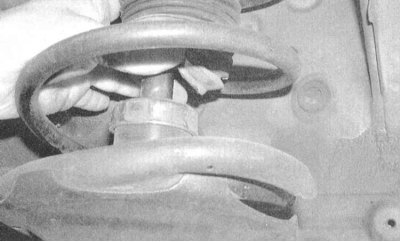
6. Inspect the suspension struts for signs of hydraulic fluid leakage. Minor dampness of the rod should not cause much concern. If noticeable leaks are detected, try to determine the source of the leak - if it is the shock absorber, it should be replaced together with the opposite one.
7. Make sure that the shock absorbers are securely fastened and that there are no signs of mechanical damage. Defective shock absorbers must be replaced in pairs (front or back).
8. The procedures for removing and installing shock absorbers are described in Chapter Suspension and steering.
Steering and suspension components
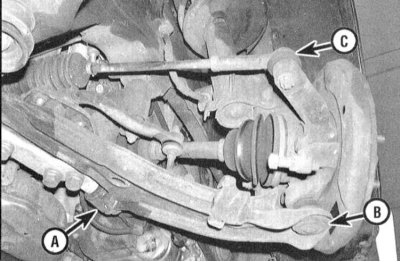
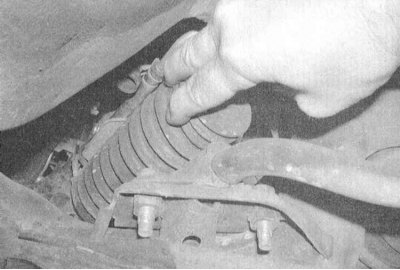
1. Visually assess the condition of the steering and suspension components (front and back). Pay attention to such defects as cracks, dents, damage to rubber components, traces of hydraulic fluid leaks, etc. Particular attention should be paid to the condition of the rubber-metal bushings by which the lower suspension arms are attached to the vehicle chassis.
The original can be read on the website: nissanbook.ru
2. Wipe the lower part of the steering knuckle, ask an assistant to grab the wheel at the 12 and 6 o'clock positions and tug it in a perpendicular direction - at the same time, assess the tightness of the suspension arm ball joint in the knuckle. The presence of the slightest play indicates the need to replace the support.
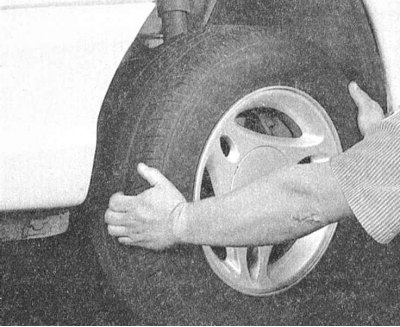
3. Grasp the wheel at the 3 and 9 o'clock positions and tug on its edges in opposite directions. Any noticeable play indicates wear of the steering components - check the condition of the pendulum arm and steering rod ends.
4. More detailed information and illustrative material on the components of the suspension and steering gear are given in Chapter Suspension and steering.
Protective covers for drive shafts
1. The condition of the protective covers of the drive shafts directly affects the wear rate of the CV joints. Oil and grease getting on the surface of the covers leads to rubber aging and premature failure of components, so it would be reasonable to wash the covers with a solution of soapy water from time to time.
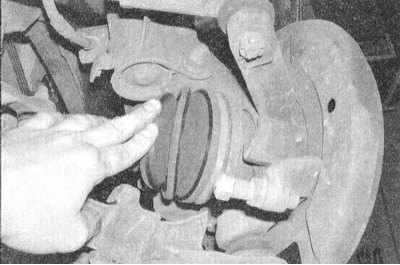
2. Check the boots for cracks and signs of grease leaks - do not forget to spread the folds of the corrugation to inspect their inner sides. Defective boots are subject to replacement (see Chapter Clutch and drive shafts).