


The cardan shaft requires very little maintenance. The cardan joints are lubricated for life and are replaced if any damage is detected. To do this, the driveshaft must be removed from the vehicle.
Since the driveshaft is a balanced component, it is crucial that it be free of any debris, dirt, or other debris. When raising the vehicle for maintenance or repair, it is recommended to clean the driveshaft and inspect it for any obvious defects. It is also necessary to check that the small balance weights on the driveshaft are in place and securely fastened. If the driveshaft is removed, it is very important that it is installed in its original position and that its balance is maintained.
If vibration occurs at high speed, the first thing to check is the runout of the driveshaft.
- Measure the runout of the driveshaft in several places by manually turning the drive flange of the final drive.
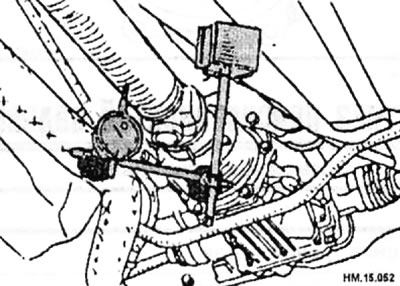
- If the runout value exceeds 0.6 mm, disconnect the propeller shaft from the final drive flange. Then check the driveshaft runout by turning it 90°, 90° again, and 90° again.
- If the runout value in all positions exceeds 0.6 mm, the driveshaft must be replaced.
- Conduct a test drive.
A test drive will help determine whether the problem is with the driveshaft or other parts of the vehicle.
- Drive the car on a clear stretch of road and note the engine speed at which the problem is most noticeable.
- Once this engine speed is detected, drive the vehicle again. This time, manually hold the CVT in first gear, then in second and third gear and accelerate the engine to the marked RPM.
- If the noise or vibration has decreased or disappeared, visually inspect the driveshaft for damage, foreign objects on the shaft that could affect balance, missing weights, and damage to the driveshaft joints. Another reason for the vehicle's behavior may be unbalanced tires, as well as deformed or damaged wheel rims.
- If noise or vibration occurs at the same engine speed regardless of the gear engaged, the fault is with the driveshaft.
- Check the wear of the universal joints as described below.
♦ On a clear stretch of road, drive the vehicle slowly with the transmission in high gear. Release the accelerator pedal, allowing the car to coast, and then accelerate the car. Clicking or ringing sounds indicate wear in the universal joints.
♦ Drive the car at a speed of approximately 15-25 km/h, and then put the gear in neutral (n range), allowing the car to coast. Listen for any abnormal noises in the transmission.
♦ Raise the vehicle and support it securely with stands.
♦ When the CVT is in neutral gear (n range) rotate the driveshaft manually, checking for excess play in the cardan joints.
Information copied from the website (Nissanbook.ru)