


Table of contents: Replacing brake pads ↓ Wheel brake cylinders ↓
Replacing brake pads
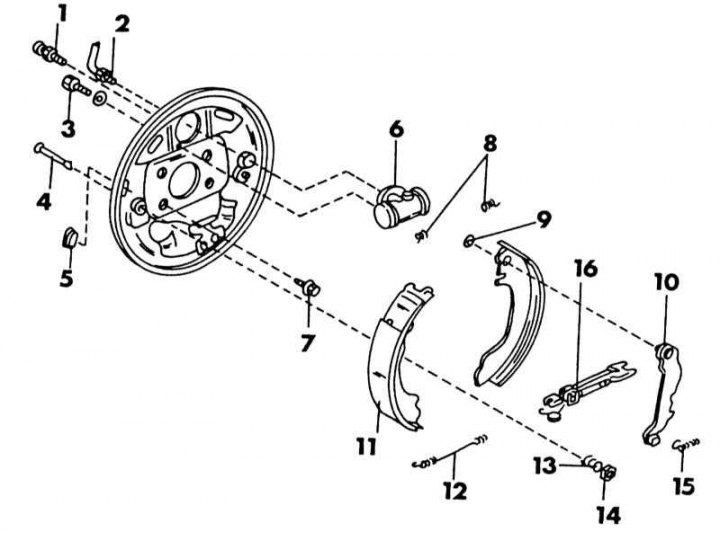
Rear drum brake assembly diagram. Large arrow points to the front of the vehicle
1 - bleed valve, 5-8 Nm; 2 - brake pipe with union nut, 15-18 Nm; 3 - bolt, 6-10 Nm; 4 - anchor pin of the pads; 5 - cork; 6 - wheel brake cylinder; 7 - bolt, 40-55 Nm; 8 - upper return springs; 9 - locking latch; 10 - brake shoe lever; 11 - brake pads; 12 - lower return spring; 13 - anchor spring of the shoes; 14 - spring cup; 15 - regulator spring; 16 - brake shoe adjuster
Using the illustration above:
1. Place the rear of the vehicle on stands. The front wheels must be blocked (those bricks), so that the car cannot slide off the supports.
2. Remove the rear wheels.
3. Release the handbrake.
4. Remove the brake drum. If the automatic adjuster works perfectly, it is possible that the brake shoes will catch on the drum. To loosen the drum, you need to set the adjuster to the opposite position.
5. To do this, remove the plug from the back of the brake shield at the location shown in the illustration below and insert a screwdriver into the hole as shown in the illustration below. Press the screwdriver inward to release the lever on the inside.
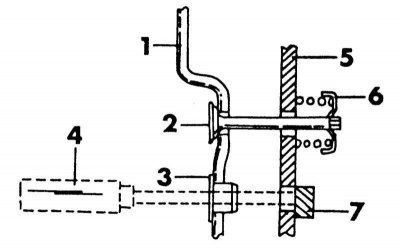
Installing an automatic adjustment device inside the brake drum
1 - brake shield; 2 - anchor pin of the shoe; 3 - cork; 4 - screwdriver; 5 - brake shoe; 6 - anchor pin spring; 7 - drive lever
6. Now you will need two M8 x 1.25 bolts, which are screwed into the places shown in the illustration below. Tighten the bolts evenly until the brake drum is removed.
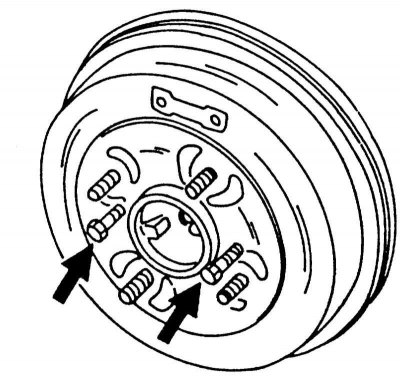
Remove the tightly seated drum by screwing two bolts into the indicated places.
7. Remove the anchor pins and springs. To do this, press the pin from the back onto the shield and turn the spring cup on the front side with pliers until the bolt head can pass through the cup. The illustration shows this work clearly. Remove the cup and spring and pull out the pin from the back. In this way, both pins are removed.
8. Using pliers, unhook the upper return spring from the brake shoes, push the shoes outward and remove the adjuster in the middle of the shoes. Remove the lower end of the brake shoe from the counter support. This will release the lower return spring, which can be removed.
9. Carefully remove the brake shoes with the handbrake cable.
10. To do this, compress the spring until the end of the cable can be removed from the lever.
11. If further disassembly is required, detach the spring from the adjustment lever.
12. When replacing the pads, the lever must be moved to the new pads. If the surface of the brake drum has grooves, the drum can be turned as long as the permissible diameter is not exceeded. Also measure the ovality of the drum, especially if the pads have overheated during braking. If the thickness of the brake pad material is less than 1.5 mm, the pads should be replaced as a set. Bent springs, also if they were bent during removal, should be replaced. The wheel brake cylinder is described below.
13. Install the brake shoes in the reverse order of removal. Lightly grease the ends of the brake shoes and the areas where the shoes meet the brake shield, and also grease the bearing areas of the adjusting lever. The adjusting devices must be lubricated at the threaded areas of the small wheels and at the connection between the adjuster and the shoe lever, and they must be installed on the old brake shield. Remember the following points:
14. The regulator on the right side has a right-hand thread.
15. The regulator on the left side has a left-hand thread.
16. If the brake shoes have been replaced, place the lever on the brake shoes so that it is on the front side and install a new locking pawl on the support pin. Insert the pawl well into the groove and then, as shown in the illustration below, squeeze with pliers. Insert the anchor pins and put the springs and spring cups on the front. Turn the pin heads 90° until the heads lie in the cups.
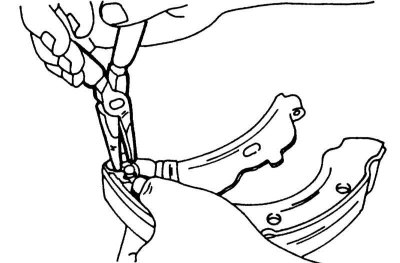
After installing the retaining ring, press it well into the groove of the support pin.
The illustration below shows schematically how this work is done.
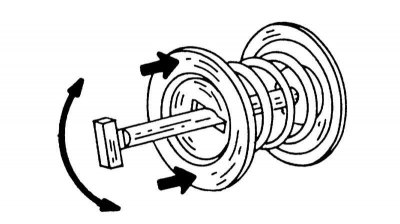
Elements for removing and installing brake shoe anchor pins.
17. After installing the brake shoes, you need to set the brakes to the automatic adjustment mode. To do this, adjust the regulator until the diameter of the brake shoes approximately matches the diameter of the brake drum. To do this, measure the diameter of the drum and brake shoes, as shown on the right and left in the illustration below.
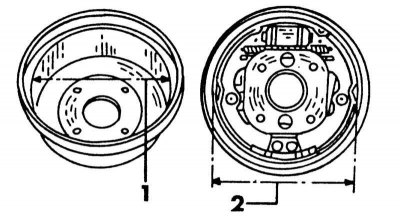
Measure the brake drum diameter (1) and the outside diameter of the installed brake shoes (2). Set the brake shoe diameter to 0.35 mm smaller than the brake drum diameter.
18. Compare the assembled brake with the illustration below. Adjuster head (i.e. the expansion rod in the middle) should in any case be closer to the front of the car. Both arrows indicate the direction of rotation of the drum and the front of the car.
19. Put on the brake drum and apply the handbrake several times. The clicking sound in the brake drum should stop after a while.
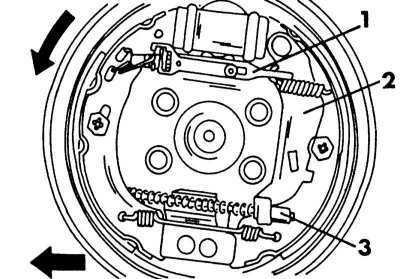
Correct assembly of the rear wheel brake
1 - regulator; 2 - brake shoe lever; 3 - end of handbrake cable
Wheel brake cylinders
To remove the wheel brake cylinder:
1. Remove the brake pads.
2. On the back of the brake shield, loosen the union nut of the brake pipe.
The full article is available on the resource: nissanbook
3. Unscrew the wheel cylinder from the brake shield.
4. Disassembling the wheel cylinder is impossible, since the adjustment valve installed inside cannot be repaired. If the cylinder is rusted or has lost its tightness, it must be replaced with a new one.