


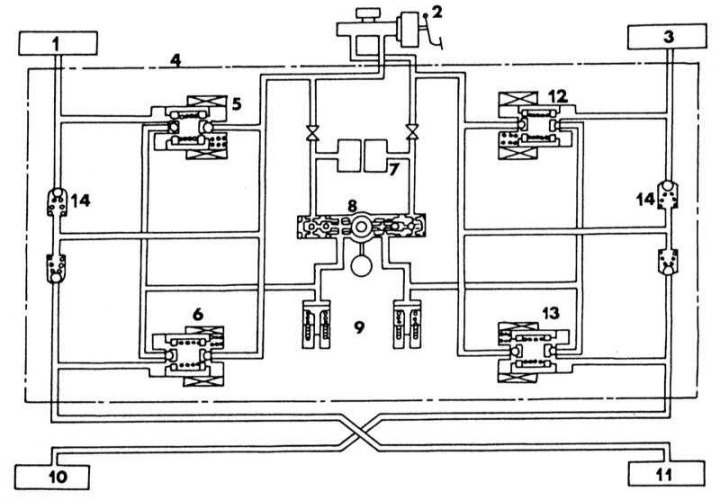
Hydraulic circuit of the anti-lock braking system (ABS)
1 - front left caliper; 2 - master brake cylinder; 3 - rear left caliper; 4 - hydraulic control device; 5 - front left adjustment valve; 6 - rear left adjustment valve; 7 - pulsation damper; 8 - injection pump; 9 - expansion tank; 10 - rear left caliper; 11 - rear right caliper; 12 - Front right control valve; 13 - rear right control valve; 14 - bypass valve
In general, there is no point in this manual describing the operating principle of the ABS system, but you will better understand your system if you know how it works.
Usually cars with ABS have disc brakes on the rear wheels. This is also the case with Primera models, i.e. only cars with a 2.0 L engine can be equipped with ABS as standard or as an option.
The decisive safety factor of the ABS system is the ability to prevent the wheels from locking during sudden braking, due to which the car remains controllable. Also, during emergency braking, there is a chance to go around the obstacle. However, do not assume that the ABS system is capable of performing miracles. If the physical limits of the system are exceeded, i.e. the speed is too high, even cars with ABS can get into an accident.
Four wheel speed sensors, which are mounted in the steering knuckles or rear hub carriers, independently monitor the speed of each wheel. In the illustrations Installation position of the front wheel speed sensor and Installation position of the rear wheel speed sensor shows where the sensors for the front and rear wheels are located. The microprocessor receives the RPM signals and detects anomalies relative to the set parameters. Thanks to this process, the brake pressure in the corresponding wheel is reduced or increased by 4 to 10 times in a matter of seconds, much faster than with the so-called pulse braking with the brake pedal, and the adjustment is carried out on each wheel separately, and not on all wheels simultaneously, as is the case when using the brake pedal on cars without ABS. In the rear brake circuit, there are two load-sensitive brake pressure adjustment valves, which prevent further risk of wheel locking, especially if the car is not heavily loaded.
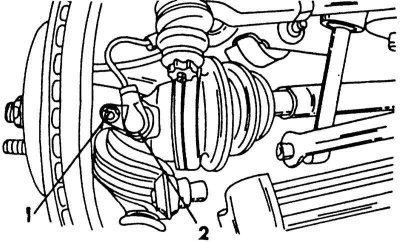
Installation position of the front wheel speed sensor
1 - bolt, 11-16 Nm; 2 - sensor
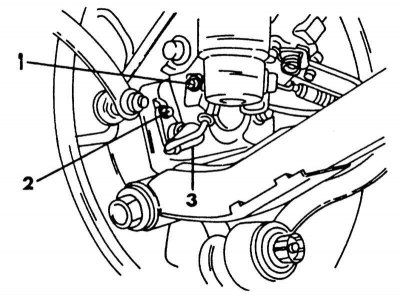
Installation position of the rear wheel speed sensor
1 - bolt, 4-6 Nm; 2 - bolt, 11-16 Nm; 3 - sensor
Two hydraulic valves precisely distribute the required brake pressure to the front wheels depending on the grip. Two other control valves control the rear brakes. In this case, the electronic control system reacts to the first wheel that tends to lock. With optimal braking, the car remains controllable, directional stability is maintained and the car can be kept under control. At speeds below 15 km/h, the system does not work. The illustration shows a schematic representation of the system, which helps you to orient yourself in the arrangement of the components.
Something should be said about the hydraulic pump and the pulsation damper (7) and (8). The pump supplies fluid to the pulsation damper and reduces the pressure in the calipers. The pump has an eccentric. When the pump presses the piston to the side through the eccentric, fluid from the expansion tank is supplied to the damper, while the inlet and outlet ports and the valves connected to them open. The piston on the other side remains in its position, i.e. the inlet and outlet valves on this side remain closed. In this way, the valves control the emptying and filling of the system. The pulsation damper accumulates brake fluid under high pressure and allows it to slowly return to the master cylinder.
This is how the ABS system provides you with additional safety.
It is not recommended to perform any work on the system yourself. A workshop will do it better. However, work that affects ABS is always carried out on the car, such as bleeding the brakes. Therefore, the following instructions should be followed for all work on the brake system:
Thoroughly clean all connections and the area around them before loosening them.
Place the removed parts on a clean surface and cover with film or clean paper. Do not use lint-free cloths.
Cover or plug open system elements if repairs are not to be performed immediately. This is especially true for work outdoors.
Install only completely clean parts. Never use parts that have been stored for a very long time.
It is tempting to use a compressed air compressor that plugs into the cigarette lighter socket to clean the parts. Do not do this under any circumstances if the system connections are open.
After the ignition is turned on, the hydraulic pump creates working pressure in the system for 60 seconds. The ABS control lamp lights up for 2-20 seconds, depending on the pressure in the system. The electronic control unit checks individual components. If any faults are detected, the system operates as a normal braking system without ABS. If this happens, i.e. the control lamp continues to light, you should contact a workshop. The workshop can use special equipment to diagnose faults that may be electrical or hydraulic in nature.