


Hydraulic diagram of the anti-lock brake system
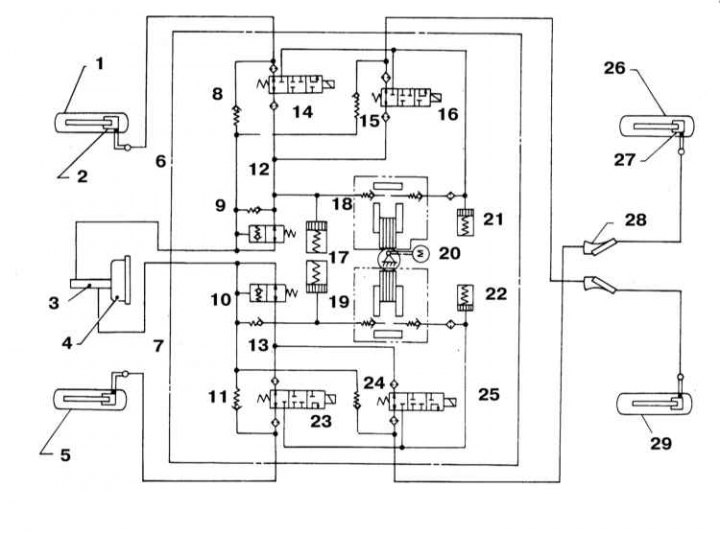
1 - Right front wheel; 2 - Brake mechanism support; 3 - GTZ; 4 - Assembling the brake booster; 5 - Left front wheel; 6 - Secondary part of the circuit; 7 - Primary part of the circuit; 8 - Left front control valve; 9 - Secondary sensitive valve; 10 - Primary sensitive valve; 11 - Right front control valve; 12 - Secondary drain valve; 13 - Primary drain valve; 14 - Right front solenoid valve; 15 - Control valve; 16 - Right rear solenoid valve; 17 - Hydraulic accumulator; 18 - Pump; 19 - Pump; 20 - Drive electric motor; 21 - Reservoir; 22 - Reservoir; 23 - Left front solenoid valve; 24 - Control valve; 25 - Left rear solenoid valve; 26 - Right rear wheel; 27 - Brake mechanism support; 28 - Load Sensing Regulator Valves; 29 - Left rear wheel
General information
When a vehicle is equipped with a conventional braking system, abruptly pressing the foot brake pedal causes the wheels to lock. This disrupts the tread's grip on the road surface and the vehicle may skid, causing it to lose control. The anti-lock braking system (ABS) prevents premature wheel locking by continuously controlling the speed of the wheels during braking by modulating the hydraulic fluid pressure in each brake mechanism.
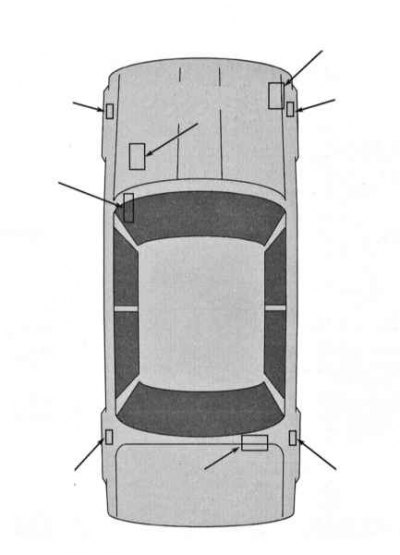
ABS consists of two main subsystems: electrical and hydraulic. The electrical part of the system includes four wheel speed sensors, an electronic control unit (ECU) and a set of connecting electrical wiring. The hydraulic part includes a pressure modulator, disc brake calipers and hydraulic lines connecting these components.
The principle of the system's operation is quite simple. Each wheel is equipped with an individual speed sensor. The sensor consists of a rotor (rings with teeth evenly spaced around their perimeter) and a sensitive element in the form of a magnetized coil. The sensitive element of the sensor records the moments when the rotor teeth pass by it and converts the received information into electrical signals that are continuously transmitted to the ABS ECU. Based on the results of processing the incoming signals, the control unit receives information about the relative rotation speed of each of the wheels. While all four wheels rotate at the same frequency, the ABS is in a passive state. As soon as any of the wheels begins to lock, the ECU records a change in the incoming signal and generates a command to operate the modulator, which instantly releases the hydraulic fluid pressure in the brake mechanism of the corresponding wheel. As soon as normal wheel rotation is restored, the processor suspends the operation of the modulator.
In reality, the ABS operating scheme is much more complicated than it may seem, so the authors of this Manual do not recommend that car owners attempt to repair the system themselves. In case of problems, it would be most reasonable to contact car service specialists. The illustration shows a functional diagram for reference, explaining the operating principle of the hydraulic part of the ABS.
ABS Components
Pressure modulator
The modulator consists of an electric-driven hydraulic pump and three electromagnetic switching valves (two left and right front and rear). The electric pump supplies hydraulic fluid to the reservoirs and the modulator, which controls the process of pressure changes in the brake system circuits. The pump is placed in a common casing with the modulator assembly. The electromagnetic switch valves play the role of actuators, which actually provide the required pressure modulations in the hydraulic tract of the brake system during ABS operation.
Wheel sensors
Special sensors, which the car wheels are equipped with, generate a frequent comb of electrical pulses when the teeth of rotating rotors pass by their sensitive elements. The analog amplitude signal of the corresponding parameters is sent to the ABS control unit (ECU), which converts it to digital form and, based on the analysis of the received information, determines the rotation frequency of each of the wheels.
The front wheel sensors are mounted on the steering knuckles in close proximity to the rotors pressed into the outer CV joint assemblies.
The rear wheel sensors are bolted to the hub assembly carriers, while the rotors are built into the hubs.
Electronic Control Unit (ECU) ABS
The electronic control unit, often also called the processor, is installed in the luggage compartment of the vehicle (models produced in 1993 and 1994.), or under the front sill trim of the driver's door (models since 1995.). The ECU, playing the role of the brain center of the system, receives information coming from the wheel sensors and, based on its analysis, controls the pressure modulations in the hydraulic tracts of the brake mechanisms of each wheel, preventing their premature blocking. The processor continues to function during normal vehicle movement, constantly monitoring the serviceability of the ABS components.
Each time the engine is started, the ABS warning lamp in the vehicle instrument cluster briefly lights up. The first diagnostic poll of the ABS components is performed by the control unit when the vehicle speed reaches 6.4 km/h (4 mph). The poll may be accompanied by a weak mechanical sound, which should not be given any importance. If a malfunction is detected, the ECU ensures that the ABS warning lamp lights up, and at the same time a corresponding fault code is stored in the processor memory, which can be read later to determine the source of the failure.
Diagnostics and repair
When the processor detects a fault in the system, the ABS indicator lamp lights up and remains on in the instrument panel. Diagnostics of faults in the anti-lock braking system is one of the rather complicated procedures and the authors of this Manual do not recommend performing it at home. However, it is possible to single out a number of simple tests that can be successfully performed by the car owner himself and allow for a high-quality determination of the cause of the failure (see below).
Models produced in 1993 and 1994.
- a) Accelerate the vehicle to 32 km/h (20 mph) and maintain this speed for at least one minute;
- b) Stop driving, but do not turn off the engine;
- c) Open the luggage compartment and count the number of flashes of the ABS warning lamp mounted in the control unit (ECU) assembly on the LED. If there are fault codes in the processor memory, the warning lamp will emit a series of continuous flashes with pauses of 5-10 seconds between them;
- d) The decoding of the codes displayed by the control lamp is given in the explanatory chart (see below).
- e) Turn off the engine.
Models since 1995.
- a) Accelerate the vehicle to 32 km/h (20 mph) and maintain this speed for at least one minute;
- b) Stop driving and turn off the engine;
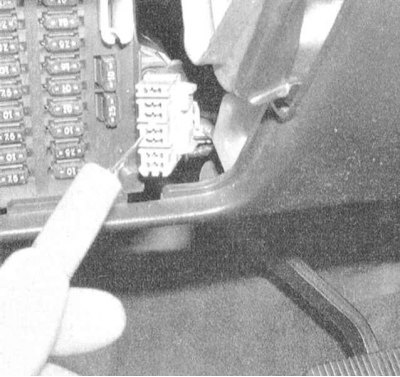
- c) Ground the DLC terminal L;
- d) Turn the ignition key to the ON position;
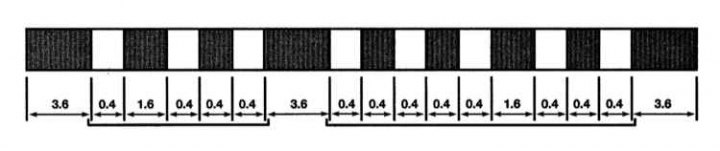
- e) After 3.6 seconds, the ABS indicator lamp will start to display the two-digit system fault codes stored in the processor memory. Each digit of the code is defined by a series of short (by 0.4 seconds) flashes of the lamp, separated by pauses of the same duration, the second digit is separated from the first by a pause of 1.6 seconds. The moment of the start of reading is marked by the output of code 12 (one flash, pause, two flashes). Then comes another long one (3.6 seconds) a pause after which the lamp begins to display the codes stored in the control unit memory.
- f) The decoding of the codes displayed by the control lamp is given in the explanatory chart (see below).
The reason for entering the code into the processor memory may be the simplest malfunction - first of all, perform the following checks:
- a) Make sure that the hydraulic fluid level in the master cylinder reservoir is correct;
- b) Check the condition of the contact connections of the corresponding electrical circuits;
- c) Check the condition of the fuses;
- d) Check the condition of the brake system (see Chapter Settings and ongoing maintenance);
- e) Check the condition of the brake pads;
- f) Check the condition of the foot brake pedal.
Clearing ABS CPU Memory
To clear the processor memory, disconnect the ground connection of the L terminal of the DLC connector - the ABS indicator lamp should remain on. Perform three successive ground connections of the L terminal within 12.5 seconds. Each subsequent ground connection should last at least 1 second longer than the previous one - the indicator lamp should go out:
- a) If the indicator lamp remains on after the manipulations performed to ground the terminal, drive the car to a service station for a more detailed diagnosis and the necessary ABS repair;
- b) If the light goes out, drive the vehicle for a short time at 32 km/h (20 mph) for at least 1 minute to ensure that the light does not come on again. If the light comes on again, take the vehicle to a service station for diagnosis and ABS repair.
ABS fault code map for 1993 and 1994 models.
| Number of flashes, LED | Suspected faulty light output unit or circuit |
| 1 | Left front wheel pressure solenoid valve switch |
| 2 | Right front wheel pressure solenoid valve switch |
| 3 | Right rear wheel pressure solenoid valve switch |
| 4 | Left rear wheel pressure solenoid valve switch |
| 5 | Left Front Wheel Speed Sensor |
| 6 | Right Front Wheel Speed Sensor |
| 7 | Right rear wheel speed sensor |
| 8 | Left rear wheel speed sensor |
| 9 | Electric motor and its switching relay |
| 10 | Solenoid valve enable relay |
| 16 (or continuous glow) | ECU |
| ABS warning light on, LED off | Ground or ECU power supply circuit |
Ground or ECU power supply circuit
| The number of flashes emitted by the LED | Suspected faulty unit or circuit |
| 12 | The moment when codes are read |
| 16 | Brake light contour |
| 18 | Wheel sensor rotor |
| 21 | Open circuit in the right front wheel speed sensor circuit |
| 22 | Short circuit in the right front wheel speed sensor circuit |
| 25 | Open circuit in the left front wheel speed sensor circuit |
| 26 | Short circuit in the left front wheel speed sensor circuit |
| 31 | Open circuit in the right rear wheel speed sensor circuit |
| 32 | Short circuit in the right rear wheel speed sensor circuit |
| 35 | Open circuit in the left rear wheel speed sensor circuit |
| 36 | Short circuit in the left rear wheel speed sensor circuit |
| 41 | ABS Modulator Right Front Brake Release Switch Valve |
| 42 | ABS Modulator Right Front Brake Inlet Switch Valve |
| 45 | ABS Modulator Left Front Brake Release Switch Valve |
| 46 | ABS Modulator Left Front Brake Inlet Switch Valve |
| 51 | ABS Modulator Right Rear Brake Release Valve Switch |
| 52 | ABS Modulator Right Rear Brake Inlet Switch Valve |
| 55 | ABS Modulator Left Rear Brake Release Switch Valve |
| 56 | ABS Modulator Left Rear Brake Inlet Switch Valve |
| 57 | Power supply voltage level violation |
| 61 | The modulator's electric motor or its switching relay |
| 63 | Malfunction in the solenoid valve relay circuit |
| 71 | ECU |
| 81 | Engine speed sensor |
| 85 | ECU ABS |
| 87 | The engine is operating in emergency mode |
| 92 | The LAN transfer start procedure is not completed |
| 94 | Reception continues after LAN transmission is completed |
| 96 | LAN is in monitoring mode |
| 98 | LAN transmission system failure |
| The indicator lamp remains lit after the ignition is turned on | Power supply circuit to ECU; Indicator lamp circuit; ECU or its wiring connector; Sticking of electromagnetic rivet relay; Power supply circuit to the solenoid valve relay coil |
| SLIP indicator remains on after engine has been started (1999) | Power supply circuit to ECU; Indicator lamp circuit; ECU or its wiring connector; Sticking of electromagnetic rivet relay; Power supply circuit to the solenoid valve relay coil |
| The indicator lamp remains lit during the self-diagnostic mode | ECU |
| The control lamp does not work when the ignition is turned on (1995÷1998) | Fuse; Control lamp; ECU |
| SLIP indicator does not come on when engine is running (1999) | Fuse; Control lamp; ECU |
| The control lamp does not work in self-diagnosis mode | ECU |