


Warning! See warning at the beginning of the Section Removal and installation of disc brake calipers!
At the same time as replacing the brake shoes, their tension and guide springs must also be replaced, as they stretch/sag over time as a result of constant cyclic mechanical and thermal loads, ceasing to develop the required force, which leads to the brakes seizing and accelerated wear of the drums.
1. Loosen the rear wheel nuts. Jack up the rear of the car and place it on supports. Support the front wheels with wheel chocks. Remove the wheels.
2. Release the parking brake and remove the brake drums.
Note. The drum should come off the hub fairly easily, but if you have any difficulty, tap it gently with a soft-faced hammer. If the drum still won't come off, press the brake shoes away from its working surface. Remove the rubber plug from the brake shield, insert a screwdriver into the opening and use it to move the self-adjuster lever away from the adjusting sprocket. Use a second screwdriver to turn the sprocket until the drum comes off completely. If the drum is stuck to the hub, screw a couple of bolts of the appropriate size into the threaded holes in its end surface and try to move the assembly by gradually tightening them.
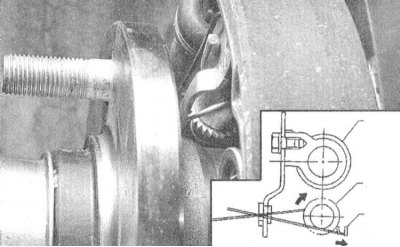 |
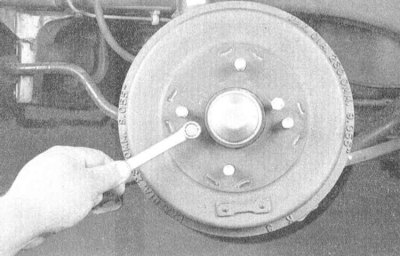 |
Note: The replacement of shoes should be done simultaneously on both brake mechanisms. To avoid confusion during assembly, the dismantling of the brake mechanisms should be done one at a time - the second one can be used as a sample during assembly
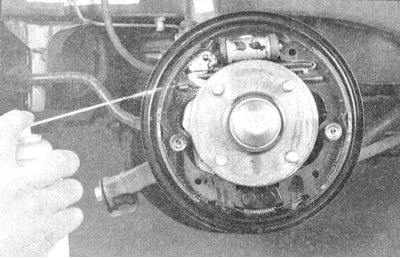
3. Thoroughly clean the mechanism components from brake dust using a special agent.
4. Remove the hub assembly with the wheel bearing (see Chapter Suspension and steering).
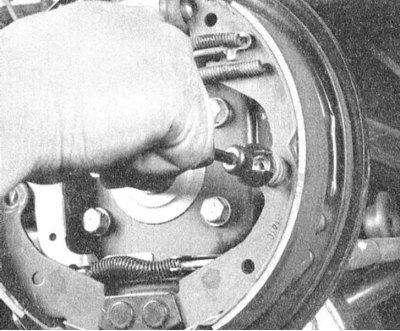
5. Remove the guide springs with their cups from the brake shoes.
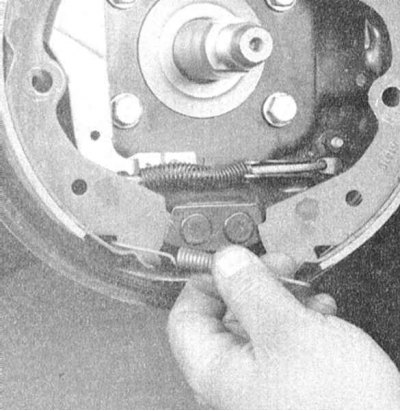
6. Pull the front shoe forward enough to disengage it from the corresponding wheel cylinder piston and anchor plate, then disconnect the lower tension spring from the shoe.
7. Pull back the rear shoe and release it from the second piston of the wheel cylinder.
8. Remove the self-regulator assembly (try to remember the installation position of the assembly).
9. Disconnect the upper tension spring from the front shoe and remove the latter from the brake mechanism.
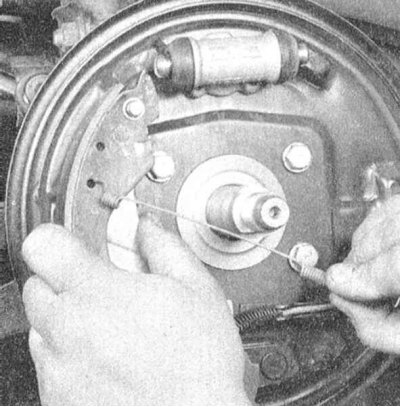
10. Disconnect the upper tension spring from the rear shoe.
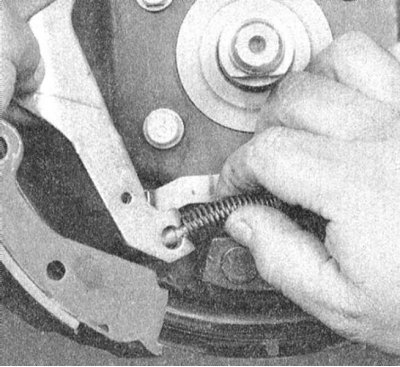
11. Disconnect the parking brake drive cable from the actuator lever on the rear shoe assembly, remove the rear shoe.
12. Pull back the dust boots of the wheel cylinder pistons and check the assembly for signs of developing leaks. If necessary, replace the cylinder (see section Removal and installation wheel cylinders).
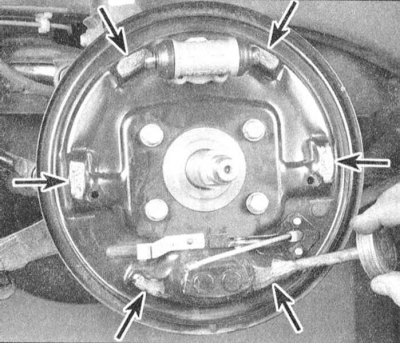
13. Wash the brake shield with a special compound, then lubricate the areas of its surface that contact the shoes with high-temperature grease.
14. Remove the parking brake actuator lever axle retaining ring. Remove the lever and transfer it to the new rear shoe. Do not forget to place a washer under the lever and replace the retaining ring.
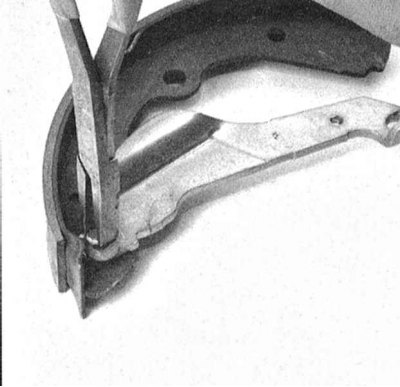
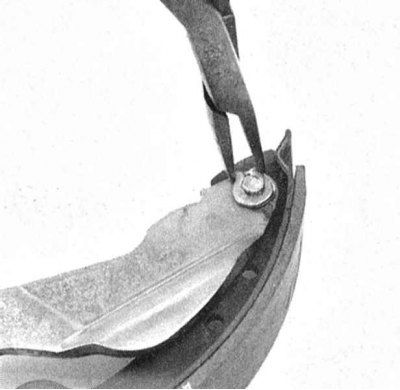
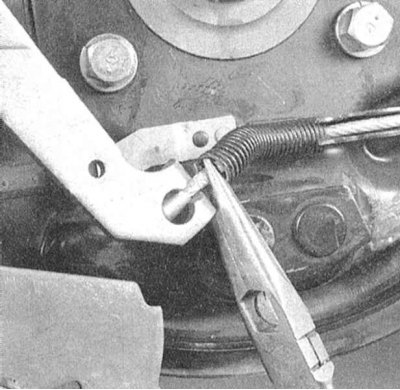
15. Connect the parking brake cable to the actuator lever.
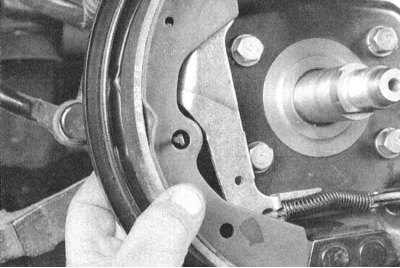
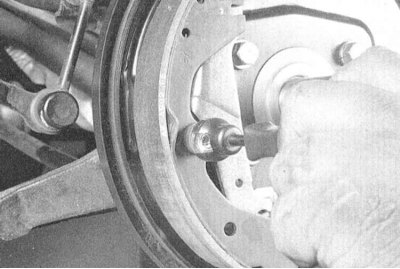
16. Install the rear shoe assembly onto the brake shield. Insert the anchor pin into the hole and install the guide spring with the cup.
 |
 |
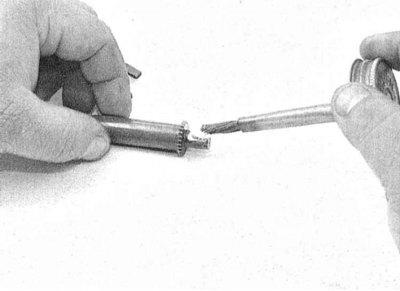
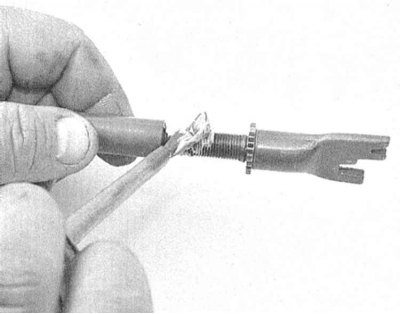
17. Clean the threads of the screw part of the regulator assembly and lubricate it with high-temperature grease. Lubricate the end of the screw shaft with the same grease.
 |
 |
18. Insert the adjuster tip into the mating groove in the rear brake shoe assembly. Make sure that the adjuster is turned correctly on the mechanism.
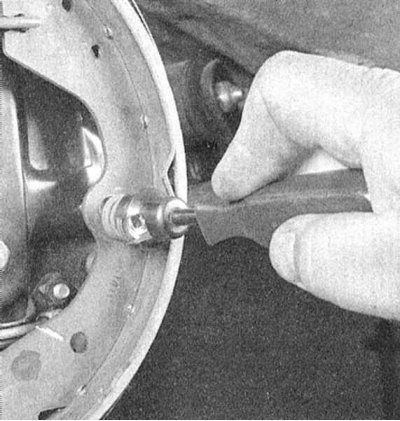
19. Install the front shoe and secure it with the guide spring. Make sure that the adjuster assembly tips engage correctly with both shoes.
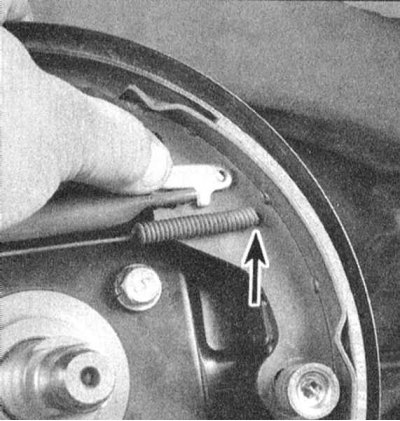
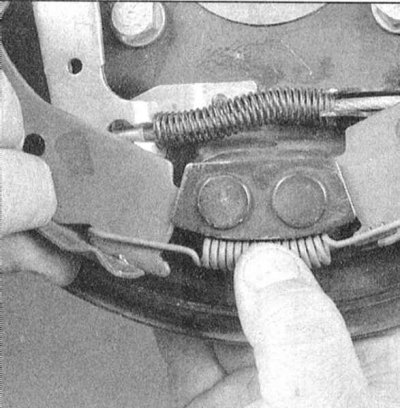
20. Install the tension springs.
 |
 |
21. Before installing the drum, check it for cracks, burrs, grooves, traces of overheating and other defects. If serious damage is detected, traces of which cannot be eliminated by treating the drum with fine-grained sandpaper, the drum should be given for turning (in compliance with the maximum permissible repair diameter).
Note. The authors of this Manual recommend turning the drums regardless of their condition in order to remove any defects and eliminate ovality. If turning the drum cannot be done without violating the requirements for the maximum permissible internal diameter (stamped on the drum), it will have to be replaced. If it is not possible to resurface the drums, at least carefully clean their working surfaces with fine-grained sandpaper.
22. Rotate the adjuster sprocket until the brake shoes are positioned so that the drum can be put on them without any difficulty. After putting on the shoe, press the shoes to the working surface of the drum through the hole in the brake shield by rotating the adjuster sprocket, then release them again so that the drum starts to rotate freely. Firmly press the foot brake pedal several times, then make sure that the drum rotates freely when you release the pedal; if necessary, tighten the adjuster sprocket accordingly.
23. Install the wheel, lower the vehicle to the ground and tighten the wheel nuts to the required torque (see Specifications in Chapter Settings and ongoing maintenance).
24. Brake the vehicle several times while moving both forward and reverse to perform automatic adjustment of the brake mechanisms (don't forget to also apply the parking brake several times).
25. Before operating the vehicle, make sure that the brakes are functioning properly.