


Table of contents: Checking for leaks ↓ Checking the amount of push rod…↓ Replacement ↓ Adjustment ↓
1. Without starting the engine, press the foot brake pedal several times. Make sure there is no change in the amount of reserve pedal travel (distance between pedal and floor).
2. Keeping the pedal depressed, start the engine. If the pedal "sinks" slightly immediately after starting, then the brake booster is working properly.
Checking for leaks
1. Run the engine for a couple of minutes, then turn it off. Slowly press the foot brake pedal several times. If at first the pedal travel gradually decreases with each press, but stabilizes after three or four pumps, then the vacuum booster assembly is not damaged.
2. Press the foot brake pedal while the engine is running. Keep the pedal depressed and turn off the engine. If after 30 seconds of holding the pedal depressed, its reserve travel does not change, then the vacuum booster assembly is not leak-proof.
Checking the amount of push rod protrusion
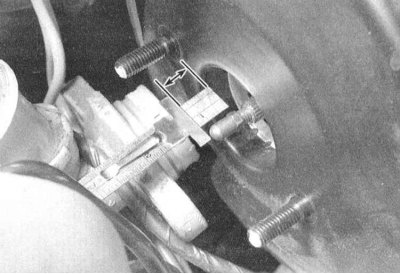
Remove the brake master cylinder assembly from the vacuum booster (see section Removal and installation the master brake cylinder).
Note. There is no need to disconnect the hydraulic lines from the master cylinder - make sure that they are not deformed during the process of retracting the assembly. Using a hand vacuum pump, create a vacuum of about 508 mm Hg in the brake booster servo assembly, press the push rod with a force of about 2 kgf and measure the protrusion length of the rod. Compare the measurement result with the requirements of the Specifications, if necessary, replace the booster assembly.
Replacement
Note: The brake booster unit is not subject to repair and in case of failure must be replaced as an assembly.
1. Remove the GTZ (see section Removal and installation the master brake cylinder).
2. Disconnect the vacuum hose that goes to the booster from the engine. Be careful not to damage the hose when removing it from the nipple on the booster assembly.
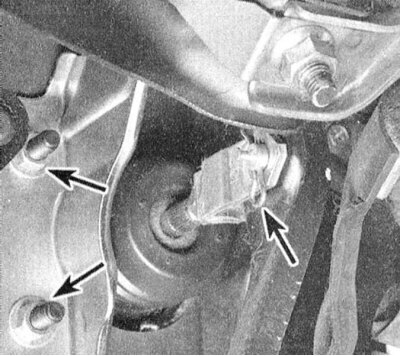
3. In the car's interior, remove the lower section of the trim panel and locate the connection point of the vacuum booster push rod to the foot brake pedal (if necessary, use a pocket flashlight).
4. Remove the cotter pin, take out the roll pin and disconnect the split push rod pin from the pedal lever.
5. From the passenger compartment side, loosen the four nuts securing the vacuum booster assembly to the engine compartment bulkhead and remove the washers (if necessary, use a pocket flashlight).
(The original is available on the web page: «nissanbook.ru»)
6. Go to the engine compartment and remove the vacuum booster assembly from the rear bulkhead. Pull the assembly strictly along the axis of its installation until the push rod is completely released from the bulkhead. Remove the assembly from the engine compartment.
7. Installation is carried out in reverse order (pre-check the correct installation of the adjustment dimensions).
Adjustment
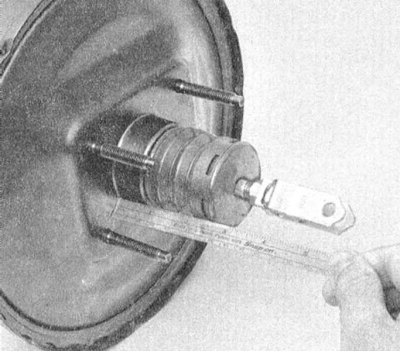
Measure the distance from the end face of the vacuum booster assembly to the hole in the split pin of the push rod. Compare the measurement result with the requirements of the Specifications, if necessary, loosen the lock nut and rotate the split pin to achieve the required value. Do not forget to tighten the lock nut.