


Table of contents: Hydraulic diagram ↓ Schematic diagram of the electrical…↓ Wheel speed sensors ↓ Control unit ↓ Actuator ↓ Actuator relay ↓ Self-diagnosis ↓ Error codes ↓
At speeds below 10 km/h the anti-lock braking system does not work.
After the ignition is turned on, the system performs a self-test, and the ABS indicator lights up for 1 second. When the vehicle reaches 6 km/h for the first time, the system performs a second test. Mechanical noise may be heard during this test, which is normal. If a malfunction is detected during this test, the ABS indicator lights up.
Mechanical noise may be heard when the anti-lock braking system is operating. This is not a sign of a malfunction.
Hydraulic diagram
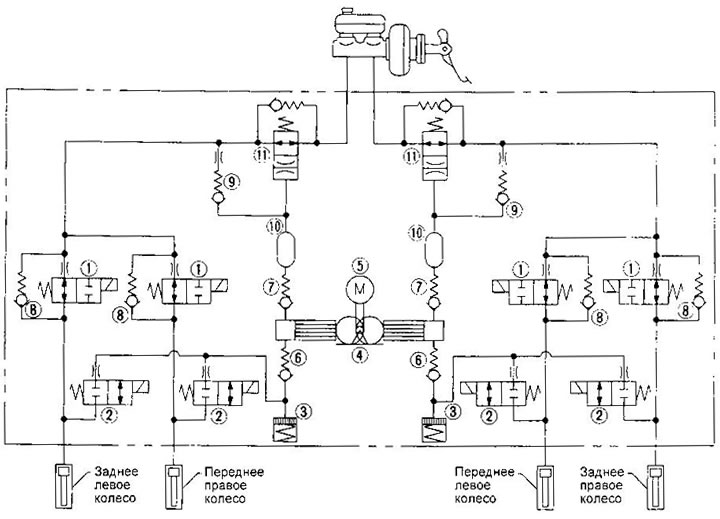
1. Inlet solenoid valve
2. Exhaust solenoid valve
3. Reservoir
4. Pump
5. Pump electric motor
6. Inlet valve
7. Exhaust valve
8. Bypass valve
9. Check valve
10. Receiver
11. Gradient switch
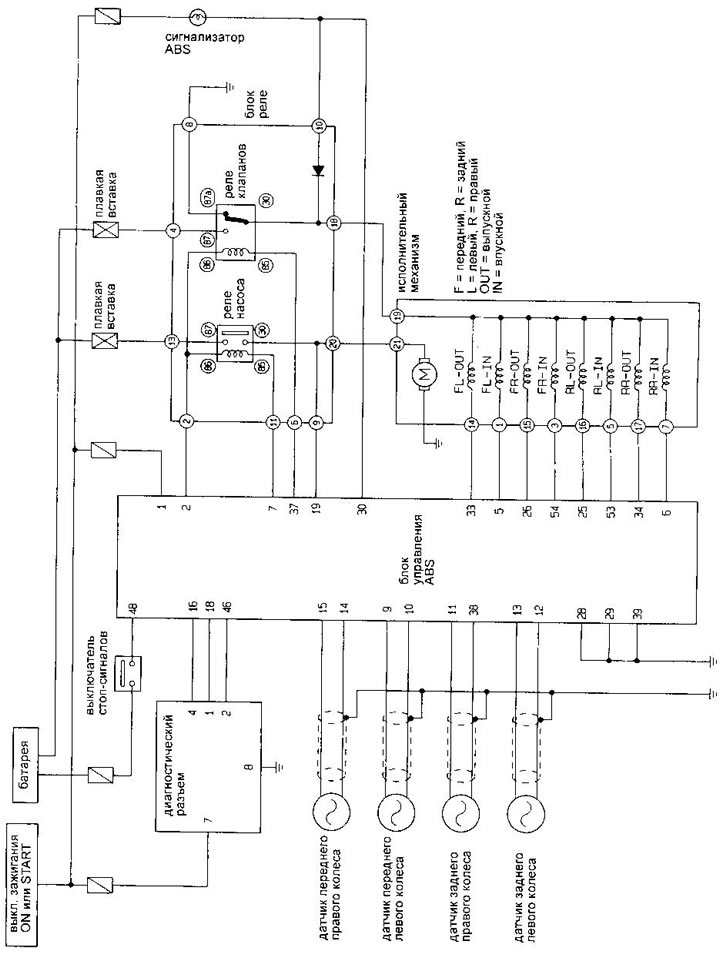
Schematic diagram of the electrical circuit
The text was copied from the portal NISSANBOOK.RU
Wheel speed sensors
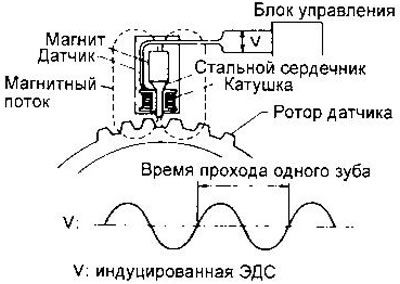
These sensors provide information on the basis of which the ABS control unit generates all control signals. The sensor is a magnet with a coil wound around it. When the rotor teeth, mounted on the rear side of the brake disc, pass the coil core, a sinusoidal EMF is induced in the coil. The frequency and amplitude of the sinusoid increase with increasing wheel speed.
Spot and sensor installation. Be careful not to damage the sensor edge and rotor teeth. When removing the front or rear wheel hub, disconnect the ABS sensor and set it aside.
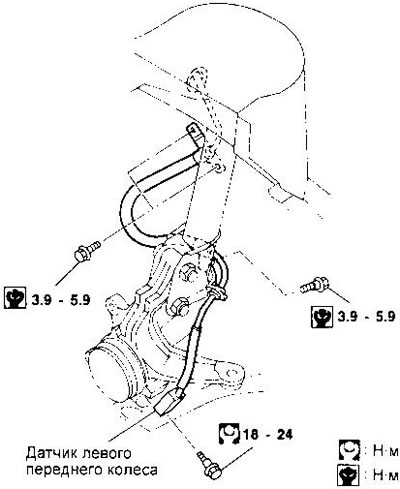
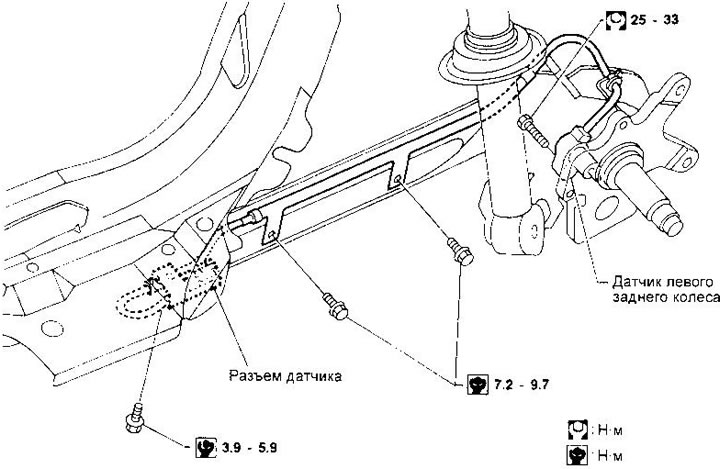
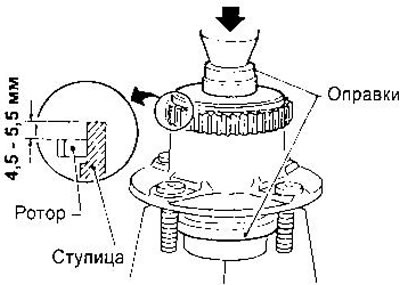
Removal and installation the rotor. First, it is necessary to remove the drive shaft or the rear wheel hub (see chapters "Front suspension and front wheel drive", "Rear suspension"). Use a suitable puller and drift to remove the rotor. Use a hammer and a wooden block as a spacer to press the rotor onto the drive shaft. When pressing the rotor onto the rear wheel hub, observe the distance shown in the figure on the right.
Checking the sensor. Measure the resistance between the sensor connector contacts. It should be within 0.8-1.2 kOhm. Make sure there is no damage to the sensor tip and rotor teeth. The gap between the sensor and the rotor should be 0.1-1.1 mm.
Control unit
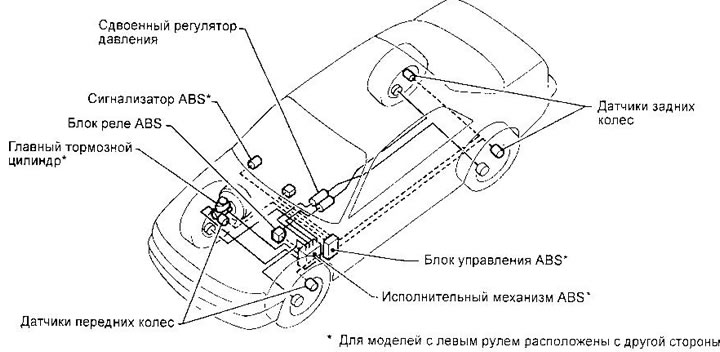
The ABS control unit calculates the wheel speed based on sensor signals and directly controls the operation of the actuator electromagnetic valves, and also switches the valve relay and pump electric motor on and off. If a fault is detected in the electrical circuits, the fault indicator is switched on and the system is switched to a non-operating state. The braking system then operates in the same way as without ABS.
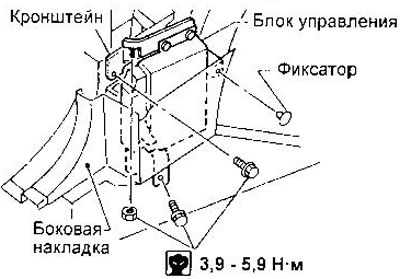
The control unit is located on the passenger side behind the side trim of the instrument panel.
Actuator
The actuator contains inlet and outlet valves for the brake mechanisms of each wheel, as well as a pump driven by an electric motor.
The figure shows the actuator mount in left-hand drive models. In right-hand drive models, the mount is generally similar.
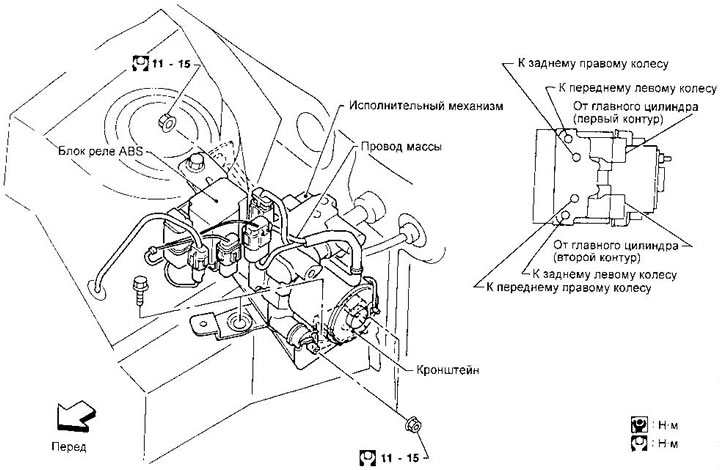
The actuator is removed in the following sequence:
1. Disconnect the wires from the battery.
2. Drain the brake fluid.
3. Discharge the air conditioning system.
4. Disconnect all connectors from the ABS relay bracket.
5. Loosen the relay bracket mounting bolt.
6. Remove the relay block together with the bracket. Remove the low pressure air conditioner pipes.
8. Disconnect the brake lines from the actuator (there is no need to remove the pipes from the vehicle).
9. Unscrew the nuts securing the actuator to the bracket.
10. Remove the actuator as shown in the figure.
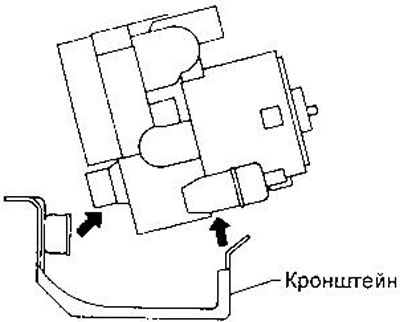
Installation is carried out in reverse order.
Actuator relay
To access the relay, remove the relay box cover.
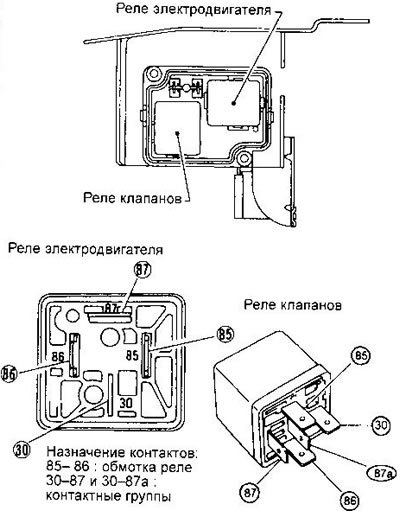
Self-diagnosis
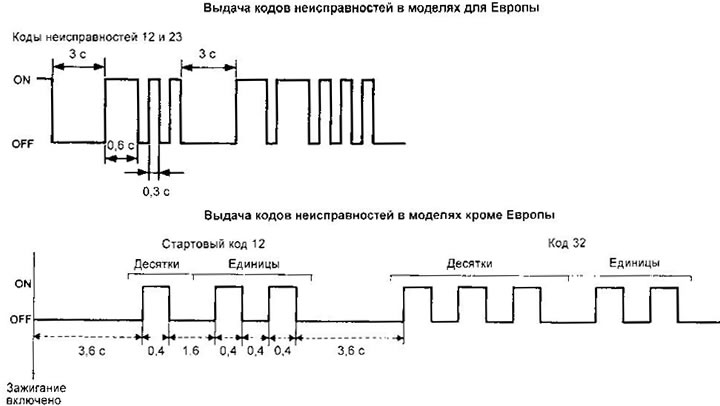
Models for Europe. To display the self-diagnostic results on the ABS indicator, drive at a speed of at least 15 km/h for at least one minute, then stop with the engine running. The control unit memory can store up to three faults. To erase fault codes from the memory, disconnect the control unit connector or ground wire from the battery for at least one minute.
The fault codes are separated by a 3-second pause. Tens are indicated by long flashes (0.6 s), units by short ones (0.3 s).
Models except Europe. To enter the self-diagnosis mode, turn off the ignition, short-circuit the L contact of the diagnostic connector to ground with a suitable conductor and turn on the ignition. The brake pedal should not be pressed. After 3.6 seconds, the ABS indicator will start flashing, showing the fault code.
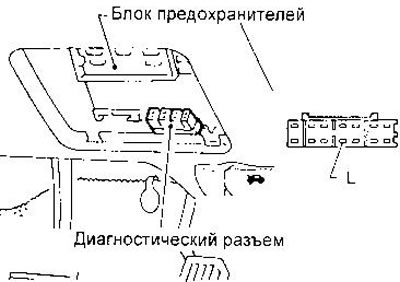
The indication stops after 5 minutes. However, after turning the ignition off and then on again, the indication will resume.
To switch to normal operation, disconnect contact L from ground and turn off the ignition.
To clear fault codes, disconnect terminal L from ground (the alarm will remain a handful) and then short it to ground 3 times within 12.5 seconds. The duration of each short circuit should be at least 1 second. After erasing is complete, the indicator will go out.
To check the system after repair, drive at a speed of at least 30 km/h for at least one minute. The ABS indicator should not light.
Error codes
| Code | Defective element |
| 45 | Front left exhaust valve |
| 4ft | Front left intake valve |
| 41 | Front right exhaust valve |
| 42 | Front right intake valve |
| 51 | Rear right exhaust valve |
| 52 | Rear right intake valve |
| 55 | Rear left exhaust valve |
| 56 | Rear left intake valve |
| 25 | Front left sensor (open circuit) |
| 26 | Front left sensor (short circuit) |
| 21 | Front right sensor (open circuit) |
| 22 | Front right sensor (short circuit) |
| 35 | Rear left sensor (open circuit) |
| 36 | Rear left sensor (short circuit) |
| 31 | Rear right sensor (open circuit) |
| 32 | Rear right sensor (short circuit) |
| 18 | Sensor rotor |
| 61 | Electric motor or its relay |
| 63 | Valve relay |
| 57 | Power supply (low voltage) |
| 71 | Control unit |
If the ABS indicator does not go out after the ignition is turned on, there may be faults in the power supply circuit of the control unit, in the indicator circuit, in the control unit or its connector, in the power supply circuit of the valve relay winding, or the valve relay is stuck.
If the indicator is constantly on or does not turn on in self-diagnostic mode, the control unit is faulty.
If the indicator does not light when the ignition is turned on, it is necessary to check the fuse, the indicator lamp and its circuit. The control unit may also be faulty.