


Table of contents: Electrically controlled clutch ↓ All-wheel drive (AWD) control unit ↓ All-wheel drive lock switch ↓
AWD system components
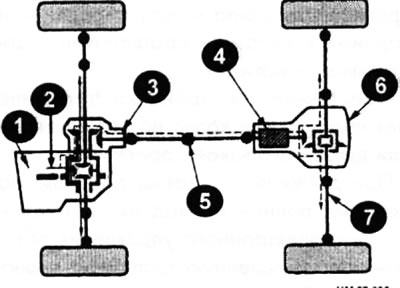
1 - CVT with drive axle; 2 - engine; 3 — transfer case; 4 - electrically controlled clutch; 5 - cardan shaft; 6 — rear final drive; 7 — rear drive shaft.
Electrically controlled clutch
- In response to the control current from the all-wheel drive (AWD) control unit, a pulling force is generated on the controlled clutch solenoid, and torque appears on the controlled clutch.
- The cam, reacting to the torque of the controlled clutch, transmits force to the main clutch.
- The main clutch transmits torque from the input shaft to the output shaft in accordance with the magnitude of the force.
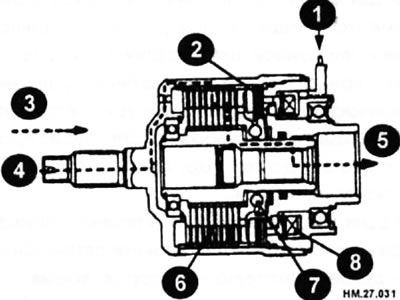
1 - control current from the all-wheel drive control unit; 2 - controlled clutch; 3 - direction of torque transmission; 4 - cardan shaft; 5 - rear axle; 6 - main clutch; 7 — cam; 8 - electromagnet.
- The true magnitude of the transmitted torque is proportional to the magnitude of the control current.
All-wheel drive (AWD) control unit
- Controls torque distribution (traction force) between front-wheel drive(distribution 1 00:1) and all-wheel drive (50:50) in accordance with signals from sensors.
- If a fault occurs in the all-wheel drive system, the AWD indicator light on the instrument panel will illuminate and the vehicle will switch to front-wheel drive mode:
Self-diagnosis is carried out using a scanner.
All-wheel drive lock switch
AUTO mode
- Electronic control allows for optimal distribution of torque between the front and rear wheels according to road conditions.
- Ensures stable movement without wheel slippage on snowy or other slippery roads.
- When driving on roads where all-wheel drive is not required, the electronic control system provides improved fuel economy by driving in conditions close to front-wheel drive mode. The sensors detect the cornering mode, and in accordance with the cornering steepness and braking mode, part of the torque is transferred to the rear wheels.
- When the vehicle is driving in AUTO or LOCK mode, when there is a large difference in the speed of the front and rear wheels for a long time, the oil temperature in the transmission becomes too high, and the all-wheel drive warning light (AWD) will start flashing rapidly. When the indicator lamp flashes rapidly, the vehicle is in front-wheel drive mode.
- When driving in AUTO mode, the AWD indicator light will flash slowly if there is a significant difference in tire pressure or wear between the different wheels. During this time, the vehicle will not operate fully efficiently and care must be taken when driving. This will continue until the engine is turned off.
- If the 4WD indicator light is flashing rapidly, stop the vehicle and let the engine idle for a while. The lamp will stop flashing and the AUTO mode will be restored.
- If the indicator lamp flashes slowly while driving but does not light up after restarting the engine, the system is operating normally. If after driving for some time the light starts flashing slowly again, the vehicle needs to be checked.
- If a difference in front and rear wheel speeds is detected while driving in AUTO mode, AUTO mode will automatically switch to LOCK mode. This is not a malfunction.
LOCK mode (the AWD LOCK indicator light is on)
- The distribution of torque between the front and rear wheels is fixed, which ensures stable movement on climbs.
- If LOCK mode is selected and the vehicle's speed increases, LOCK mode automatically switches to AUTO mode. If the vehicle's speed then decreases, the vehicle automatically reverts to all-wheel drive.
- If there is a significant difference in tire pressure or wear between different wheels, the vehicle will not operate fully efficiently. Depending on the condition of the tires, the LOCK mode may be disabled or may only be enabled in a limited speed range.
All-wheel drive (AWD) indicator light
- This indicator lamp comes on when a fault occurs in the all-wheel drive system. When the indicator lamp comes on, it indicates that the emergency mode is activated and the vehicle switches to front-wheel drive mode.
- The control lamp also lights up when the ignition is turned on in order to check the lamp. If the AWD system is operating normally, the light will go out approximately 1 second after the engine is started.
All-wheel drive (AWD) system diagnostics
| Verification conditions | Indicator lamp indication |
| Checking the lamp | Turns on when the engine starts to check the lamp's functionality. Goes out approximately 1 second after the engine starts |
| Malfunction in the all-wheel drive system | Lights up if there is a fault in the all-wheel drive system |
| Large difference in tire diameters between the front and rear wheels | The all-wheel drive indicator lamp flashes once every 2 seconds |
| The difference in rotation speed between the front and rear wheels and the increase in oil temperature in the all-wheel drive system | The all-wheel drive indicator light flashes twice per second |
| Conditions other than those specified above | The control lamp does not light |