


Attention! The procedure described below applies only to gearboxes before 1993. Gearbox repairs after 1993 are performed at a car service center.
Stage 1 of disassembly
1. Clean and wash the gearbox housing.
2. Remove the lever boot from the clutch housing.
3. Remove the release bearing and hub together with the lever (Chapter 8).
4. Remove all switches from the gearbox housing (photo).
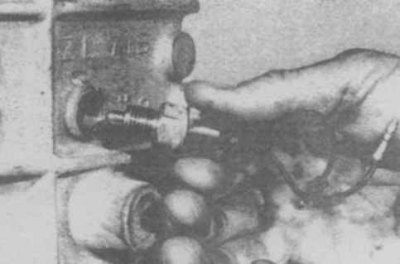
4.4 Unscrew the switches from the gearbox housing
5. On rear-wheel drive vehicles, unscrew the bolts and remove the speedometer gearbox (photo).
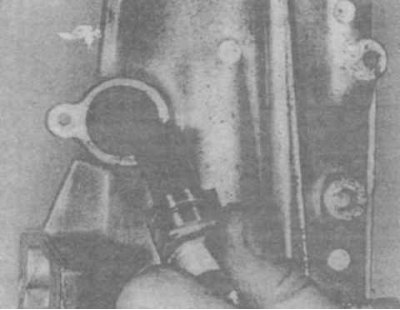
4.5 Removing the speedometer gearbox
6. Remove the retaining ring and knock out the pin (photo).
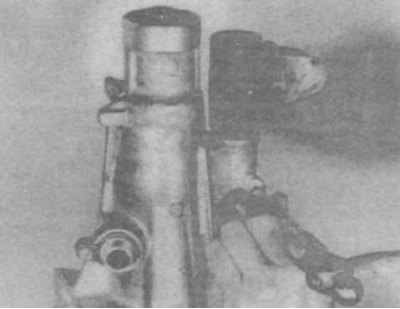
4.6 Removing the pin
7. Unscrew the plug, remove the spring and plunger (photo).
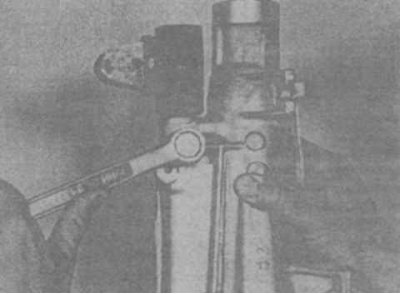
4.7 Unscrewing the plug.
8. Unscrew the two screws and remove the reverse limiting sleeve (photo).
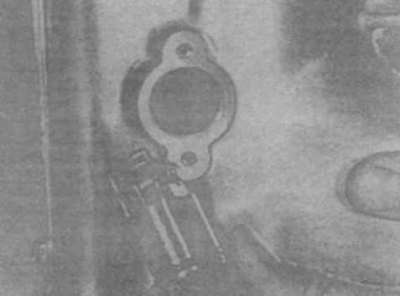
4.8 Reverse limiting sleeve
9. Unscrew the two bolts and separate the rear cover from the gearbox housing (photo).
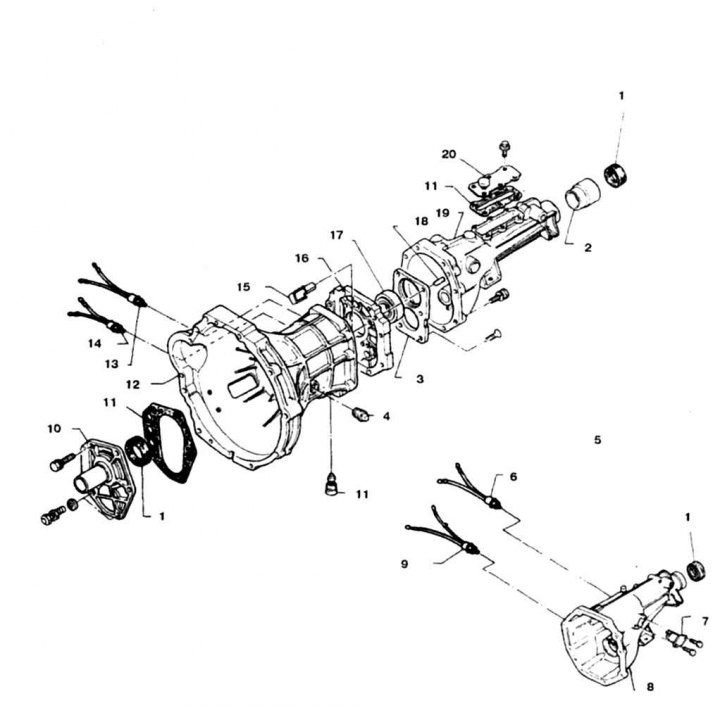
4.9a Parts of the housing of 4- and 5-speed gearboxes of early production
1. Seal; 2. Dust cover; 3. Bearing housing; 4. Filler cap; 5. 5-speed gearbox; 6. Neutral position switch; 7. Reverse limiting sleeve; 8. Back cover
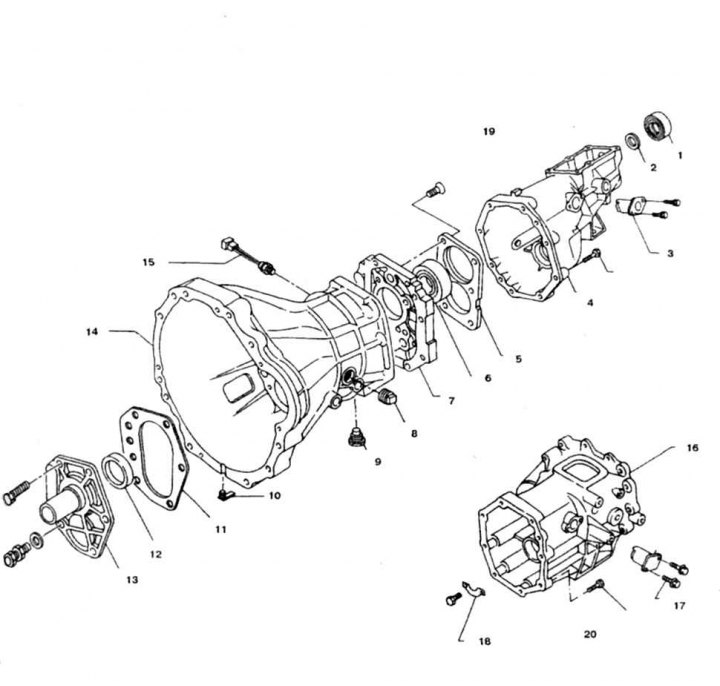
4.9b Parts of the 5-speed gearbox housing FS5W71B/C
1. Dust cover; 2, 12. Seal; 3, 17. Reverse limiting sleeve; 4. Back cover; 5. Bearing housing; 6. Bearing; 7. Transition section; 8. Filler cap; 9. Drain plug
10. Loosen the bolts and remove the front cover, remove the adjusting washer and bearing retaining ring (photo).
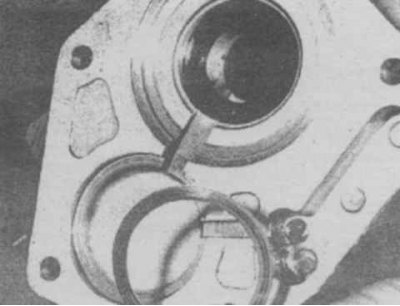
4.10 When removing the front cover, the adjusting washer falls out
11. Separate and remove the gearbox housing.
12. Clamp the transition section of the crankcase in a vice, bolting the auxiliary plate (make it yourself).
13. Knock out the gear shift fork pins (photo).
14. Unscrew all three fastener plugs.
15. Remove the fork stems (photo).
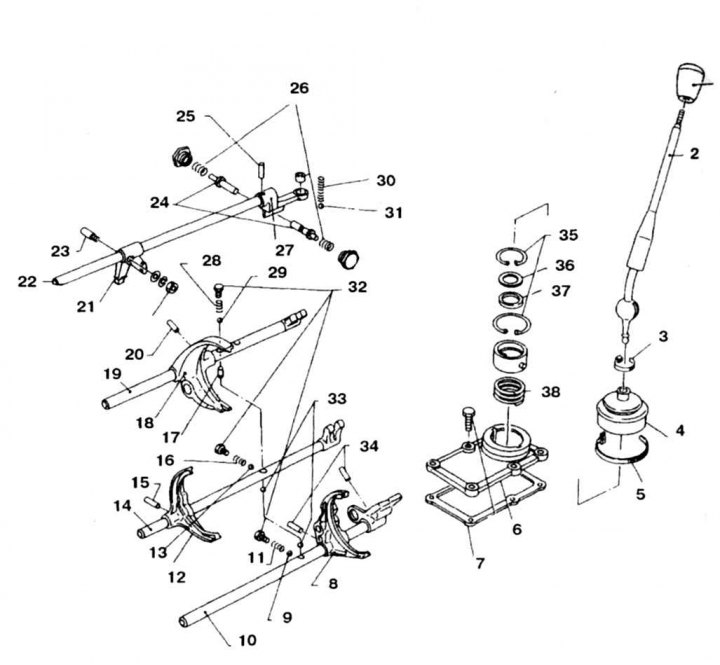
4.15a Gear shift mechanism parts for transmissions manufactured before 1993.
1. Handle; 2. Lever; 3. Upper retaining ring of the cover; 4. Cover; 5. Bottom clamp; 6. Lid; 7. Gasket; 8. Fork for engaging 5th gear and reverse; 9, 13, 29, 31, 33. Locking ball
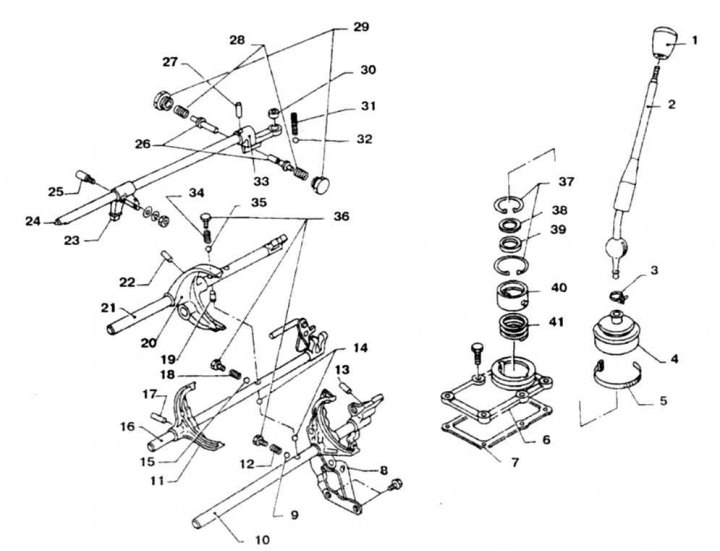
4.15b Gear shift mechanism parts for transmissions produced after 1993. (for rear-wheel drive vehicles)
1. Handle; 2. Lever; 3. Upper retaining ring of the cover; 4. Cover; 5. Bottom clamp; 6. Lid; 7. Gasket; 8. Fork for engaging 5th gear and reverse
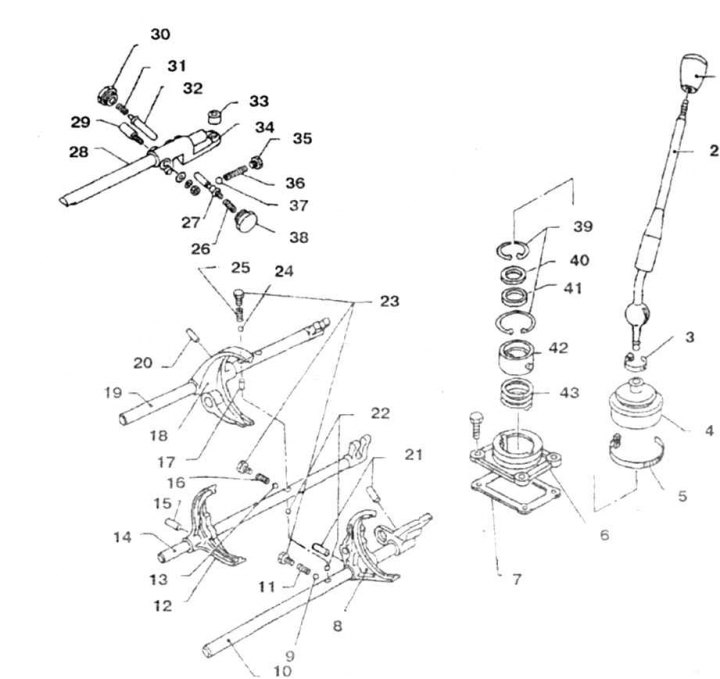
4.15v Gear shift mechanism parts for transmissions produced after 1993. (for all-wheel drive vehicles)
1. Handle; 2. Lever; 3. Upper retaining ring of the cover; 4. Cover; 5. Bottom clamp; 6. Lid; 7. Gasket; 8. Fork for engaging 5th gear and reverse
16. As you remove the rods, remove the forks and balls with springs. The smaller diameter balls are the detent balls.
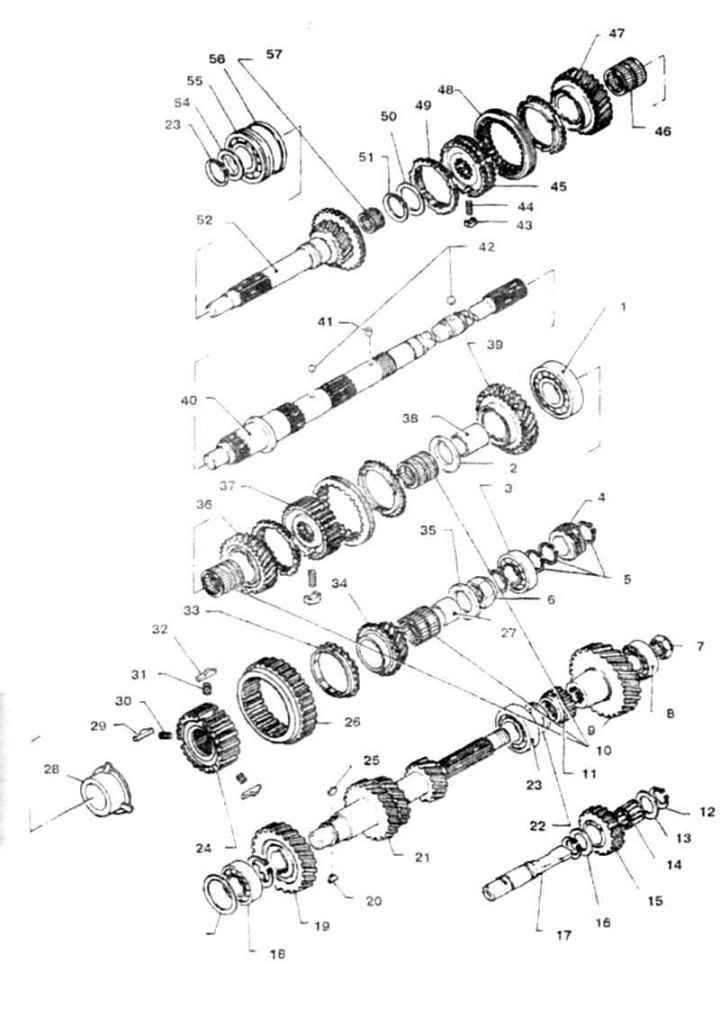
4.17a Gearbox parts FS5W71B/C (until 1993.)
1. Secondary shaft bearing; 2, 13, 16. Thrust washer; 3. Bearing of the driven gear of the 5th gear; 4. Speedometer gear drive pinion; 5, 12, 51, 53, 56. Retaining ring; 6, 7. Nut; 8. Intermediate shaft rear bearing
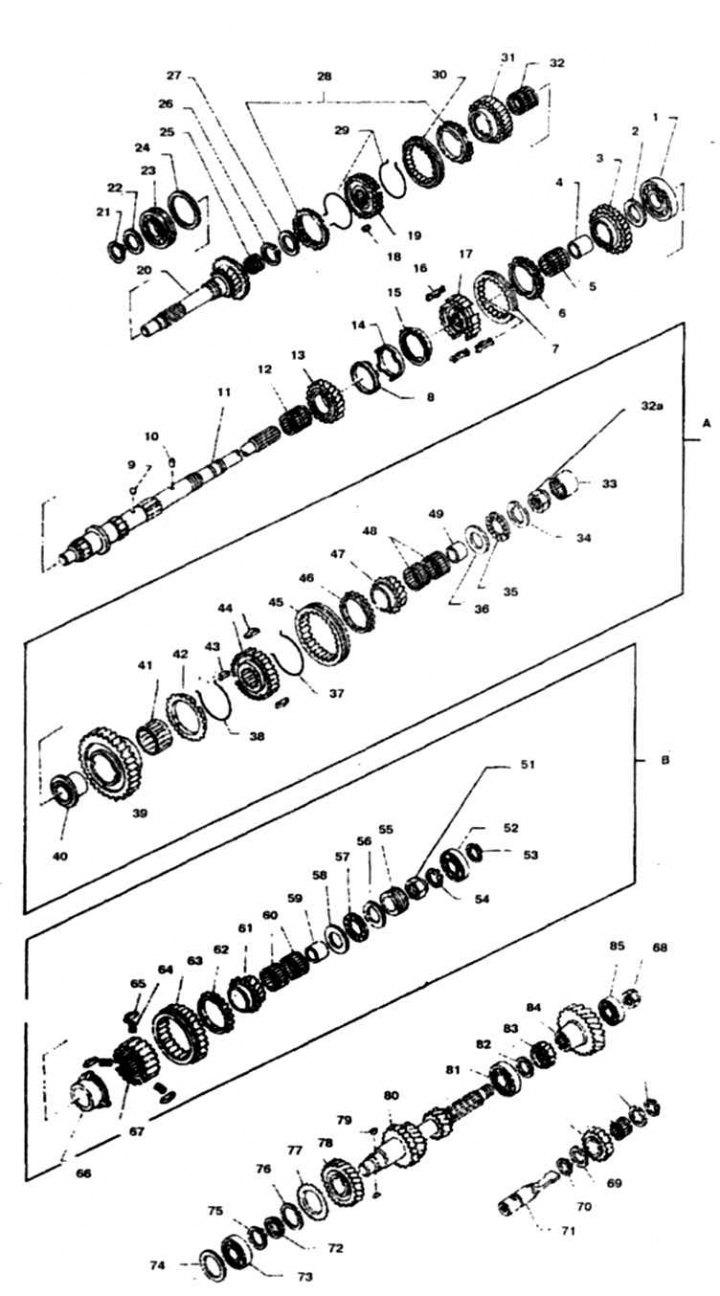
4.176 Gearbox parts FS5W71B/C (after 1993.)
1. Secondary shaft bearing; 2, 13, 16. Thrust washer; 3. 1st gear driven gear; 4. Bushing; 5, 12, 32. Needle bearing; 6, 28. Synchronizer locking ring; 7, 30. Synchronizer clutch; 8. Internal
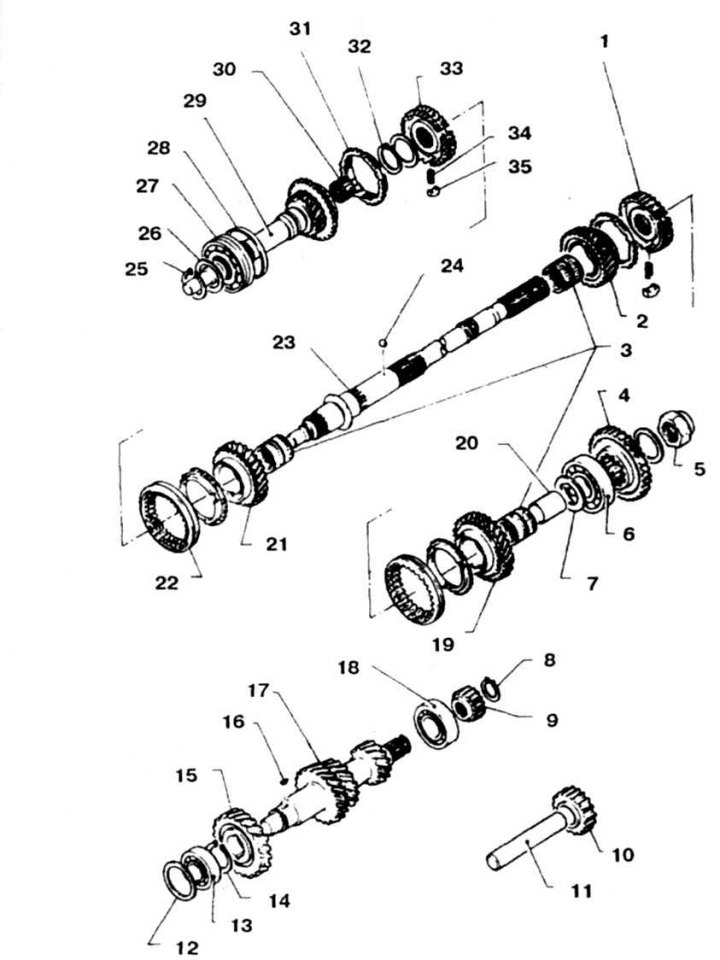
4.17v Details of 4-speed gearbox F4W71B/C
1. 1st and 2nd gear synchronizer hub; 2. 2nd gear driven gear; 3. Needle bearing; 4. Reverse driven gear; 5. Secondary shaft nut; 6, 13, 27. Bearing; 7. Thrust washer; 8, 25, 28, 32, 34. Retaining ring
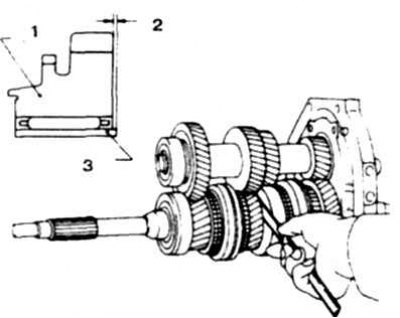
4.18 Checking the axial play of the gearbox gears
1. Gear; 2. End gap; 3. Secondary shaft or sleeve
19. If damage is observed and the play exceeds the norm, then completely disassemble the gearbox and replace the worn parts
20. Press off the front bearing of the intermediate shaft using a puller.
21. Remove the retaining ring.
22. Carefully remove the intermediate and primary shafts.
23. Remove the retaining ring and thrust washer from the input shaft.
24. Remove the 3rd and 4th gear synchronizer and the 3rd gear pinion.
25. Use a hammer and punch to straighten the punched areas of the secondary and intermediate shaft nuts.
26. Remove the reverse gear and adjusting washer.
27. Press off the 5th gear pinion and bearing
28. Unscrew the intermediate shaft nut (the nut needs to be replaced).
29. Remove the retaining ring and remove the reverse idler gear.
30. Remove the retaining ring and remove the speedometer gear.
31. Remove 2 retaining rings and remove the secondary shaft bearing.
32. Unscrew the primary shaft nut (the nut needs to be replaced).
33. Remove the thrust washer, bushing, needle bearing, 5th gear pinion, reverse driven gear, synchronizer and collar.
34. Carefully knock the secondary and intermediate shafts out of the transition section.
Secondary shaft
35. Check the condition of the shaft splines and gear teeth, disassemble and replace worn gears.
36. Check the condition of the shaft (wear of splines, violation of their straightness, wear, taper).
37. Check the condition of the synchronizers, especially if the operation of the gearbox was accompanied by noise.
38. Fit the locking rings tightly onto the gears and check the clearance between the gear ring (photo).
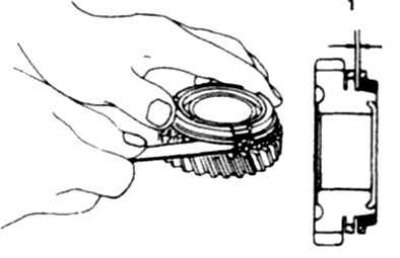
4.38 Checking the clearance between the pinion ring and the synchronizer locking ring
1. Gap
39. When assembling the synchronizer, make sure that the ends of the retaining rings on both sides of the hub fit into different grooves.
40. Begin assembly by installing the needle bearing on the secondary shaft. Then install the 2nd gear pinion, the locking ring and the 1st and 2nd gear synchronizer, ensuring that they are installed correctly.
41. Install the 1st gear locking ring, needle bearing, ball (lubricate before assembly), washer, bushing and 1st gear.
Intermediate shaft
42. The front bearing of the intermediate shaft is removed when disassembling the gearbox.
43. The rear shaft bearing remains in the transition section of the crankcase.
44. Remove the drive gear and take out the 2 keys.
45. Check the condition of the shaft splines and gear teeth.
46. Assembly is carried out in reverse order.
Primary shaft
47. Remove the retaining ring and adjusting washer.
48. Press the bearing (subject to replacement).
49. Press the new bearing onto the outer race.
50. Put on the washer.
51. Select a washer of sufficient thickness to compensate for axial play.
[Information copied from the portal: www.NissanBook.ru]
Seals
52. Press out the rear oil seal and press in a new one.
53. Install the speedometer gear seal ring.
54. Replace the front oil seal by pressing in a new one using a mandrel.
Rear section of the crankcase
55. Loosen the slider rod pin nut and unscrew it halfway.
56. Press out the pin, holding onto the nut (photo).
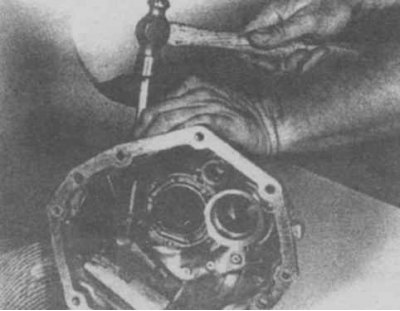
4.56 Removing the pin from the slide rod
57. Remove the lever from the rod and take out the rod.
58. Check the condition of the rod and lever, replace if necessary. Replace the rod seal.
59. Check the condition of the bushing in the rear part of the section; if cracks or wear are detected, replace the section.
60. Install the slide rod in reverse order.
Assembly
61. Remove the intermediate and secondary shaft bearings from the transition section of the crankcase and check their condition. To do this, unscrew the 6 holder screws on the transition section.
62. Press out the bearings, resting against the outer races.
63. After washing, check the bearings for free rotation. If they jam, make increased noise when rotating, or if the races become loose, replace the bearings.
64. Check the press fit of the guide pins in the transition section of the crankcase.
65. Press the bearings into the transition section using light blows.
66. Press the intermediate gear shaft into the transition section by 2/3 of its length so that a fits into the slot
the bearing lock plate was moving on the shaft.
67. Install the lock plate and tighten the screws to the specified torque.
68. Punch the screws to prevent them from loosening.
69. Carefully press the intermediate shaft rear bearing into the transition section.
70. Press the secondary shaft into the transition section, resting against the inner bearing race.
71. Press in the intermediate shaft.
72. Place the needle bearing, 3rd gear gear, locking ring and 3rd and 4th gear synchronizer on the secondary shaft.
73. Install the thrust washer and retaining ring, selecting the correct thickness to minimize axial play (see table below).
74. Place the guide needle bearing on the input shaft.
75. Engage the primary shaft pinion with the 4th gear pinion. Engage the primary shaft with the pinion with the secondary and intermediate shafts. Press in the secondary shaft pinion with a piece of pipe of a suitable diameter.
76. Install the intermediate shaft drive gear retaining ring, selecting its thickness to minimize axial play (see table below).
77. Using a mandrel, press the bearing onto the intermediate shaft.
78. Place the reverse gear spacer washer on the intermediate shaft.
79. Install the retaining ring, thrust washer, needle bearing, reverse intermediate pinion, intermediate pinion thrust washer, intermediate pinion thrust washer, and rear retaining ring on the intermediate pinion shaft.
80. Install the collar on the rear side of the secondary shaft (if provided), synchronizer, reverse driven gear, sleeve, needle bearing and locking ring.
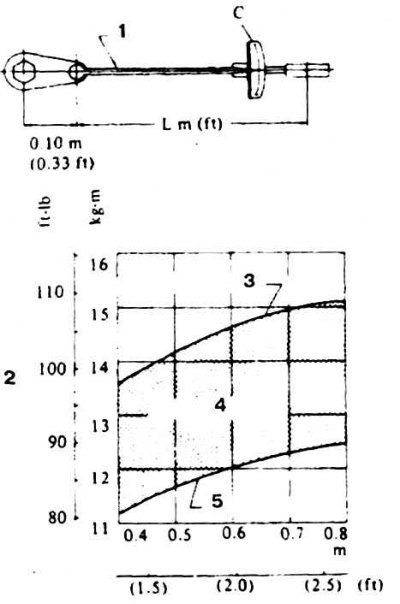
4.85 Actual tightening torque dependence (with extension cord) from the indication on the key scale
1. Torque wrench; 2. Reading moment; 3. Upper limit; 4. Transformed moment; 5. Lower limit
81. Place the reverse drive gear on the intermediate shaft.
82. Engage both 5th gear pinions and place them on the intermediate and secondary shafts.
83. Lubricate the ball with grease and install the ball and thrust washer on the rear side of the secondary shaft.
84. Install the new secondary shaft nut and tighten to the specified torque.
Attention! To tighten the gearbox secondary shaft nut with the specified torque, use an extension (photo) on the torque wrench. In this case, determine the actual tightening torque from the attached diagram (photo).
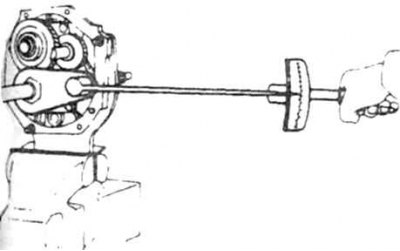
4.84 Tightening the secondary shaft nut
85. Install the intermediate shaft rear bearing (photo).
86. Tighten the intermediate shaft nut to the specified torque.
87. Punch the shaft nuts so that the nut crowns fit into the grooves on the shafts.
88. Check the end clearance of the gears (see above).
89. Place the retaining ring on the secondary shaft and press on the rear bearing.
90. Select the rear retaining ring by thickness (see table).
91. Install the retaining ring, lubricate the ball and install the ball and the speedometer reduction gear drive gear on the secondary shaft. Install the outer retaining ring.
92. Install the fork on the synchronizer sleeve of the 1st and 2nd gears. The extended part of the fork should be facing the intermediate shaft. Install the fork on the synchronizer sleeve of the 3rd and 4th gears. The extended part of the fork should be facing the opposite direction.
93. Install the fork onto the 5th and reverse gear synchronizer sleeve. The upper hole in the fork rod should be in line with the 3rd and 4th gear fork.
94. Insert the 1st/2nd gear fork rod into the hole in the transition section and into the fork. Align the holes and press in the new pin.
95. Align the recess in the stem with the hole and insert the ball, spring and screw on the plug, lightly lubricating it with sealant.
96. Turn over the transition section with shafts and forks so that the assembled lock is in the extreme lower position. Lower 2 balls into the hole for the 3rd and 4th gear lock and using a thin tool feed the balls until they stop in the 1st and 2nd gear fork rod (if the transition section is installed correctly, the balls should fit into place). Pass the 3rd and 4th gear rod through the upper hole in the 5th and reverse fork and the transition section and insert it into the 3rd and 4th gear fork. The balls should be between the rod being installed and the 1st and 2nd gear fork rod. Align the holes in the fork and rod and press in a new pin. Insert the ball, spring and plug into the 3rd and 4th gear lock hole, lightly lubricating it with sealant. Before installing the lock ball, make sure that the groove in the rod matches the hole.
97. Lower 2 balls into the remaining hole. Insert the 5th gear and reverse fork rod into the hole in the fork and in the transition section. Make sure that the balls are between the rod being installed and the 3rd and 4th gear fork rod. Make sure that the hole in the retainer matches the recess on the rod and insert the ball, spring into the hole and screw on the plug with sealant. Align the holes in the fork and the rod being installed and press in the new pin.
98. Tighten all 3 plugs to the specified torque.
99. Lubricate the rods and check that they move smoothly.
100. Clean the separating surfaces of the crankcase and transition section and lubricate with sealant.
101. Carefully place the crankcase on the transition section, making sure that the intermediate and secondary shaft bearings fit into the crankcase grooves. Lightly tap the crankcase into place.
102. Install the input shaft bearing retaining ring.
103. Clean the separating surfaces of the transition and rear sections, lubricate with sealant.
104. Move the forks to neutral position and install the rear section, the slider lever should engage with the gear selector rods.
105. Tighten the crankcase section bolts to the specified torque.
106. Check the protrusion A of the front bearing of the intermediate shaft relative to the plane of the crankcase (photo) and select an adjusting washer according to thickness (see table).
Table
| Measurement (mm) | Washer thickness (mm) |
| 2,92-3,01 | 0,6 |
| 3,02-3,11 | 0,5 |
| 3,12-3,21 | 0,4 |
| 3,22-3,31 | 0,3 |
| 3,32-3,41 | 0,2 |
| 3,42-3.51 | 0,1 |
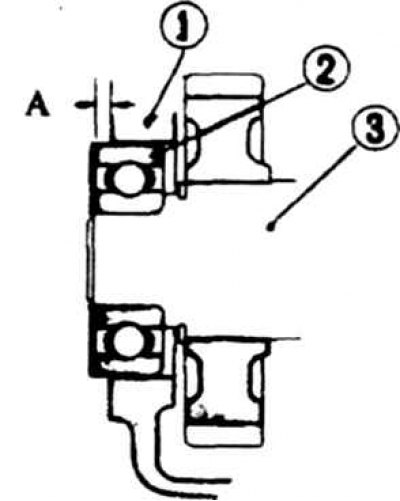
4.106 Checking the protrusion A to select the thickness of the adjusting washer
1. Carter; 2. Bearing; 3. Intermediate shaft
107. Secure the washer with thick grease and fit the front cover with a new seal and a new gasket, being careful not to damage the seal.
108. Apply sealant and tighten the cover bolts to the specified torque.
109. The remaining operations are performed in reverse order.