


Table of contents: General information ↓ Installing a towbar connector ↓ Installing a trailer plug ↓
General information
There are several types of towbar connectors available, each with a different terminal arrangement. The most common is the 7-pin connector, which provides two additional circuits, typically used to supply power to the reversing lights and the trailer's electric brakes.
When installing a towbar, it may be necessary to replace the old turn signal flasher with a more powerful one in order to maintain the flashing frequency of the signal lights specified in the traffic regulations adopted in a particular region. The authorities of some regions also require mandatory installation of turn signal repeaters on the instrument panel.
If the towbar connector's receiving socket does not match the size of the plug installed on the trailer, you should purchase one of the suitable adapters available (see accompanying illustration).
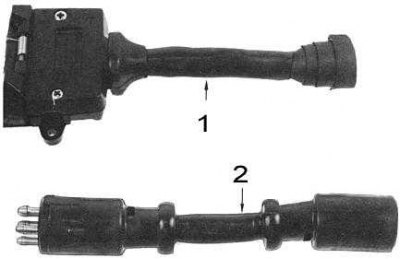
1 - for connecting a Brylite type plug to a Utilux type socket
2 - for connecting a 6-pin Utilux type plug to a 5-pin Utilux type socket
Installing a towbar connector
Note: To equip a trailer hitch with a towbar socket, you will need: (to a minimum): trailer plug-matching socket, support bracket, 7-core flexible cable, insulated wire connectors and rubber grommet.
Necessary components for trailer power supply equipment using a Utilux type towbar connector
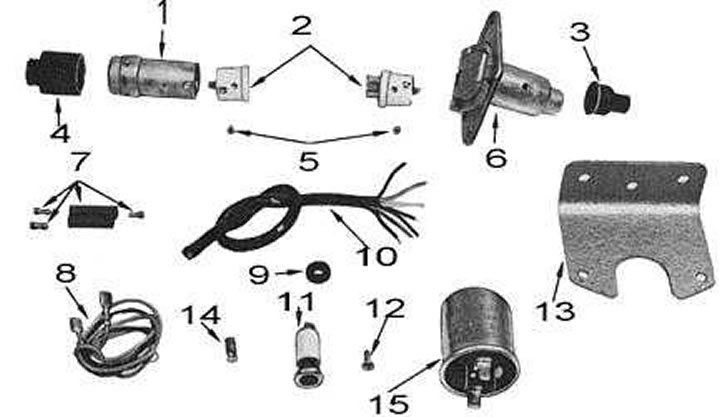
1 - plug; 2 - terminal blocks; 3 - dust cover; 4 - dust cover; 5 - screws; 6 - nest; 7 - connector for connecting wires; 8 - wire; 9 - bushing,; 10 - 7 - core flexible cable; 11 - control repeater; 12 - screw; 13 - support bracket; 14 - lamp
1. Disconnect the negative cable from the battery.
2. Locate the wiring harness for the lights at the rear of the vehicle.
3. Locate the power wires for the right and left rear turn signals, rear parking lights, brake lights, reversing lights and ground. Using the wiring diagrams at the end of this Chapter, determine the color coding of each of the listed wires.
4. Using insulated connectors, connect a 7-wire flexible cable to each of the found wires.
5. If using a 7-pin type towbar connector, please adhere to the following standard color coding scheme:
| Terminal No | Circuit | Color |
| 1 | Left turn signal lamp | Yellow |
| 2 | Reverse light lamp | Black |
| 3 | Weight | White |
| 4 | Right turn signal lamp | Green |
| 5 | Electric brakes | Blue |
| 6 | Brake light bulb | Red |
| 7 | Parking light bulb | Brown |
6. If using a 6-pin type towbar connector, please adhere to the following standard color coding scheme:
| Terminal No | Circuit | Color |
| 1 | Parking light bulb | Brown |
| 2 | Left turn signal lamp | Yellow |
| 3 | Right turn signal lamp | Green |
| 4 | Brake light bulb | Red |
| 5 | Auxiliary circuit | Blue |
| 6 | Weight | White |
7. If using a 5-pin type towbar connector, please adhere to the following standard color coding scheme:
| Terminal No | Circuit | Color |
| 1 | Left turn signal lamp | Yellow |
| 2 | Weight | White |
| 3 | Right turn signal lamp | Green |
| 4 | Brake light bulb | Red |
| 5 | Parking light bulb | Brown |
8. Drill a suitable hole in the vehicle floor panel and install the rubber grommet into it.
Note: Before drilling a hole, check whether it is possible to use any of the existing technologies. A bushing must be installed without fail to avoid rubbing the wires.
9. Thread the 7-core flexible cable through the hole with the installed bushing.
10. Cut the cable to the required length and put the boot on it.
11. Strip each cable core from insulation by approximately 15 mm.
12. Connect the cable wires to the terminals of the receiving jack, observing the standard color scheme and following the instructions of the connector manufacturer.
13. Assemble the socket and install the boot on its rear end. The components of the 7-pin Brylite type towbar connector are shown in the accompanying illustration.
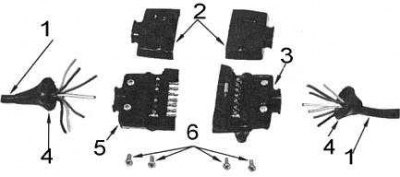
1-7 - core flexible cable; 2 - lids; 3 - nest; 4 - dust cover; 5 - plug; 6 - screws
14. Install the support bracket as close to the tow hitch ball pin as possible and high enough to maintain the vehicle's ground clearance.
15. Install the connector receptacle into the bracket.
16. Connect the trailer plug to the towbar receptacle to check that they are properly connected.
Installing a trailer plug
Note: To equip a trailer with a towbar connector plug, you will need (to a minimum): A plug that matches the vehicle's socket, a 7-core flexible cable and insulated connectors for connecting the wires.
The procedure for installing the plug on a trailer is similar to that for installing the socket on a vehicle, taking into account the points listed below.
1. Connect the trailer wiring to the connector plug in accordance with the generally accepted color coding standard. Follow the connector manufacturer's instructions. If the free length of the trailer wiring harness is not sufficient, extend the harness using 7-wire flexible cable and insulated connectors for connecting the wires.
2. If the trailer wiring color scheme does not correspond to the generally accepted standard, identify each wire by:
- Locate the trailer ground wire;
- Connect a jumper wire from the negative terminal of the 12-volt battery to the ground wire;
- Connect a jumper wire to the positive battery terminal and connect each of the trailer harness wires to it one at a time. Record the color of each wire and the device that triggered when it was connected (signal light/brake).
3. After installation is complete, connect the plug to the towbar receptacle on the vehicle to check if the connector components are properly connected.