


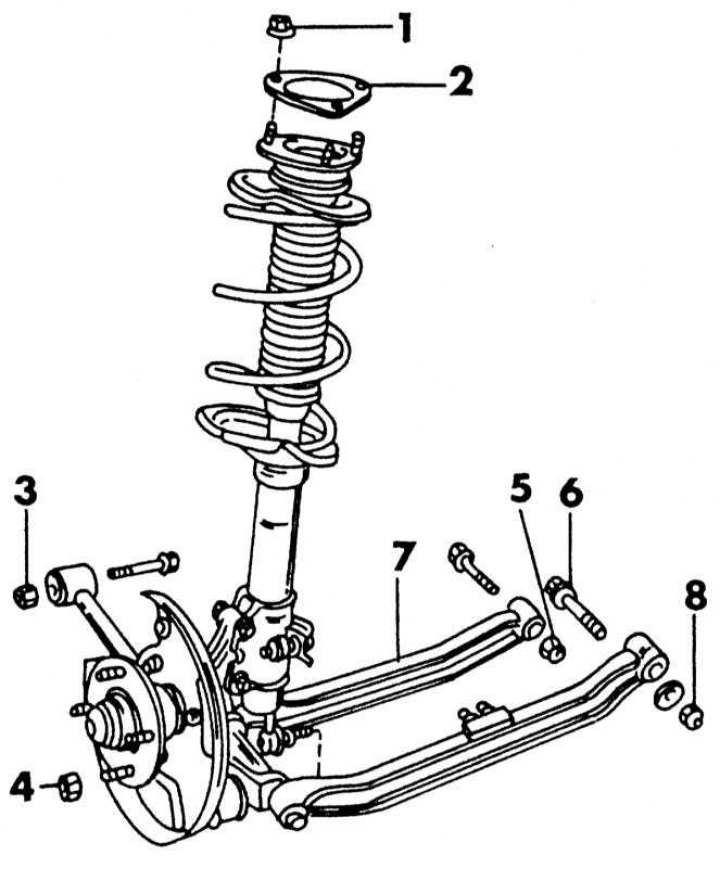
View of the assembled rear suspension from one side (with disc brakes)
1 - nut, 45-55 Nm; 2 - gasket; 3 - nut, 90-110 Nm; 4 - nut, 100-120 Nm; 5 - nut, 110-130 Nm; 6 - adjusting bolt; 7 - parallel lever; 8 - nut, 110-130 Nm

Elements of the disassembled rear suspension
1 - nut, 110-130 Nm; 2 - nut, 110-130 Nm; 3 - steering knuckle; 4 - dust plate; 5 - wheel hub; 6 - washer; 7 - hub nut, 190-260 Nm; 8 - cotter pin; 9 - hub grease cap; 10 - bolt, 10-14 Nm; 11 - parallel lever bolt; 12 - nut, 110-130 Nm; 13 - washer; 14 - connecting rod of the anti-roll bar; 15 - shock absorber strut bolt; 16 - nut. 42-48 N·m; 17 - longitudinal lever; 18 - nut, 90-110 Nm; 19 - longitudinal arm bolt; 20 - nut, 90-110 Nm; 21 - shock absorber strut; 22 - nut, 100-120 Nm
The rear suspension view is shown in illustrations. Those familiar with earlier Nissan models may notice that this is a completely new design. Instead of the previously used transverse levers, parallel levers with a longitudinal lever and an anti-roll bar are installed. The suspension arm closest to the stabilizer has an adjuster, with which you can adjust the toe-in of the rear wheels. Elements for repair or replacement can be removed separately. To replace individual parts, there is no need to remove the entire suspension.
The rear wheel hubs rotate on tapered roller bearings and must be tightened to a specific torque.