


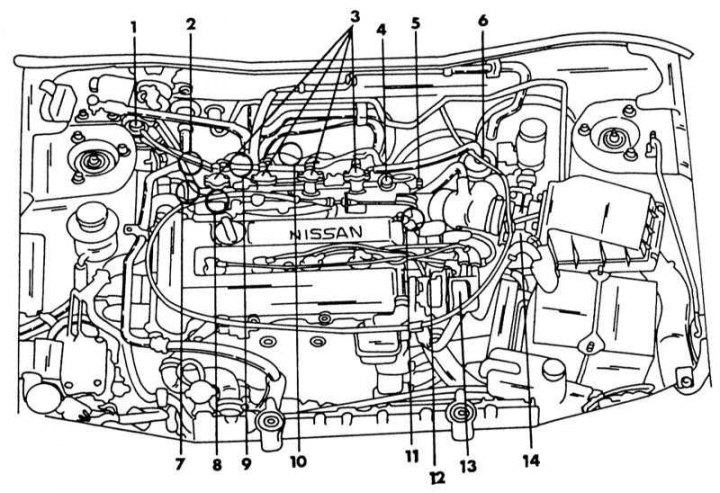
Position of individual components of the fuel injection system and ignition system in the engine compartment of a vehicle with an SR20DE engine
1 - adsorber; 2 - additional air valve; 3 - injection valves; 4 - fuel pressure regulator; 5 - throttle position sensor; 6 - fuel filter; 7 - switching valve, idle speed adjustment; 8 - coolant temperature sensor; 9 - air regulator; 10 - resistor; 11 - transistor; 12 - ignition coil; 13 - crankshaft angle sensor; 14 - air flow meter
If you open the hood, you will see the usual for a modern car multitude of hoses, wires and other parts that belong to either the injection system or the ignition system. The illustration above shows a view of the engine compartment, showing the location of the main elements of both systems. Let us briefly dwell on the operation of some of the elements. The crankshaft angle sensor (13) is installed in the ignition distributor and is the main element of both systems. The sensor monitors the engine speed and the position of the pistons and sends the corresponding signal to the control unit to control the injection, ignition and other functions. The sensor has a rotor disk and a current circuit. The disk has 360 splines, each of which corresponds to a crankshaft rotation of 1°, as well as 4 other splines, which serve for 4 cylinders and are located at a distance of 180°. Light and photocells are installed in the current circuit. When the rotor passes between the light and photocells, the splines on the disk interrupt the light signal transmitted from the LED to the photocell. Without going into detail, it can be said that this generates pulses that are converted by the current circuit and sent as signals to the electronic control unit. The latter processes them and makes the appropriate adjustments in the injection and ignition systems.
1. Air flow meter (14) is located next to the air filter and measures the amount of air sucked in. The measurement is carried out as follows: the electronic control device receives an electrical signal, which corresponds to the heat given off by the heating element blown by the flow of sucked air. When the sucked air flows into the intake manifold and at the same time blows on the heating element, the air receives the heat generated by this element. The amount of heat depends on the amount of air. Since the temperature of the heating element is automatically regulated to a certain value, it is necessary to supply current to the heating element in order to maintain the temperature of the element constant. Based on the electrical changes, the control device determines the amount of air.
2. Engine temperature sensor (8) is located behind the oil filter in the location shown in the illustration below. The sensor monitors the coolant temperature and transmits information to the electronic control unit as a signal. The sensor is equipped with a thermistor that responds to temperature changes. The electrical resistance of the thermistor decreases as the temperature increases.
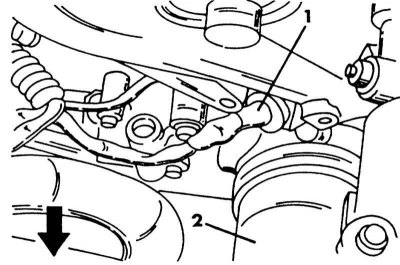
The position of the coolant temperature sensor (1) is next to the oil filter (2).
3. Throttle Position Sensor (5) reacts to the movement of the gas pedal. It converts the position of the throttle valve into a signal and transmits it to the electronic control unit. The control unit determines the idle position of the throttle valve when the unit receives the corresponding signal and, for example, stops the fuel supply.
4. Injection valves (3) have small switching valves. When the electronic device sends a signal to the injection valve, the valve coil pulls the needle and fuel is injected into the intake manifold. How long the fuel is injected is also determined by the control device.
5. Fuel pressure regulator (4) maintains a constant pressure of 3.0 bar in the system. Since the amount of fuel injected depends on the duration of the injection, the pressure must be maintained at a given level.
6. The signal coming from the control unit goes to the amplifier stage (11), which controls the primary current circuit of the ignition coil. High voltage is removed from the secondary circuit of the coil. The ignition coil is not of a standard type.
7. Air regulator (9) regulates the air flow bypassing the throttle valve if the engine is cold or during warm-up at fast idle. The regulator reacts to the temperature and changes the cross-section of the channel depending on it. At location (2) is located additional air valve, which works with the control valve (7). These interdependent elements receive signals from the control unit and regulate the engine idle speed to a specified value. The illustration below shows what the switching module looks like. The idle speed adjustment screw is located at the indicated location.
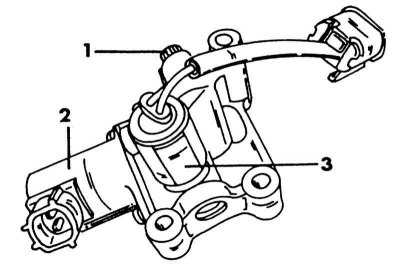
View of additional air valve and related components
1 - X.X adjustment bolt; 2 - additional air valve; 3 - switching valve
7. Speed sensor is installed in the speedometer and converts the speed signal into pulses that are sent to the control unit. In order to maintain the idle speed when the engine is subjected to additional load during servo control operation, an oil pressure sensor is installed in the high-pressure line of the steering system, which sends a load signal to the control unit. It informs the additional air valve of the necessary increase in idle speed depending on the size of the load.
8. On the cylinder block is located knock sensor engine. If the engine is subject to vibration due to detonation, this is converted by the sensor into a voltage signal, which is fed to the control unit.
9. Fuel filter (6) is housed in a metal housing to withstand high fuel pressure. One hose is connected to the filter at the top and bottom. The filter sits in a spring clip. Before replacing the filter (recommended every 40,000 km or every 2 years), the fuel pressure in the system should be reduced to avoid fuel splashing. Install only the appropriate Specifications filter.
10. Adsorber with activated carbon (1) serves the purposes described in Section Emission control systems for a carburetor engine. All elements related to the ignition system are described in Chapter Engine electrical system.
11. Fuel pump is located in the fuel tank. The control unit turns on the fuel pump a few seconds after the ignition is turned on, to make it easier to start the engine. When the control unit receives a "180" signal from the crankshaft position sensor, it knows that the engine is turning and turns on the pump. If this signal is not received, the engine is turned off and the pump is set to a mode that saves battery voltage and ensures safety. The control unit starts the pump through a separate relay.
12. On cars with a catalytic converter, a lambda probe is installed in the exhaust system. It measures the oxygen content in the exhaust gases and changes the ratio of fuel and air accordingly.
Work on the system
When performing any work on the system that involves disconnecting the fuel lines, first reduce the fuel pressure. In this case, proceed as follows:
1. Open the fuse box cover and remove the fuse shown in the illustration. This is the fuel pump fuse. Now start the engine. After a while, it will stall because it will not receive fuel. Turn the crankshaft with the starter two or three more times to relieve all the pressure. Immediately put the fuse back in place. Now you can disconnect all the fuel hoses between the engine and the body.
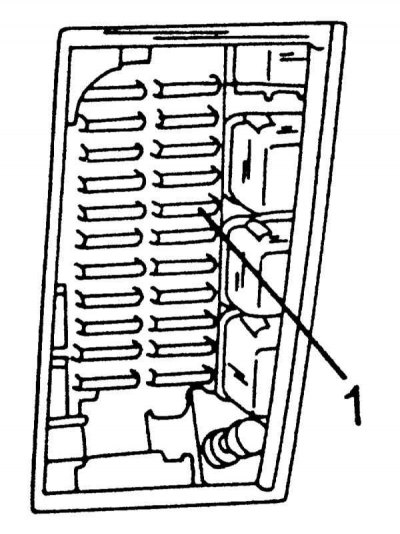
Position of the fuel pump fuse (1) in the fuse box.
2. For all other work, especially electrical work, which requires the necessary knowledge, observe the following safety precautions:
[The source of the article is on the website NissanBook.ru]
3. Use only 12-volt battery.
4. Never disconnect battery cables while the engine is running.
5. Never disconnect the injection valve cables while the engine is running.
6. Never apply devices connected directly to the battery to the injection valves.
7. The air flow meter is very sensitive and should be handled accordingly. It should not be disassembled. It should also not be washed with any liquid.
8. The additional air valve cannot be disassembled.
9. Even small leaks in the air intake system can affect engine performance.
10. The electronic control device cannot be repaired.
11. When starting the engine, do not press the gas pedal. Do not increase engine speed immediately after starting and before turning off.
12. If there is no fuel in the tank, do not turn on the starter to start the engine, as the fuel pump should not operate without fuel.
13. Always connect the control unit cable plugs as described. A poor connection may cause a voltage surge and damage the ignition coil and other components. Keep the main cable routing at least 10 mm away from other cables to avoid external influences on the cable connections. All cable harnesses must be dry. Always turn off the ignition and disconnect the ground cable from the battery before loosening any connection.