


Table of contents: Requirements for towing ↓ Towing a car with an automatic…↓ Towing a car with an automatic…↓
When towing a vehicle, first of all, it is necessary to comply with local traffic regulations for towing vehicles. To avoid damage to the vehicle, only use suitable towing equipment. To ensure proper towing and to avoid accidental damage to the vehicle, Nissan recommends using a special towing vehicle driver. Before towing, the towing vehicle driver must familiarize himself with the following requirements:
Requirements for towing
It is necessary to make sure that the gearbox, axles, steering and power transmission are in good condition. In case of damage to any of the units, it is necessary to resort to towing the car on a towing dolly.
When towing with the front wheels on the ground, turn the ignition switch to the "OFF" position and lock the steering wheel in the straight ahead position (for example, by tying it with a rope). Do not set the ignition key to the "LOCK" position. This will damage the steering wheel lock device.
When towing with the rear wheels on the ground: Release the parking brake and place the transmission lever in neutral ("N").
Always attach safety chains to the towed vehicle.
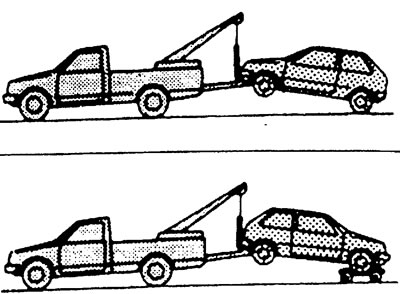
nissan recommends towing this vehicle with the drive (front) wheels off the ground as shown in the illustration.
Towing a car with an automatic transmission
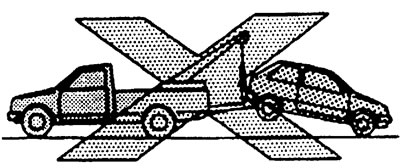
ATTENTION! Do not tow a vehicle with an automatic transmission using the "rear wheels off the ground, front wheels on the ground" method. This can cause serious damage to the transmission and the need for expensive repairs. If you need to tow a vehicle with the rear wheels raised, place a towing dolly under the front wheels.
Towing a car with an automatic transmission using four wheels on the ground
In this case, the following restrictions on speed and towing distance must be observed:
- Speed no more than 50 km/h.
- Distance no more than 65 km.
WARNING! Towing a vehicle with an automatic transmission with all four wheels on the ground should never be done from behind (the car should not move in the opposite direction). This can result in serious damage to the transmission and the need for costly repairs.