


Table of contents: General information ↓ Airbag modules ↓ Precautionary measures ↓ Disabling the SRS system ↓ Turning on the SRS system ↓ Removal and installation SRS…↓
General information
All models covered in this Guide are equipped with a supplemental restraint system (SRS), better known as airbags. Two airbags are included as a mandatory feature on models produced since 1995. The system provides additional protection for the driver and front passenger of the vehicle in the event of a severe frontal impact. Early models are equipped with only a driver's airbag. The SRS control unit includes a self-diagnostic module. The SRS ECU is located inside the vehicle's passenger compartment.
1998 and 1999 models are additionally equipped with front seat side airbags that deploy in the event of a severe side impact.
The airbags are triggered by signals from the directional overload sensors processed by the SRS ECU.
Airbag modules
Driver's airbag
The module is placed in the hub of the steering wheel and consists of a casing, inside which the airbag itself and the gas generator unit are placed. The gas generator is located in the rear part of the casing and provides almost instantaneous filling of the airbag with gas upon a command issued by the SRS. An electric signal is sent to the gas generator through a spring contact installed in the hub of the steering column behind the airbag module.
The signal is transmitted via a spring contact regardless of the position of the steering wheel. The igniter inside the gas generator assembly converts the incoming command into a thermal pulse, causing the ignition of a powder mixture of sodium azide and copper oxide. When the powder explodes, nitrogen is released, filling the airbag in a fraction of a second.
Passenger airbag
The passenger airbag module is mounted in the car's instrument panel directly above the glove compartment. In this case, the "SRS" marking is applied to the top of the instrument panel. The composition and operating principle of the module are similar to those discussed above for the driver's airbag.
The passenger cushion is slightly larger in volume than the driver's and is equipped with a steel support casing. The decorative cover is divided by a sealed seam that diverges when the system is triggered.
Side airbags
With a more compact design, the side airbags provide protection for the driver and front passenger in the event of a severe side impact. The side airbag overload sensors are located in the lower part of the door pillars.
Control/self-diagnostic unit and additional overload sensors
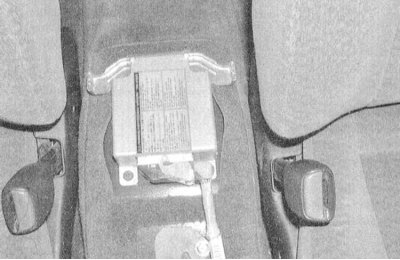
The SRS control/self-diagnosis unit consists of a microprocessor that monitors the system's operating parameters and an overload sensor. The system notifies the driver of any detected faults by turning on the control lamp. At the same time, the corresponding fault code is entered into the processor's memory. In such a situation, the car should be immediately driven to a service station. The control lamp will remain lit until the processor's memory is cleared after the appropriate repair has been performed. On most models, the SRS control unit is located under the rear of the center console, but can also be installed under the instrument panel.
The airbag is activated only when the main and additional directional overload sensors are triggered simultaneously. In the event of a battery failure, power is supplied to the SRS system from an autonomous backup source.
Precautionary measures
Warning! Failure to follow safety precautions when handling SRS components may result in serious injury!
When servicing any components located near the airbags, always disable the SRS first:
When removing air bag modules, always hold them with the front facing away from you. Do not place the module on a workbench or other surface with the air bag opening facing down.
Do not use an ohmmeter to measure the resistance of SRS components under any circumstances - the voltage from the meter's built-in power source may cause the airbags to deploy.
Before using arc welding on your vehicle, be sure to disconnect the SRS wiring (the yellow connector located under the steering column next to the connector for the combined steering column switch is the driver's airbag) and the same connector behind the glove box assembly (passenger airbag).
Disabling the SRS system
Disconnect the negative cable from the battery first, then the positive cable and wait at least 10 minutes before proceeding with the procedures.
Warning! If the car stereo system is equipped with a security code, make sure you have the correct combination to activate the audio system before disconnecting the battery!
Driver's airbag
Remove the access panel in the center of the steering wheel under the air bag module assembly and disconnect the 2-pin connector of the wiring harness that runs between the module and the spring contact (see Chapter Suspension and steering).
Passenger airbag
Open the glove compartment.
At the top of the storage compartment, near the latch, disconnect the 2-pin connector of the yellow wiring harness that connects the airbag module to the main harness.
Side airbags
Using a special pry tool, carefully separate the rear trim panel of the corresponding front seat, being careful not to touch the yellow electrical wiring.
Disconnect the electrical wiring connector.
Turning on the SRS system
The SRS modules are switched on in the reverse order.
Turn off the ignition.
Connect the battery.
Removal and installation SRS components
Driver's airbag
See Chapter Suspension and steering.
Passenger airbag
Disable the appropriate airbag module.
Remove the lower trim section from the passenger side of the instrument panel (see Chapter Body).
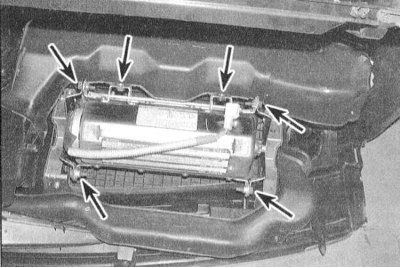
Disconnect the 2-pin electrical connector. Remove the sealed TORX head bolts, then gently pry the airbag module away from the instrument panel with a screwdriver.
Attention! The module is quite heavy, so hold it with both hands
Installation is carried out in reverse order.
Note: The module mounting bolts must be replaced.
Side airbags
Disable the SRS system.
Disconnect the electrical connector of the corresponding airbag module. Remove the two TORX-head screws and remove the module.
Installation is carried out in reverse order.