


Table of contents: Examination ↓ Replacement ↓
Knock sensors detect increased engine vibration, usually caused by detonation of the air-fuel mixture. Based on the information received from the sensor, the PCM adjusts the ignition timing to maintain it at the maximum possible level, which guarantees sufficient engine efficiency. The sensor generates an AC signal, the amplitude of which increases proportionally to the vibration level. To compensate for detonation, the PCM issues a command to advance the ignition timing in the direction of retardation, if necessary. On 1993 and 1994 models, the sensor is mounted on the right side of the engine, directly below the exhaust manifold. On 1995 and later models, the sensor is located under the intake manifold.
Examination
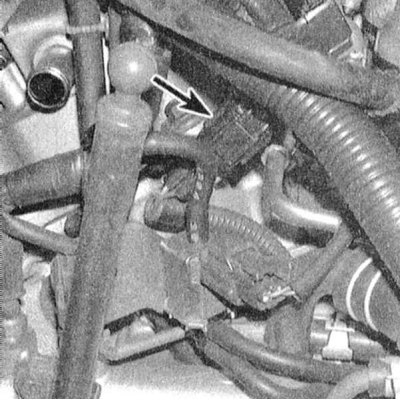
Disconnect the wiring from the sensor. Measure the resistance between the two terminals of the sensor connector - the ohmmeter should register conductivity, otherwise replace the sensor.
Note: The electrical resistance of the knock sensor is very high, use an ohmmeter whose connecting wiring is rated for at least 10 mOhm.
Replacement
Models produced in 1993 and 1994.
Attention! Before starting the procedure, wait until the engine has completely cooled down.
1. Drain the cooling system (see Chapter Settings and ongoing maintenance).
2. Jack up the car and place it on supports
3. Disconnect the electrical wiring from the knock sensor and release the harness from the intermediate fasteners.
4. Remove the sensor from the engine block.
[The material is based on data from the portal NISSANBOOK]
5. Installation is carried out in reverse order.
6. Do not forget to fill the cooling system (see Chapter Settings and ongoing maintenance).
Models since 1995.
1. Remove both (upper and lower) sections of the intake manifold (see Part SOHC engines Chapters Engine).
2. Disconnect the electrical wiring from the sensor.
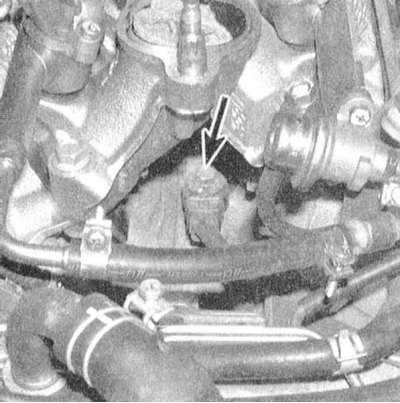
3. Loosen the mounting bolt and remove the sensor from the engine block.
4. Installation is carried out in reverse order.
5. Reinstall the intake manifold (see Part SOHC engines Chapters Engine).