


General information
The λ-probe located in the engine exhaust tract monitors the oxygen content in the exhaust gas flow. When O2 molecules come into contact with the probe's sensitive element, the sensor generates an amplitude signal in the range from 0.1 to 0.9 V, depending on the oxygen concentration. Moreover, a value of 0.1 V corresponds to a high O2 content (lean mixture), and the value of 0.9 V is low (enriched mixture). The upper-flow oxygen sensor sends information to the PCM about the residual O2 content in the exhaust system. The PCM continuously monitors the signal coming from the oxygen sensor, if necessary issuing commands to adjust the air-fuel mixture composition by changing the duration of the injection injectors opening. The optimal ratio of the combustible mixture components, which guarantees minimum fuel consumption with the most efficient operation of the catalytic converter, is 14.7 parts air to 1 part fuel - this is what the control module tries to constantly maintain, focusing on the information coming from the λ-probe.
The downstream lambda probe does not affect the air-fuel mixture control module's assembly process. The sensor is identical in design and operation to the upstream sensor. By comparing the oxygen content in the exhaust tract above and below the catalytic converter, the PCM determines the efficiency of the catalytic converter. Note: Only one oxygen sensor is used on 1993 and 1994 models (upstream). On models produced since 1995, two upper-flow λ-probes are provided (one for each row of cylinders) and one downstream.
It should be noted that the oxygen sensor is capable of generating a signal voltage only when warmed up to normal operating temperature (318°C). While the sensor is cold, the PCM operates in OPEN CIRCUIT mode, controlling the air-fuel mixture configuration based on the basic parameters embedded in it. The proper functioning of the oxygen sensor depends on the fulfillment of a set of certain specific conditions:
- a) Electrical parameters: The stability of the low voltage amplitude signal generated by the sensor depends to a large extent on the quality of the contact connections of the λ-probe circuit, which should be checked first in case of problems;
- b) Outside air supply: The design of the λ-probe allows for free circulation of outside air inside the sensor. When installing the probe, always check the air ducts for patency;
- c) Operating temperature: The PCM begins to respond to information coming from the λ-probe only after the sensor has warmed up to normal operating temperature (approximately 320°C). This fact should not be overlooked when checking the correct functioning of the probe;
- d) Fuel quality: Correct functioning of the λ-probe is only possible if UNLEADED fuel is used to refuel the vehicle!
In addition to the conditions listed in the previous paragraph, some special precautions should be observed when servicing the λ probe:
- a) The oxygen sensor is equipped with a permanently mounted section of electrical wiring equipped with a contact plug, attempts to disconnect which may lead to irreversible failure of the probe;
- b) Avoid allowing dirt and grease to enter the sensor louvers or its electrical connector;
- c) Do not use any solvents to clean the oxygen sensor;
- d) Handle the λ-probe with extreme care, do not drop it and try not to shake it;
- e) The silicone protective cover must be placed on the sensor in a strictly defined manner so as not to melt and impair the proper functioning of the probe.
In the event of a malfunction of the λ-probe or its circuit, the RCM switches to open-loop mode, ignoring the information coming from the sensors and maintaining the composition of the air-fuel mixture at a certain specified level, ensuring sufficient engine efficiency.
Examination
Caution! Oxygen sensors are extremely sensitive to electrical circuit overloads. Use fuse-equipped jumper wires to connect the voltmeter to the λ-probe connector. Be extremely careful when inserting the meter probes into the connector from the back (see Chapter On-board electrical equipment). Use only digital meters to check sensors.
Performing the procedure below may cause a fault to be stored in the OBD memory and the Check Engine Light to be illuminated. Once the check and any necessary repairs have been completed, be sure to clear the system memory (see section On-Board Diagnostics (OBD) System - Operating Principle and Error Codes).
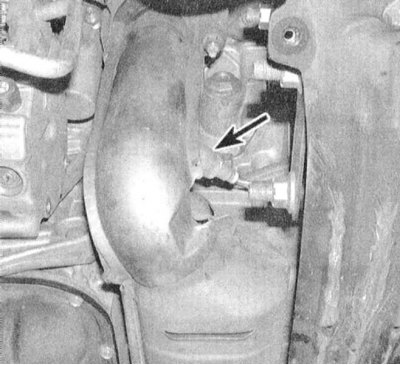
1. Locate the electrical connector of the sensor. From the back of the connector, connect the positive probe of the voltmeter to the terminal of the white wire (see Chapter On-board electrical equipment). Ground the negative probe. Start the engine and warm it up to normal operating temperature. Using the voltmeter readings, determine the value of the sensor signal voltage:
- a) The amplitude of the signal generated by the upper flow sensor should be in the range from 100 to 900 mV, actively changing within the specified limits.
- b) The downstream sensor must produce a signal voltage in the same range (on average 400 mV), however, without active changes.
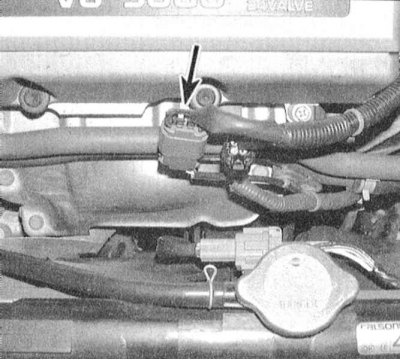 |
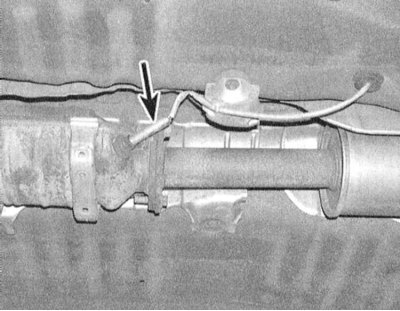 |
2. Check the battery voltage supply to the sensor. Assess the grounding quality. Disconnect the wiring from the sensor and connect the positive probe of the voltmeter to the green-black terminal (1993 and 1994)/red-black (since 1995) contact connector (see electrical connection diagrams at the end of the Chapter On-board electrical equipment). Connect the negative wire to the terminal of the blue/blue-yellow wire. With the ignition on, the device should register a voltage close to the battery voltage.
3. Check the resistance of the oxygen sensor heating element. Connect an ohmmeter to the two terminals of the heating element in the λ-probe wiring connector (from the latter's side). Note: The wiring harness built into the sensor is usually not color coded.
The required resistance is:
- a) For models produced in 1993 and 1994 - 3.0÷1000 Ohm;
- b) For models produced in 1995 and 1996 - 2.3÷4.3 Ohm (upstream sensors) and 5.2÷8.2 downstream;
- c) For models produced since 1997 - 2.3÷4.3 Ohm.
4. If a break is detected or if the measurement results are excessively high, replace the corresponding sensor.
Note: If the above checks are positive, the wiring between the sensor and the PCM should be checked for open and short circuits. If no abnormalities can be detected, the vehicle should be taken to a service station for more detailed diagnostics.
Replacement
1. Removing the λ-probe on a cold engine can be extremely difficult due to thermal contraction of the metal of the exhaust manifold/pipe of the exhaust system. To avoid the risk of damaging components, warm up the engine for a couple of minutes before proceeding with removing the sensor - try not to burn yourself on hot surfaces during the procedure:
- a) Oxygen sensors are equipped with a built-in wiring harness with a contact connector. Damage to this harness will result in irreversible failure of the sensor - use caution;
- b) Try to keep the sensor connector and louvers free of oil, grease, dirt, moisture, etc.;
- c) NEVER use any solvents to clean the sensor;
- d) Try not to drop or shake the sensor abruptly.
2. Jack up the car and place it on supports.
3. Carefully disconnect the oxygen sensor wiring connector.
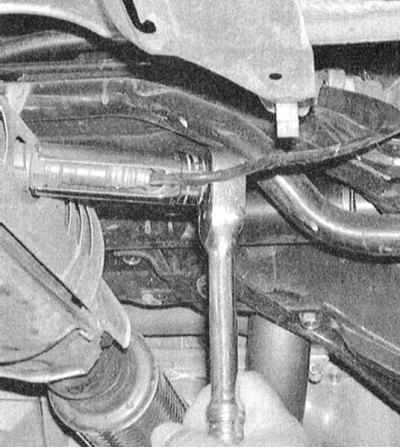
4. Using a special key, carefully unscrew the probe from the corresponding section of the exhaust system.
5. Before screwing in the sensor, lubricate its threaded part with anti-seize sealant.
6. Screw the sensor into its original place and tighten it securely.
7. Lower the vehicle to the ground and connect the electrical wiring to the sensor.
8. Perform a road test of the vehicle. Check the control module memory for fault codes.