


Table of contents: Information about diagnostic devices ↓ General description of the OBD system ↓ Information sensors ↓ Executive devices ↓ Reading fault codes ↓ Clearing ECM/PCM memory ↓ Models produced in 1993 and 1994. ↓
Information about diagnostic devices
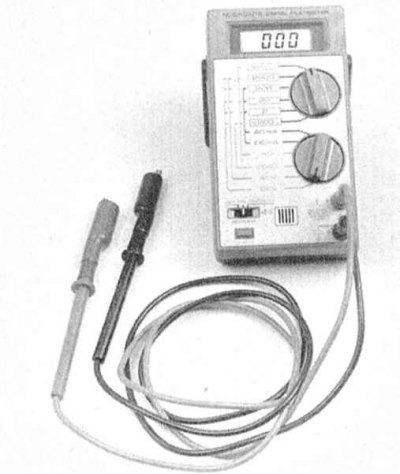
The proper functioning of injection system components and exhaust gas toxicity reduction systems is checked using a universal digital meter (multimeter). Using a digital meter is preferable for several reasons. Firstly, it is quite difficult to measure the value of an analog meter (sometimes it's impossible), determine the result of the reading with an accuracy of up to hundredths and thousandths, while when examining circuits that include electronic components, such accuracy is of particular importance. The second, no less important, reason is the fact that the internal circuit of the digital multimeter has a fairly high impedance (the internal resistance of the device is 10 million ohms). Since the voltmeter is connected to the circuit being tested in parallel, the accuracy of the measurement is higher, the smaller the parasitic current that passes through the device itself. This factor is not significant when measuring relatively high voltage values (9÷12 V), but it becomes decisive when diagnosing elements that produce low-voltage signals, such as, for example, an oxygen sensor, where we are talking about measuring fractions of a volt.
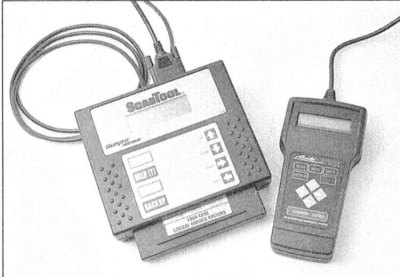
The most convenient devices for diagnosing engine management systems of modern car models are hand-held scanner-type readers. First-generation scanners are used to read OBD-I system fault codes. Before use, the reader should be checked for compliance with the model and year of manufacture of the vehicle being tested. Some scanners are multifunctional, due to the ability to change the cartridge depending on the model of the vehicle being diagnosed (Ford, GM, Chrysler, etc.), others are tied to regional government requirements and are intended for use in specific areas of the world (Europe, Asia, USA, etc.).
With the introduction of the second generation of on-board diagnostics (OBD-II) systems that meet the latest environmental legislation, specially designed readers have begun to be manufactured. Some manufacturers have started producing scanners designed for use by amateur mechanics at home - ask in car accessory stores.
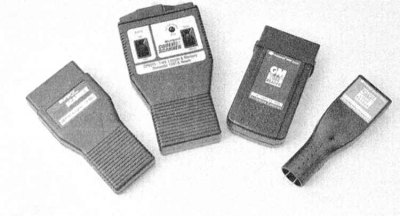
There are also scanners of another type, designed for reading from the memory of the on-board processor by direct connection to the diagnostic connector of the main wiring harness of the car.
General description of the OBD system
All models described in this Manual are equipped with an on-board diagnostics system (OBD). The 1993 and 1994 models use the OBD-I system, and starting in 1995, all vehicles were equipped with second-generation diagnostic systems (OBD-II).
The core element of both systems is the onboard processor, more commonly referred to as the electronic powertrain control module (PCM). The PCM is the brain of the engine management system. Input data is fed to the module from various information sensors and other electronic components (switches, relays, etc.). Based on the analysis of data received from information sensors and in accordance with the basic parameters stored in the processor memory, the RCM generates commands to operate various control relays and actuators, thereby adjusting the engine operating parameters and ensuring maximum efficiency with minimum fuel consumption.
Maintenance of engine management/exhaust gas reduction components is subject to special extended warranty obligations. You should not attempt to independently perform diagnostics of RSM failures or replace system components until the terms of these obligations are fulfilled. Please contact the specialists of Toyota's branded service stations.
Information sensors
Camshaft position sensor (CMP) - The sensor generates information signals, based on the analysis of which the CMP determines the current valve timing and engine speed, using the received information to control the injection sequence and ignition of the air-fuel mixture in the combustion chambers.
Crankshaft Position Sensor(s) (CPS) - All models from 1995 onwards use two CPS sensors, whereas earlier models used only one. The signals from the sensors are used by the PCM as references when determining engine speed and the TDC positions of each cylinder piston. Based on the information received, the PCM controls the injection and ignition sequence of the air-fuel mixture in the combustion chambers. In OBD-II systems, the signals generated by the CPS sensors are also used in diagnosing powertrain failures.
Engine Coolant Temperature (ECT) Sensor - Based on the information received from the sensor, the PCM makes the necessary adjustments to the air-fuel mixture composition and ignition timing, and also monitors the operation of the EGR system.
EGR temperature sensor - Information received from the sensor is used to determine the intensity of exhaust gas recirculation into the engine intake tract.
Fuel Temperature Sensor - PCM uses the information provided by the sensor to diagnose failures of system components.
Intake Air Temperature (IAT) Sensor - The PCM uses information from the IAT sensor to make injection adjustments, spark advance settings, and to control the operation of the EGR system.
Knock sensor - The sensor is a piezoelectric element that reacts to changes in the intensity of engine vibrations. Based on the analysis of information received from the sensor, the RCM adjusts the ignition timing in order to promptly eliminate detonation of the air-fuel mixture in the combustion chambers, which is fraught with premature wear of the internal components of the engine.
Absolute pressure sensor in the pipeline (MAP) (models since 1996.) - The sensor monitors variations in the vacuum depth in the intake manifold associated with changes in crankshaft speed and engine load, and converts the information received into an amplitude signal. The information received from the sensor is used by the control module when diagnosing engine failures.
Mass Air Flow (MAF) Sensor - The MAF sensor measures the volumetric and weight parameters of the air flow entering the intake manifold. The sensor uses a filament as a sensing element. The PCM uses the information supplied by the MAP and IAT sensors to make fine adjustments to the injection parameters.
Oxygen sensor (λ-probe) - The sensor generates a signal, the amplitude of which depends on the ratio of the amount of oxygen (O ₂) contained in the engine exhaust gases and the outside air. Based on the information received from the sensor, the PCM determines the parameters of the air-fuel mixture, promptly enriching or depleting it.
Power Steering Fluid Pressure Switch (PSP) - Based on the information received from the PSP switch, the PCM increases the idle speed (due to the operation of the IAC valve) in order to compensate for the increasing loads on the engine associated with the operation of the power steering when performing maneuvers.
Throttle Position Sensor (TPS) - The sensor is located on the throttle body and is connected to the throttle shaft. Based on the amplitude of the signal output by the TPS, the PCM determines the opening angle of the throttle valve (controlled by the driver using the gas pedal) and accordingly adjusts the fuel supply to the combustion chamber intake ports. Sensor failure or loosening of its fastening leads to injection interruptions and disturbances in the stability of idle speed.
Vehicle Speed Sensor (VSS) - As its name suggests, the sensor informs the processor of the current speed of the vehicle.
Other parameters controlled by the PCM - In addition to the information provided by the sensors listed above, the PCM also receives additional information on the operation of various units and systems that determine the engine's operating characteristics. Other systems and units whose operation is controlled by the PCM include the following:
- a) Air conditioning system;
- b) ABS;
- c) Battery (output voltage);
- d) EVAP system;
- e) Ignition switch;
- f) Start permission switch sensor;
- g) Grounding circuits;
- h) Transmission control system.
Executive devices
The relay for controlling the operation of the K/V clutch - RCM switches off the K/V compressor during intensive acceleration.
Check Engine Light - The PCM illuminates this light when a malfunction occurs in the engine management system.
The cooling system fan control relay - RCM controls the operation of the cooling system fans based on the analysis of signals received from the coolant temperature sensor.
EGR Vacuum Control Solenoid Valves - On pre-1999 models, the PCM controls the opening of the EGR vacuum control valve via a dedicated intermediate solenoid valve.
EGR Valve - On 1999 models, the EGR valve controls the flow of exhaust gas recirculation through an electronic EGR valve.
Canister Purge Valve - This electromagnetic valve, when activated by the PCM, purges the EVAP canister, removing the fuel vapors accumulated inside it into the engine intake tract.
Fast Idle Speed Control Solenoid Valve - This valve is used on models since 1995 and serves to increase idle speed in cold weather. In essence, this valve acts as an air damper on carburetor models.
Front Powertrain Mount - On some models, the PCM also controls the stiffness of the front engine mount depending on vehicle speed. Vibration can be minimized by selecting one of two mount settings.
Fuel injection injectors - PCM provides individual activation of each of the injectors in accordance with the established firing order. In addition, the module controls the duration of the injector opening, determined by the width of the control pulse, measured in milliseconds and determining the amount of fuel injected into the cylinder. More detailed information on the operating principle of the injection system, replacement and maintenance of injectors is given in Chapter Power and exhaust systems.
Fuel Pump Relay - The relay is activated by the control module when the ignition key is turned to the START/RUN position. When the ignition is turned on, the relay supplies power to the fuel pump, which increases the pressure in the vehicle's fuel system. More detailed information on the location and operation of the relay is provided in Chapters On-board electrical equipment and Power and exhaust systems.
Idle Air Control Valve (IAC) - The IAC valve controls the amount of air bypassed around the throttle valve when the throttle valve is closed or at idle. The PCM controls the opening of the valve and the resulting air flow.
Oxygen sensor heater - The operation of this device is controlled by the PCM. The heater quickly warms up the l-probe to normal operating temperature.
Power Transistor - The transistor amplifies the ignition signal generated by the PCM and at the right moment in time instantly grounds the primary circuit of the ignition system to ground, which causes the secondary circuit of the system to generate a high-voltage signal, which is sent by the coil(s) directly to the spark plugs (for more details, see Chapter Engine electrical equipment).
Power Valve Control Solenoid - On 1993 and 1994 models, the power valve is controlled by the PCM via a dedicated solenoid.
The transmission control module (TCM) - TCM, being a separate control module from the RCM, receives signals from various information sensors, such as VSS, start enable switch, turbine shaft speed sensor, TPS, CMP, etc., and uses the received data to determine the moment of gear shifting, the required pressure in the tract and the moment of locking the rotation converter.
Reading fault codes
When a fault is detected that is repeated over two consecutive trips, the PCM issues a command to turn on the instrument cluster mounted "Check Engine" warning lamp, also called the malfunction indicator. The lamp will remain lit until the fault disappears and does not reoccur for three or more trips.
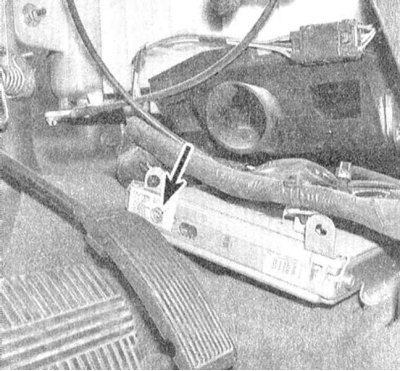
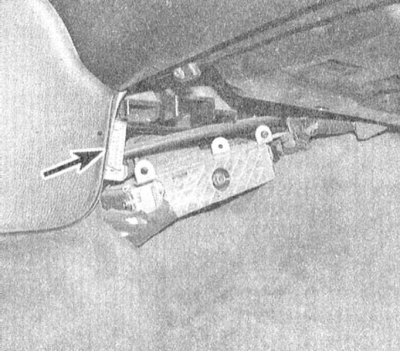
Reading fault codes in the OBD-II system can be done in two ways. In the first case, it is necessary to provide access to the PCM in order to switch the selector to display codes via diagnostic lamps/check engine light. The PCM should be removed from its support bracket (without disconnecting the wiring) and proceed in accordance with the instructions below.
Models produced in 1993 and 1994.
- a) Turn on the ignition (without starting the engine). The "Check Engine" indicator light on the instrument panel should remain on, confirming that it is receiving power from the PCM and that the light itself is working properly.
Failure to follow the procedure described below may result in accidental clearing of the PCM memory!
- b) Using a screwdriver, turn the selector on the PCM wall clockwise until it stops. The diagnostic lamps should start flashing - after three flashes, turn the selector counterclockwise until it stops;
- c) Carefully observe the operation of the diagnostic lamps. The red LED serves to highlight the first digit of the fault code, the second digit of the code is highlighted by the green diode. For example, the code (TPS circuit) 43 will look like this: four flashes of the red diode, then three flashes of the green one. The absence of violations detected by the system is indicated by the display of code 55 (see below in this Section for a map of fault codes);
- d) When the ignition is turned on again after it was turned off during the code reading process, the system automatically cancels the results of the previous search and the reading procedure must be started again. Note: Starting the engine automatically closes access to the self-diagnosis system.
Models since 1995.
- a) Turn on the ignition (without starting the engine). The "Check Engine" indicator light on the instrument panel should remain on, confirming that it is receiving power from the PCM and that the light itself is working properly.
Failure to follow the procedure described below may result in accidental clearing of the PCM memory!
- b) Using a screwdriver, turn the selector on the PCM wall clockwise until it stops. The diagnostic lamps should start flashing - after three flashes, turn the selector counterclockwise until it stops;
- c) Carefully observe the operation of the "Check Engine" indicator light. The light will flash the first digit of the code as a series of long (approximately 0.6 sec) flashes, then, after a 2-second pause, it will begin to display the second digit of the code in the form of a series of short (0.3 s) flashes. In order to determine the displayed code, write down the number of flashes in each series, so code 0403 (TPS circuit) will look like this: 4 long flashes, then, after a pause, three short ones. The absence of any violations detected by the system is indicated by the display of code 0505 (see below in this Section for a map of fault codes);
- d) When the ignition is turned on again after being turned off during the code reading process, the system automatically cancels the results of the previous search and the reading procedure must be restarted. Note: Starting the engine automatically closes access to the self-diagnosis system.
The second method involves using a special scanner and is only applicable to models equipped with the OBD-II system (since 1995.). with the help of the scanner, a more in-depth diagnosis of the engine condition and a fine assessment of its operating parameters can be made. In addition, the scanner allows reading the data frozen by the OBD system at the time of the occurrence of an unstable failure.
Note: When using a scanner, a different form of code entry is used than when reading via the Check Engine Light. In this case, a prefix such as P0 or P1 is used (see the corresponding section of the code map table). If you don't have a scanner at hand, diagnostics of unstable engine control system faults can only be performed in a car service workshop.
Clearing ECM/PCM memory
After the faults identified during the diagnostic process have been corrected, the PCM memory should be cleared of the fault codes recorded in it.
You should not clear the memory by disconnecting the negative cable from the battery, as this will also result in the loss of basic parameters and instability of idle speed during the first time after starting the engine.
Note: When using the scanner in OBD-II systems, you should set the device to the mode "CLEARING CODES" and act in accordance with the manufacturers' instructions.
Models produced in 1993 and 1994.
- a) Read the fault codes stored in the system memory;
- b) Wait at least two seconds, then turn the selector on the wall of the PCM fully clockwise - the LEDs should start flashing;
- c) After four flashes of the diodes, turn the selector fully counterclockwise;
- d) Turn off the ignition.
Models since 1995.
- a) Read the fault codes stored in the system memory;
- b) Wait at least two seconds, then turn the selector on the PCM wall fully clockwise;
- c) Wait at least another two seconds and turn the selector fully counterclockwise;
- d) Turn off the ignition.
Clearing the memory must always be performed before the first engine start after replacing the engine management system components. If a fault code for any of the information sensors was recorded in the module memory, then if after replacing the failed component the engine is started without clearing the memory, the old code will remain in effect and the system will switch to the basic settings mode, excluding the new sensor from the number of working components.
Note: During the first 15-20 seconds after the first start, the engine speed may remain unstable, which is due to the processor restoring its operating characteristics.
Identifying Engine Management System Fault Codes
The Specifications provide a complete map of possible fault codes, not all of which may apply to a specific vehicle configuration.