


Note: The transmission mounting bolts are of different lengths, are not interchangeable and must be screwed into their original locations during installation.
1. Remove the battery with the tray (see Chapter Engine electrical equipment).
2. Remove the air cleaner assembly and the air intake resonator (see Chapter Power and exhaust systems).
3. Disconnect the wiring harness from the transmission solenoids, speed sensor, start/reverse switch, VSS, and, on 1995 and later models, the crankshaft position (CKP) sensor. It is a good idea to remove the CKP sensor to avoid damaging it during transmission removal.
4. Disconnect the corresponding ventilation hoses.
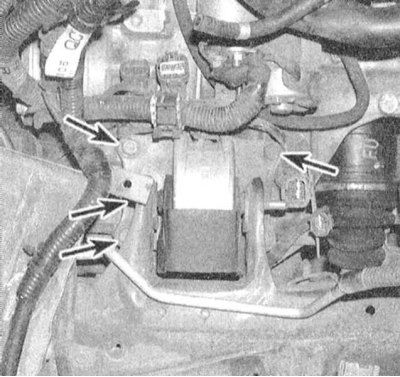
5. Remove the left transmission mount.
6. Remove the upper transmission-to-engine mounting bolts.
7. Remove the starter (see Chapter Engine electrical equipment).
8. Loosen the wheel nuts, jack up the car and place it on stands. Remove the wheels. Drain the ATF (see Chapter Settings and ongoing maintenance).
9. Remove the transmission fluid dipstick guide tube.
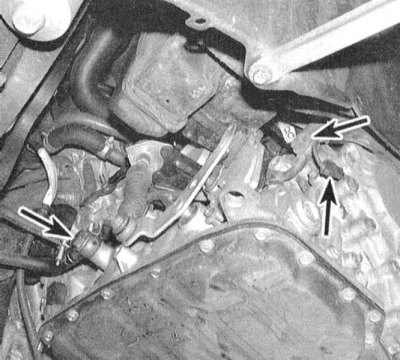
10. Disconnect the oil cooling lines.
11. Disconnect the gear shift control drive cable from the transmission (see section Checking, adjusting and replacing the gear shift cable).
12. Remove the drive shafts (see Chapter Clutch and drive shafts).
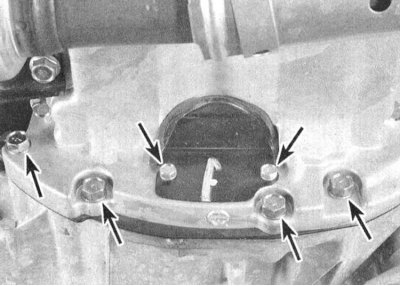
13. Remove the access cover to the rotation converter.
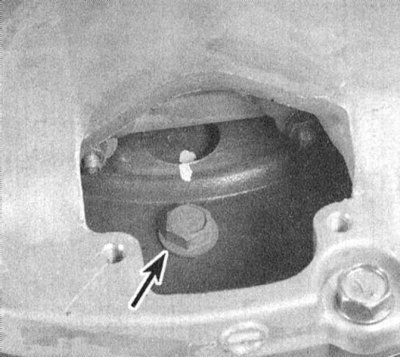
14. Mark the position of the rotation converter in relation to the drive disk.
15. Unscrew the rotation converter mounting bolts.
16. Hang the engine on a winch or beam, or support it from below with a jack (don't forget to put a wooden block underneath to distribute the load).
17. Using a specially equipped jack, support the transmission and secure it to the jack with safety chains.
18. Remove the center beam (see Chapter Engine).
19. Remove the bolts securing the engine oil pan to the transmission. Remove the front bolt securing the transmission to the engine and the rear bolt securing the engine to the transmission.
20. Lower the transmission slightly on the jack and make sure one last time that nothing is preventing it from being separated from the engine.
21. Move the jack to the side, removing the transmission housing assembly from the guide pins. Make sure that the rotation converter does not fall out - immediately secure it inside the separated assembly. Lower the jack and remove the transmission from under the car.
Installation
1. Make sure the torque converter is securely fastened to the transmission. Measure the distance from the bolt hole in the converter to the mating surface of the transmission - it should be at least 19 mm on 1993 models, 18 mm on 1994 models, 14 mm on 1995 through 1997 models and 19 mm on 1998 and later models, otherwise rotate the converter while pressing it into the assembly - a click should be heard.
2. Having secured the transmission assembly to the jack with safety chains, move it to its regular place - make sure that the rotation converter does not slip out (try not to tilt the assembly).
3. Press the transmission onto the engine, carefully fitting the receiving holes onto the guide pins.
4. Align the mounting marks on the rotation converter and the drive disk.
5. Install the transmission mounting bolts and tighten them to the required torque.
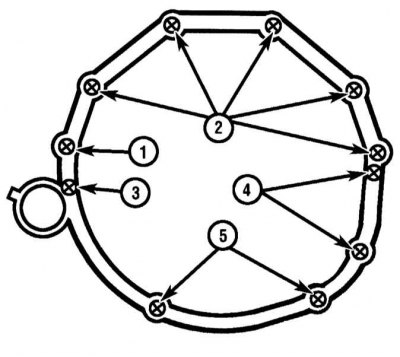
1 - Bolts 60 mm
2 - Bolts 45 mm
3 - Bolts 25 mm
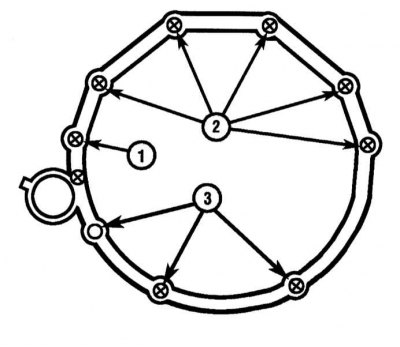
1 - Bolts 60 mm
2 - Bolts 45 mm
3 - Bolts 25 mm
4 - Bolts 20 mm
5 - Bolts 28 mm
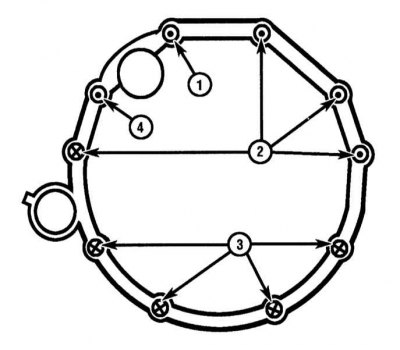
1 - Bolts 65 mm
2 - Bolts 52 mm
3 - Bolts 40 mm
4 - Bolts 124 mm
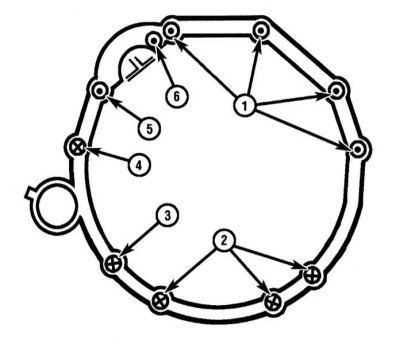
1 - Bolts 45 mm
2 - Bolts 30 mm
3 - Bolts 40 mm
4 - Bolts 45 mm
5 - Bolts 80 mm
6 - Bolts 65 mm
6. Screw in the bolts securing the rotation converter to the drive disk one by one, tighten them with the required force. Install the converter access cover in place, tighten its fasteners securely.
7. Install the central beam. Make sure the fasteners are tightened securely.
8. Install the left transmission mount. Tighten the mounting bolts and nuts securely.
9. Remove the jacks supporting the transmission and engine assemblies.
10. Reinstall the dipstick guide tube.
11. Install the starter (see Chapter Engine electrical equipment).
12. Connect the gear shift cable (see section Checking, adjusting and replacing the gear shift cable).
13. Connect the wiring to the appropriate solenoids and sensors.
14. Connect the drive shafts to the transmission (see Chapter Clutch and drive shafts).
15. Lower the car to the ground.
16. Fill the transmission with the required amount of ATF of the required grade (see Chapter Settings and ongoing maintenance). Perform road tests on the vehicle, check the unit for signs of developing leaks.