


Table of contents: General electrical checks ↓ Checking the working pressure ↓
Checking the operation of the fuel pump and fuel pressure is not something very difficult. Before starting the test, please take the above precautions into account. Following these precautions will help prevent fire and/or explosion.
If your engine fails to start or stalls randomly and you suspect a faulty fuel pump, perform the following basic checks before deciding to purchase a new fuel pump. Then continue checking.
The fuel pump will operate as long as the engine is rotating or cranking and the ECM (ECU) receives reference pulses from the electronic ignition system. If reference pulses are not received, the fuel pump will turn off after 2-3 seconds.
After relieving the fuel pressure, it is recommended to place a rag under the connection being separated so that any remaining fuel can be collected when working on the fuel system components.
First of all, check if there is enough fuel in the fuel tank. Most incorrect conclusions about a faulty fuel pump have been made due to insufficient attention to this first check. If you are not sure that there is enough fuel in the tank, add fuel to the tank.
General electrical checks
- If the fuel system is not delivering the required amount of fuel or no fuel is delivered at all, the following should be checked. In your vehicle, the fuel pump is located inside the fuel tank. Unscrew the fuel tank cap. The assistant must turn on the ignition (there is no need to start the engine). Listen to the hole on the fuel tank to see if the fuel pump is working. Power is supplied to the electric fuel pump for a few seconds each time the ignition is turned on. A buzzing sound should be heard that lasts for several seconds.
- If the fuel pump does not work when the ignition is turned on and the engine is cranked with the starter, it is necessary to determine whether voltage is supplied to the fuel pump or not.
- To check the voltage supply to the fuel pump, you will need to perform several tests.
- First, check the fuel pump fuse, the location of which is shown on the previous page. Using a test light, check for voltage at both fuse contacts. Turn on the ignition. Connect one wire of the test light to ground and touch the other wire to both fuse contacts in turn.
- If there is voltage on both contacts of the fuse, this indicates that the fuse is working properly. To be absolutely sure that the fuse is working properly, you need to remove it and check if there is any corrosion on its contacts. If corrosion is found, clean the contacts and recheck that the fuel pump is working.
- If the fuse is blown, replace it and check if it blows again. If the fuse blows, check the fuel pump circuit for a short circuit using the electrical diagram.
- If there is voltage at the fuse and the fuse is good, check the relay and the fuel pump circuit.
- Connect one wire of the test light to ground and the other wire to the voltage supply terminal of the relay. If voltage is supplied, use an auxiliary wire to connect the terminal that is supplied with voltage to the terminal that connects to the fuel pump.
- Once you are sure which terminals need to be connected to each other, connect them and have an assistant check to see if you can hear the fuel pump running. If the pump starts working, the relay is most likely faulty. If the pump still does not work, move on to the pump itself.
Checking the working pressure
- Correct fuel pressure is very important for the proper operation of the engine management system. Insufficient or excessive fuel pressure can cause many problems. Low fuel pressure can lead to difficulty starting the engine, frequent engine stops or uneven operation, and excessive fuel pressure can lead to" overflow", high fuel consumption or poor engine performance.
- To check the fuel pressure you will need a fuel pressure gauge (1) and a set of adapters (for fuel line connections) (2 and 3).
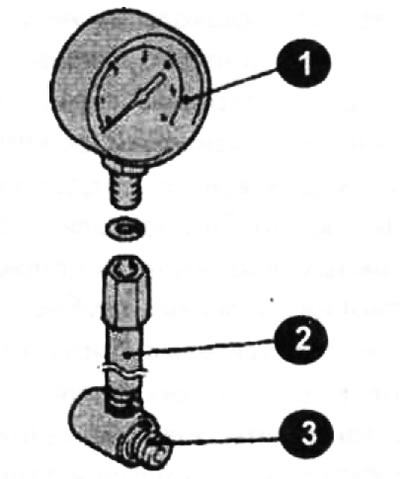
- Relieve pressure in the fuel system.
- Disconnect the outlet line from the fuel filter, connect a three-way fitting between the filter and the fuel line, and connect a pressure gauge to it. Make sure the hose clamps are tightly tightened.
- Turn off all electrical components and turn the ignition key to the ON position. The fuel pump should turn on for 5 seconds; read the pressure gauge. It should correspond to 3.0 kgf/cm².
- Start the engine and let it idle.
- With the engine idling, measure the fuel pressure, which should be approximately 2.5 kgf/cm² at the base idle speed.
- Disconnect the vacuum hose from the fuel pressure regulator, cover its opening with your finger and measure the pressure, which should be 3.0 kgf/cm² at the base idle speed.
- Check that the fuel pressure at idle does not drop even after pressing the accelerator pedal several times.
- While pressing the accelerator pedal several times in a row, lightly pinch the fuel return hose with your fingers to feel the presence of fuel pressure in the hose.
Note: If fuel consumption is low, there will be no pressure felt in the fuel return hose.
- If the measured values do not correspond to the standard values, then there is a malfunction in the system. Please perform the following checks.
♦ If the pressure is excessively high, check the vacuum supply to the fuel pressure regulator for proper operation. Changing engine speed should result in vacuum surges. If a vacuum exists, check the fuel return line hose and tube for patency and condition. If the return line is OK, replace the pressure regulator.
The source is published on the portal: NissanBook.ru
♦ If the pressure is excessively low, check the condition and patency of the fuel filter and the fuel line running from the fuel line to the fuel tank. If no abnormalities are found during inspection, start the engine and slowly pinch the return line. If the pressure increases above 3.0 kgf/cm², replace the pressure regulator.
Caution: Do not allow the pressure to increase above 4.2 kgf/cm².
- If the pressure is still too low, replace the fuel pump.
- Turn off the engine and check for changes in the fuel pressure gauge readings. The fuel system is in good condition if the pressure in the fuel line does not drop within 2 minutes.
- Relieve pressure in the high pressure fuel line.
- Disconnect the pressure gauge together with the adapter from the fuel rail.