


As air flows through the working element, it cools it and therefore increases the amount of current required to heat the working element. Since the required current varies directly proportionally to the temperature and density of the incoming air, the magnitude of the current is directly proportional to the mass of air entering the engine. This information is fed to the computer and the air-fuel mixture is controlled according to engine operating conditions.
When the engine is turned off, any dirt on the wire is electrically burned off as the element heats up to 1000°C for one second. Any dirt remaining on the wire will cause an incorrect signal to be sent to the control unit, resulting in improper fuel mixture preparation.
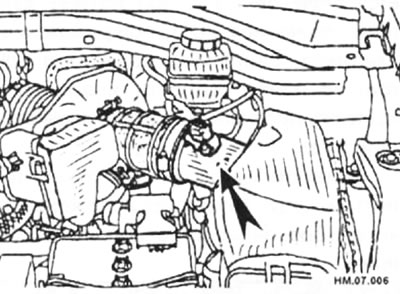
The air flow meter is located inside the intake air duct (arrow).
To determine the fault code, do the following:
- Turn the ignition key to the ON position and wait 6 seconds.
- After starting the engine, wait 3 seconds.
- After turning the ignition key to the OFF position, wait 3 seconds, then turn it to the ON position.
- Run self-diagnosis mode.
Examination
- Turn the ignition key to the ON position, start the engine and warm it up to operating temperature.
- Check the voltage between contact (1) and ground.
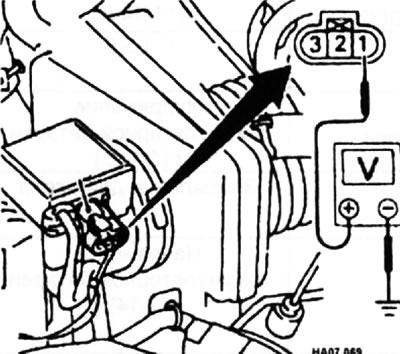
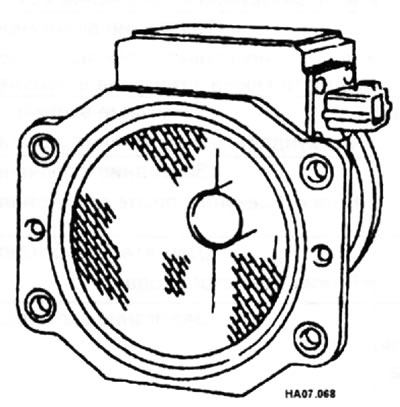
- If the measurement result is negative, remove the sensor from the air duct. Check the heated surface for damage.
(The full article is available on the resource: nissanbook.ru)
Required measurement results
| Ignition key ON (the engine is stopped) | Less than 1.2 V |
| Idling speed when the engine is warm | 1.0-1.7 A |
| Engine speed 2500 rpm | 1.7-2.1 V |
| Engine speed 4000 rpm | 4.0 V |