


Removal
1. Disconnect the hose from the regulator (see photo in Chapter 4, Section 9).
2. Disconnect the connector.
3. Loosen the bolts and remove the regulator from the intake manifold.
Examination
4. You can independently determine the presence of voltage on the regulator, the resistance of the regulator, as well as the closing of the shutter when the regulator is heated. If the shutter does not close when there is voltage and normal resistance, then take the regulator to a car service for diagnostics.
5. Remember the position of the regulator shutter. At a temperature of 14-19°C, the shutter should cover approximately half of the channel. As the temperature drops, the shutter opens more.
6. Apply to the regulator using auxiliary wires (solder a fuse into one of them) battery voltage.
7. When the regulator is heated by the current from the battery, the shutter should close the channel (in about 5 minutes). In this case, the regulator is in good condition, perform the operations starting from point 10.
8. If the shutter closes too slowly, check the resistance of the regulator.
9. If the resistance differs from the norm, replace the regulator.
10. Check the voltage on the regulator by connecting a voltmeter between terminals a and b of the connector (photo). The voltage should be about 12 V and after 5 seconds drop to 0. Otherwise, the regulator wiring is faulty.
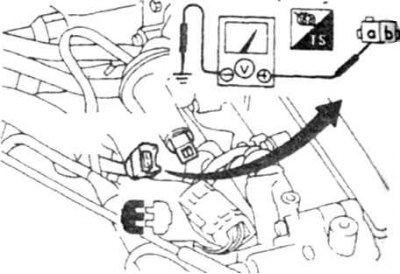
7.10 Checking the voltage on the regulator
11. The regulator may not operate if there is no connection to ground through the processor unit, despite the presence of voltage at terminal "a". Check the integrity of the wire from the regulator to the processor unit.
Installation
12. Installation is carried out in reverse order. Replace the sealing ring.