


2. The system is installed on 4-cylinder engines of cars produced in 1987-88 and on V6 engines since 1987. The system is controlled by the ECU processor unit, which is part of the ECCS processor system of the car. The recirculation valve is open when starting the engine, on a cold engine, at speeds above 3200 min⁻¹.
Checking the recirculation valve
3. Find the valve (photo).
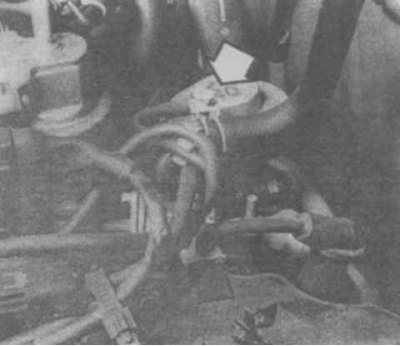
3.3 The EGR valve on V6 engines is mounted behind the throttle body on the intake manifold at or below 900 rpm. Otherwise, the valve is closed.
4. Check the freedom of movement of the diaphragm by pushing it upwards (photo). If the diaphragm is jammed, replace the valve.
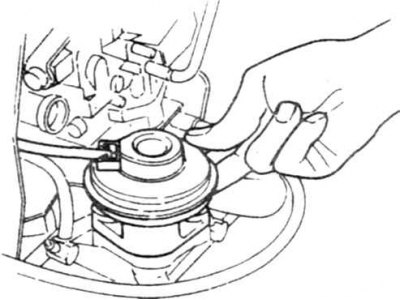
3.4 Checking the recirculation valve diaphragm
5. Start the engine and close the valve by hand by pressing on the diaphragm (put on gloves). The engine should lose speed and even stall. If the engine speed does not change, check the condition of the exhaust gas sampling tube. If a check valve is provided, eliminate it by connecting the damper valve and the recirculation valve with a hose. Warm up the engine and bring the speed to 2000-2500 rpm. Disconnect the vacuum hose from the recirculation valve, the diaphragm should slowly move down as the speed increases. Connect the hose, as the speed decreases, the diaphragm should slowly move down.
6. If the diaphragm does not move, check the vacuum on the valve. To do this, disconnect the vacuum hose, on which vacuum should be felt. If vacuum is present, replace the recirculation valve. Otherwise, check the condition of the hose, the serviceability of the damper valve.
Checking the differential control pneumatic valve (VRT valve)
7. Disconnect the vacuum hoses at the top of the valve.
8. Remove the valve. Plug one of the fittings and try to create a vacuum through the other fitting. If you can create a vacuum, then the valve is faulty (air must flow freely in the direction of the suction). Create pressure on the nipple at the bottom of the valve, but air should not pass through the vacuum nipple. Otherwise, replace the valve. Blow out the hoses before installing the valve.
Checking the vacuum distribution valve (TVV valves)
Attention! On 4-cylinder injection engines, the distribution valve is mounted in the front part of the intake manifold.
9. With the engine cold, disconnect the vacuum hose on the recirculation valve, start the engine and check the vacuum build-up. If the vacuum builds up immediately, replace the TW valve. If there is no vacuum on a warm engine, check the condition of the hoses. If the hoses are in good condition, replace the TW valve.
Checking the damper valve
10. Remove the valve and blow from the side connected to the recirculation valve, air should flow freely. In the opposite direction, air should flow with difficulty. Otherwise, replace the valve.
The material is taken from a web resource www.NissanBook.ru
Checking the EGR shut-off solenoid valve
11. Performed in a car service center, as special verified equipment is required.
Control differential pneumatic valve (VRT valve)
12. Disconnect the hoses, unscrew the screws and lift the valve.
13. Disconnect the tube at the bottom of the valve and remove the valve.
14. Installation is carried out in reverse order.
Vacuum distributor (TW)
15. Drain about 1 liter of coolant.
16. Label and disconnect the vacuum hoses.
17. Unscrew the distributor.
18. Installation is performed in reverse order. Screw the distributor onto the sealant.