


Table of contents: The engine gets very hot ↓ There are external coolant leaks ↓ There are internal coolant leaks ↓ There is a disturbance in the…↓
The engine gets very hot
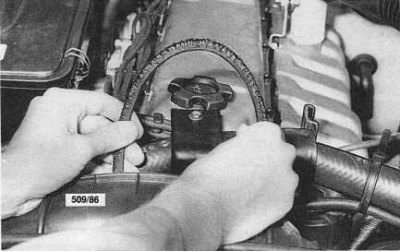
The water pump drive belt is broken or slipping. Check it out (see accompanying illustration), adjust the belt or replace it.
The coolant level has dropped. Try to find out the reason for the loss of liquid. It can be overflow, external or internal leaks - refer to the relevant subsection below.
Note: Never remove the radiator cap on a hot engine. Wait for the engine to cool down, then wrap the cap in a thick layer of rags and begin to unscrew it slowly. When you reach the first stop, wait for the excess pressure to release and only then can you finally remove the cap.
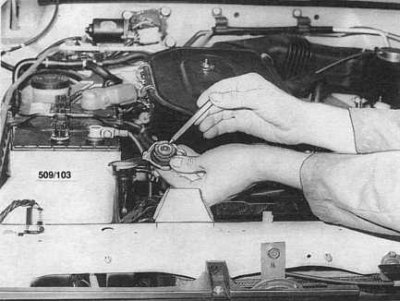
The radiator cap is faulty. Check it out (see accompanying illustration), replace.
The air flow from the front part of the radiator heat exchanger to the rear is blocked. Blow the path from the rear side of the heat exchanger with compressed air, or pump it with water supplied under pressure. The thermostat is faulty. Check, replace if necessary.
The thermostatic clutch of the cooling system fan is faulty. Replace the coupling.
The circulation of the coolant is disrupted. Check and make any necessary corrections.
The ignition timing angle setting is incorrect. Check and make adjustments.
The exhaust system is blocked. Eliminate the cause of the blockage or replace the faulty section/component.
The composition of the air-fuel mixture is incorrect. Check as described in the Section on diagnostics of power supply system faults), make appropriate corrections if necessary.
The engine oil level has dropped. Stop the engine immediately and add oil to the required level.
The brake adjustment is out of order or the brakes are "sticking". Check, make necessary adjustments or replace components (see the corresponding subsection of the Section dedicated to diagnostics of brake system faults).
The clutch is slipping. Check and make necessary repairs.
There are leaks through the cylinder head gasket. Check and make necessary repairs.
The engine has not been developed after major repairs. Check that the relevant fasteners are not overtightened. Turn off the engine and let it cool down.
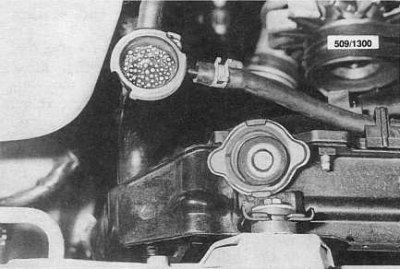
Note: Engine overheating is usually accompanied by steam emissions from the engine compartment. A characteristic sign of a cylinder head gasket leak is bubbling coolant when the engine is running (see accompanying illustration).
There are external coolant leaks
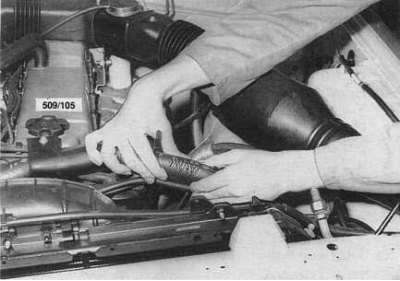
The hose clamp is loose or the hose is faulty (see accompanying illustration). Tighten the clamp or replace the defective hose.
There are leaks from the radiator heat exchanger or its tanks. Make the necessary repairs or replace the radiator.
The water pump bearing and/or seal is worn or damaged. Replace the pump.
The radiator drain plug is loose or damaged. Tighten or replace the plug.
There are external cracks in the block or cylinder head. Replace faulty components.
There are leaks from the thermostat housing or water pump. Replace the faulty component.
There are leaks from the heater heat exchanger or through its tap. Make the necessary repairs or replace the faulty component.
Note: To check for signs of external coolant leaks, park the vehicle in a clean, dry area and warm the engine to normal operating temperature. Also check for signs of moisture in the vehicle's interior under the heater core.
There are internal coolant leaks
Leaks occur through the cylinder head gasket due to a violation of the flatness of the mating surfaces (either or both) cylinder head or block. Check, regrind or replace the defective component (head/block). Replace the gasket.
There are cracks in the cylinder head or block. Replace the faulty component.
Note: To check for signs of internal coolant leaks, remove the engine oil dipstick and inspect the blade for signs of oil foaming. Start the engine and observe the exhaust. Excessive steam emission indicates coolant is present in the combustion chambers. Check the compression pressure (see the appropriate subsection in Chapter Settings and ongoing maintenance) to identify a defective cylinder.
There is a disturbance in the circulation of the coolant
The tension adjustment is incorrect or the water pump drive belt is faulty. Adjust the tension or replace the belt.
The coolant level in the system has dropped. Top up, check the system for leaks.
There was a partial blockage of the radiator heat exchanger tubes. Backflush or replace the radiator.
There is excessive scale deposition in the engine water passages. Perform a reverse flow flush of the cylinder block.
Thermostat is faulty. Check and replace if necessary.
The radiator hoses collapsed. Check and replace defective hoses.
The water pump is faulty. Replace.
Note: The easiest way to check for a circulation problem is to remove the radiator cap and observe the turbulence of the fluid after the engine has warmed up to normal operating temperature.
If the system is in good condition, turbulence should occur at partial throttle opening. In the worst case, when several faults are present at the same time, diagnostics can be performed by eliminating the good components during the sequential performance of the tests in the listed order.