


Table of contents: Transmission and transfer case ↓ Cardan shafts ↓
Transmission and transfer case
There are difficulties when shifting gears
The clutch is not fully depressed. See the section on diagnostics of clutch faults.
The transmission oil in the gearbox is of the wrong grade. Replace the oil with the one that meets the specifications (see size and adjustment tables at the end of the Guide).
The gear shift mechanism is worn out. On 4.2L models, remove the top cover and replace the defective components. On 3.0L models, disassemble the transmission assembly to perform the repair.
The synchronization mechanism is faulty. Perform a major transmission overhaul. Check the condition of the friction surfaces of the locking rings and cones for signs of wear and damage (see accompanying illustration).
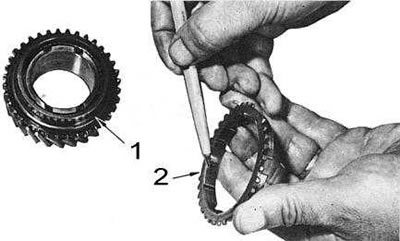
1 - synchronizer cone
2 - blocking ring
When downshifting, the transmission makes a clunking noise
The clutch is not fully depressed. See the section on diagnostics of clutch faults.
The wrong type of transmission oil was poured into the gearbox. Change the oil (see size and adjustment tables at the end of the Guide).
The synchronization mechanism is faulty. Perform a major transmission overhaul. Check the timing teeth on the gears and the locking rings for chips and signs of wear (see accompanying illustration).
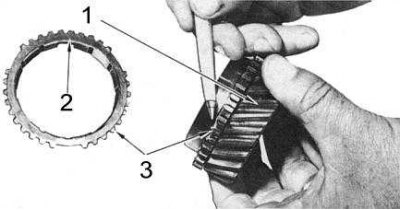
1 - 2nd gear pinion
2 - blocking ring
3 - synchronizing teeth
Excessive axial play of the driven shaft and/or intermediate shaft gears of the transmission. Disassemble the transmission assembly and replace defective components.
The transmission "jumps" out of the selected gear
Excessive play in the gearbox control lever. Disassemble the lever assembly with the housing and replace worn components.
The gear shift mechanism is worn out. On 4.2L models, remove the top cover and replace the defective components. On 3.0L models, disassemble the transmission assembly to perform the repair.
The synchronization mechanism is faulty. Perform a major transmission overhaul.
Excessive axial play of the driven shaft and/or intermediate shaft gears of the transmission. Disassemble the transmission assembly and replace defective components.
The bearings of the primary or driven shafts of the gearbox are worn out. Disassemble the transmission assembly and replace the bearings.
Note: In most cases, this situation is caused by wear or damage to the internal components of the transmission.
Transmission makes unusual noises in neutral
The transmission oil level has dropped. Check the transmission for signs of leaks. Make any necessary corrections, add the required amount of oil of the required grade.
The gearbox input shaft bearings are worn out. Disassemble the transmission and replace the bearings.
(The article was obtained from the portal: «nissanbook»)
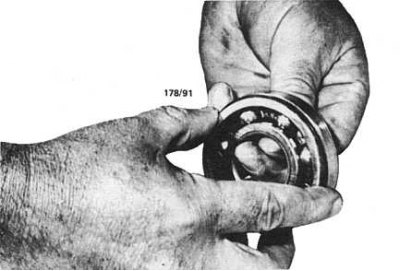
Note: If bearings are equipped with a cage and cannot be visually inspected, wash them thoroughly in solvent, lightly lubricate and rotate slowly by hand, checking for any sticking or binding points (see accompanying illustration).
The intermediate shaft gears of the transmission have defects in the form of chips or cavities, or the shaft bearings are worn out. Perform a major transmission overhaul by replacing damaged components.
Excessive axial play of the transmission intermediate shaft. Disassemble the transmission and replace defective components.
Note: To detect transmission noise in neutral, depress the clutch with the engine running and engage any gear. If the noise disappears, the transmission is the source.
Transmission or transfer case making noise (any of the forward gears is engaged, the car is moving)
The transmission oil level has dropped. Check the transmission for signs of leaks. Make any necessary corrections, add the required amount of oil of the required grade.
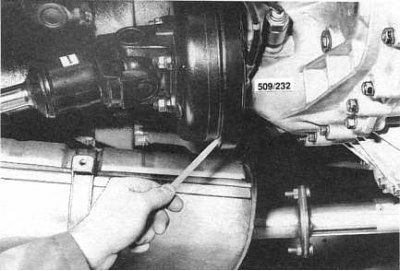
Note: Traces of oil at the base of the parking brake drum indicate a faulty transfer case seal (see accompanying illustration).
The transmission or transfer case bearings are worn out. Disassemble transmission/transfer case, replace bearings.
The gears have defects in the form of chips and cavities. Perform a transmission/transfer case overhaul by replacing damaged components.
Excessive axial play of the transmission or transfer case intermediate shaft. Disassemble transmission/transfer case, replace defective components.
Difficulty switching transfer case modes
The transfer case switch components are worn out or have become loose. Tighten fasteners or replace faulty components.
The splines of the hub and the up/down shift clutch are worn. Perform a major overhaul of the transfer case.
The engagement splines on the up/down gear hub or input gear are damaged or worn (primary) shaft. Perform a major overhaul of the transfer case.
Difficulty engaging all-wheel drive mode
The transfer case switch components are worn out or have become loose. Tighten fasteners or replace faulty components.
The 4WD synchronizer components are worn out. Perform a major overhaul of the transfer case.
The teeth of the 4WD synchronizer sprocket are worn or damaged.
Note: Difficulties in engaging the all-wheel drive mode may also be related to the difference in the size of the tires on the front and rear wheels of the vehicle. Make sure that the wheels are selected correctly.
If problems with switching to all-wheel drive mode occur only when cold, reduce speed until you come to a complete stop.
Cardan shafts
There is vibration of the cardan shaft
The nuts and/or bolts securing the driveshaft have become loose. Replace the fasteners, tightening them to the required torque.
The cardan joints are worn out. Check and replace if necessary.
The driveshaft is bent. Check the shaft runout using a plunger-type dial gauge and compare the measurement result with the permissible values (see size and adjustment tables at the end of the Guide).
The propeller shaft is out of balance. Check for balancing weights on the shaft. If necessary, balance the shaft.
There was a mutual misalignment of the front and rear cardan shaft joints. Disconnect the sliding joint from the shaft and align the joints.
The splines of the sliding joint of the cardan shaft are worn out. Replace the shaft assembly.
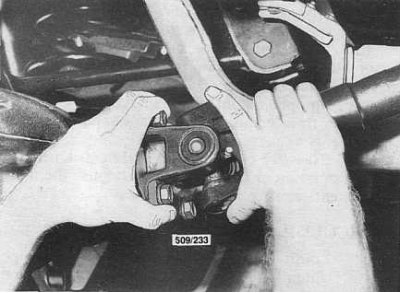
Note: Use manual manipulation to check the universal joints and sliding joints for signs of wear (see accompanying illustration).
If the driveshaft has excessive runout, loosen the fasteners and rotate the shaft half a turn. Retighten the fasteners and repeat the runout check. Replace the shaft if necessary.
There is excessive radial play in the propeller shaft
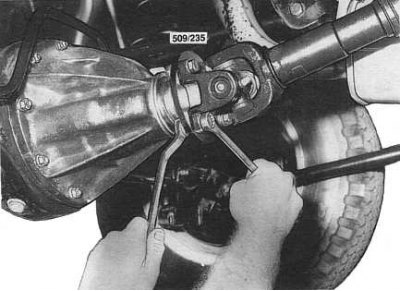
The bolt/nuts securing the propeller shaft have become loose. Replace the fasteners, tightening them to the required torque. Be sure to check that the fasteners are securely tightened (see accompanying illustration).
The cardan joints are worn out. Check the degree of wear of the joints by manipulating them manually. Replace if necessary.
The splines of the sliding joint of the cardan shaft are worn out. Check it out (by manual manipulation), if necessary, replace the shaft assembly.
The radial play of the crown (driven) gear of the main transmission is excessive. Remove the main gear assembly and adjust the driven gear.